
This is the first time in the last 4 years that I am not attending the Annual PNWA Conference in Seattle. The PNWA Conference in 2009 was my first, and it truly launched me on the path to becoming a professional author. I mean, I had written a couple of novels by then, but they were bad novels. I had no idea of how the publishing world worked, nor did I know how much work it was to turn bad writing into good writing. 2009 was a bit of a shock to my system, and left me dazed and slightly devastated, but it also had some very good moments. It’s where I first met Pam Binder, the PNWA President, and where I first met my agent Sally Harding.
There are two major reasons I am not attending this year’s conference. First, and most obviously, I am still in the recovery phase for Guillain-Barre Syndrome. Four months ago, when I should have been booking my reservations, I was still wondering if I would ever be able to walk to the mailbox and back. Now, it turns out that I probably could have attended and survived, but I didn’t know that at the time. But I still couldn’t have done the 16 hour days like I did last year, and I didn’t want to worry that I was going to have a major setback by overdoing it.
The second reason was work related. I’ve missed a lot of work already this year, and my coworkers have really picked up the slack. It’s summertime now, and many of them are taking their vacations, so more of the day-to-day client support tasks have been falling to me. Taking two days off work wasn’t really practical with the office short-staffed.
But I couldn’t stay away from the conference completely. So last night I made a brief appearance, and this time, I brought my wife along to meet everyone. It was wonderful to see Pam and some of the other volunteers I worked with the last few years. I also tracked down Jason Black, one of the people to whom I owe so much of my success. Yesterday, he launched his latest novel, Pebblehoof. I had the honor of reviewing his outline for this book last year, and also doing a beta read on an early draft and providing feedback. It’s a great middle-grade book set in the American West during the 1800’s, and a pleasure to read. I highly recommend it, and hope to soon do a re-read and a review on the published version.
Just the brief exposure to the conference crowd, and all the writers there—the hum of the collective nervousness and talent—left me champing at the bit to get back to writing on a regular basis. I won’t miss out on next year’s conference. It’s just too important to my career as a writer to forgo two years in a row.
But the highlight of the night was sitting down with my agent, Sally Harding—and her literary assistant, Rachel Letofsky—for drinks and appetizers prior to last night’s conference dinner. Sally, Rachel and I have talked many times on the phone, and I’ve met Sally a few times at the conference, but I had never met Rachel in person, nor had either of them met my wife, Lisa. This was the first time we could just sit down and chat, and I wasn’t trying to sell something. We talked books and hobbies and television and personal background, and the hour flew by.
When people talk about how important it is to find the right “fit” between an agent and an author, I couldn’t agree more. Sally and I just “fit” perfectly. We’re on the same page with where my writing needs to go, and on strategies for success. We talked about important things I need to do now to prepare for being successful (i.e. join Toastmasters to learn how to speak in public, and practice reading my books aloud so my speaking doesn’t turn people off from my written words.) We talked about how my writing has changed over the past couple of years, and how I made the jump from (and I’m paraphrasing here) “good stories” to “well-written good stories”. Had I not had an agent I trusted, I wouldn’t have made the effort to recognize where my writing was weak. I trust Sally (and Rachel) and I am so happy that she is my agent. Everyone should have that kind of relationship with their agent. If you don’t, you should either be looking elsewhere, or looking deeply at your own responses to criticism and seeing if you are not listening when you really should be.
After the appetizers and the fantastic, productive conversation, we went our separate ways. My wife and I briefly toured the conference book store, and I wished I could have bought a bunch of books. Perhaps next year. Right now, my shelf is too full of unread books and magazines to justify buying any more until I can get back to my regular reading habits.
Finally, to top off the evening, my wife and I caught a movie. We wanted to see the new Batman flick, but were just a bit too late for the start of the movie, so we saw The Amazing Spiderman instead. It wasn’t the greatest movie ever made, but it was entertaining, and better yet, it was our first late night out since I got sick back in February. As of this morning, I don’t feel much the worse for wear.
Life is returning to normal. Slowly, but surely, it is returning to normal.
And I can’t wait to get back to writing again.
In honor of officially having the net and production meters installed for my solar panels today, thus integrating said panels into the country’s electrical grid so I can now supply you with the electricity you need to view my blog on a daily basis, I’ve decided to give you all a musical treat. Enjoy!
Five months. It seems hard to believe it’s been five months. Shortly after I was diagnosed with Guillain-Barre Syndrome, and I was worried that it would be years before I got better, one of my former coworkers told me on Facebook that they knew someone with GBS who was pretty-much back to normal in six months. That gave me hope that I would be able to resume a normal life within a calendar year, and it wouldn’t be something I would struggle with the rest of my life.
At five months, I think I am much closer to being normal (and closer to the 6 months for recovery) than I am to where I started (and the years of recovery). That is to say, I am well past 50% better. Closer to 80%, I think. There are still things I can’t do, and things I can do, but not for long, and things I can do that I really feel the next day. But those are getting to be fewer and fewer each week.
Work-wise—which seems to be my best measuring stick because I do it every day, and have statistics on my timecard—I was up to 36.75 hours this week, between Monday and Friday, including one day of 8.5 hours, which absolutely knocked me on my ass that night. It was just one of those days where customer problems started late in my day, and kept me online far longer than I wanted. I’m not ready for back-to-back 8 hour days yet. 7 still seems like a practical limit for me—a limit where I am still getting better each day, and not just surviving.
Below is a graph of my working hours since my diagnosis. Those first couple of weeks, where I tried to work 20-25 hours, were absolutely insane, and I don’t recommend anyone with GBS trying it. This week creeps up to 40 because I had production problems yesterday and this morning that required me to work, again, unexpectedly. The trend is promising, though. Everyone’s recovery from GBS will be different, but for me, adding a half-hour per day per week (i.e. 2.5 hours per week), was probably the right slope for my recovery graph.

Personally, I have been able to start doing a few other things as well. I started going for longer walks this week… all the way around the block, instead of just to the mailbox. Soon, the lengths of the walks will justify putting my leg braces on before I go out so I can walk further. That’s part of the plan for the next couple of weeks.
I’ve been able to go out and play catch with my baseball-addicted son for 10-15 minutes at a time recently as well, though I have to be careful not to try to overreach and pop my weakened left shoulder back out. Yesterday I did my first, very short, session of weight lifting to try to rebuild the shoulder muscles I’ve lost over the last 5 months. It’ll be a few weeks before I go through a full workout, but it was nice to do a bit without having to spend the next 3 hours on the couch recovering. I also cut the grass and did the trimming this week, though that was split over multiple days, and wiped me out pretty good each day.
The biggest problem remaining is still my eyes, and my inability to read for any length of time without getting an eye-strain headache. I got a new prescription for my reading glasses, and that seems to help a bit, but not completely. I’ve been slowly reading a novel, a chapter or two at a time, and only on the weekends, when my eyes aren’t as fatigued from work. I start Vision Therapy (yes, there is such a thing), the week after this, and hopefully the therapist and I can come up with a plan that gets my eyes back to normal sooner, rather than never.
I’m hoping that July is the month where I start to get back into shape, and move beyond healing into rebuilding. So if you see me out and about more, know that I’m not completely better yet, but I am getting there.
Very well, thank you very much. While the rest of the country is pre-grilling their veggies before they even get picked, the Pacific Northwest has been serving up a spring growing season like I have never before seen.
We’ve been eating lettuce and radishes for a few weeks now. Since I’ve been working from home so much, I often step outside just before lunch or dinner, cut off a few handfuls of lettuce, and add that to my meal.
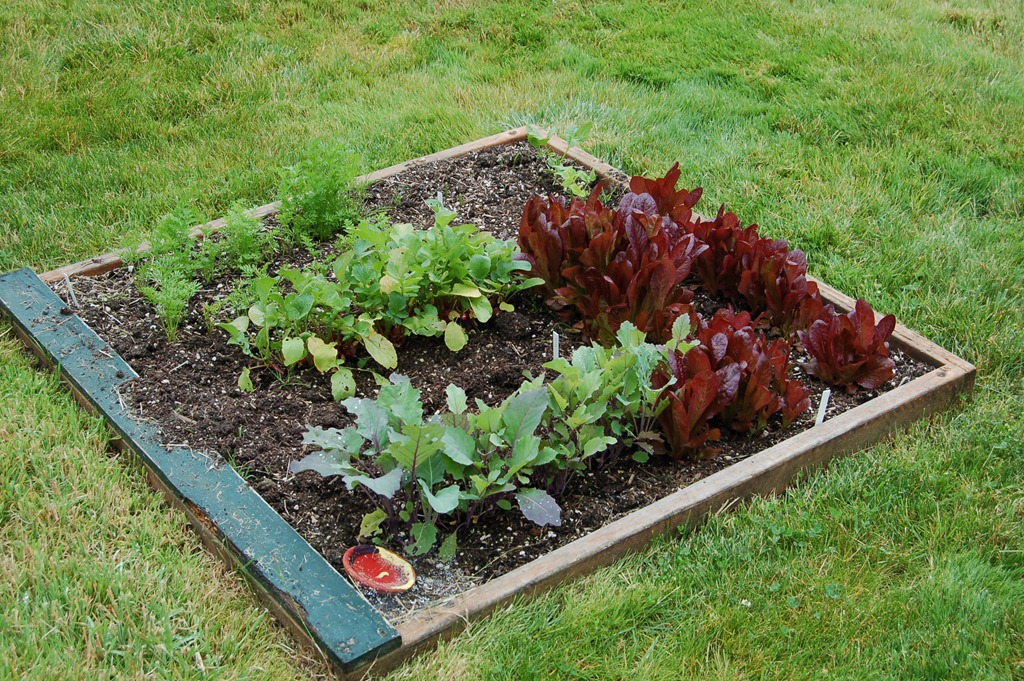
The peas (on the left against the fence in the picture below) were the only plants that haven’t done really well. We planted our first carrots a little too deep, but a second planting is doing much better. The pole beans against the fence look really good too. By August, we’ll be drowning in them.
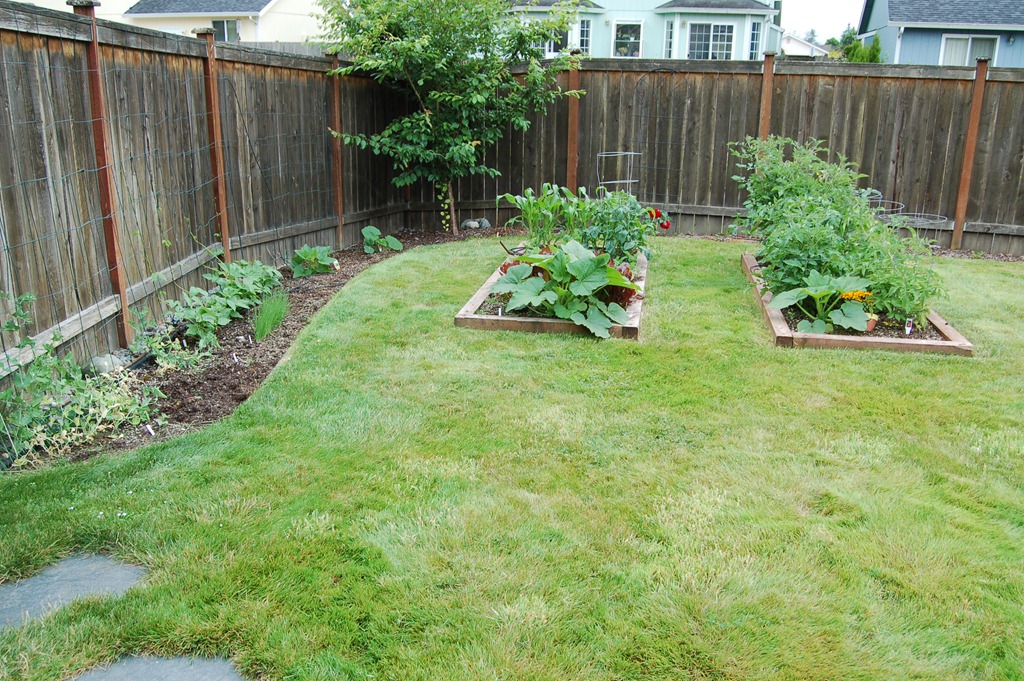
Last year, most of our tomatoes got wiped out by cold, wet weather. This year, I think they have plans on growing legs and attacking us while we sleep.

I just wish I had just a little more energy to help keep the weeds down. We have a particularly annoying little creeper vine with huge root systems that takes over the garden when you’re not looking. I hit it with vinegar in the spring, and thought I had killed it all, but I don’t think the vinegar form of weed control really kills roots, just the tops of the weeds. Or perhaps there were just a lot of seeds left in the ground that hadn’t germinated yet when I sprayed. I’m trying to keep the garden organic this year. I don’t think it’s that hard if you have the time and energy to pull weeds once a week. But I won’t know for sure until I get all my energy back.
Anyway, this, combined with my Terra-Organics orders are keeping us filled with very fresh produce this year.
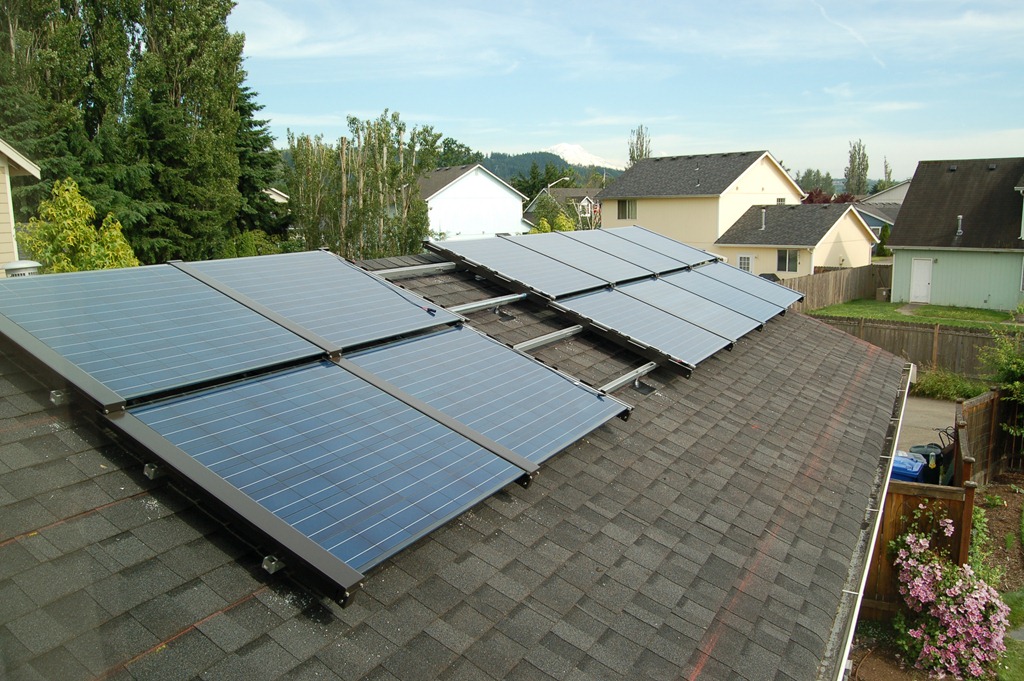
The finals panels were installed yesterday, and now my death ray solar array is complete. There are still a few things that need to be done to complete the build (like final inspections), but soon, soon I will have THE POWER! I promise to use it mostly for good. Mostly. MWHA-ha-ha-ha-ha…ahem.
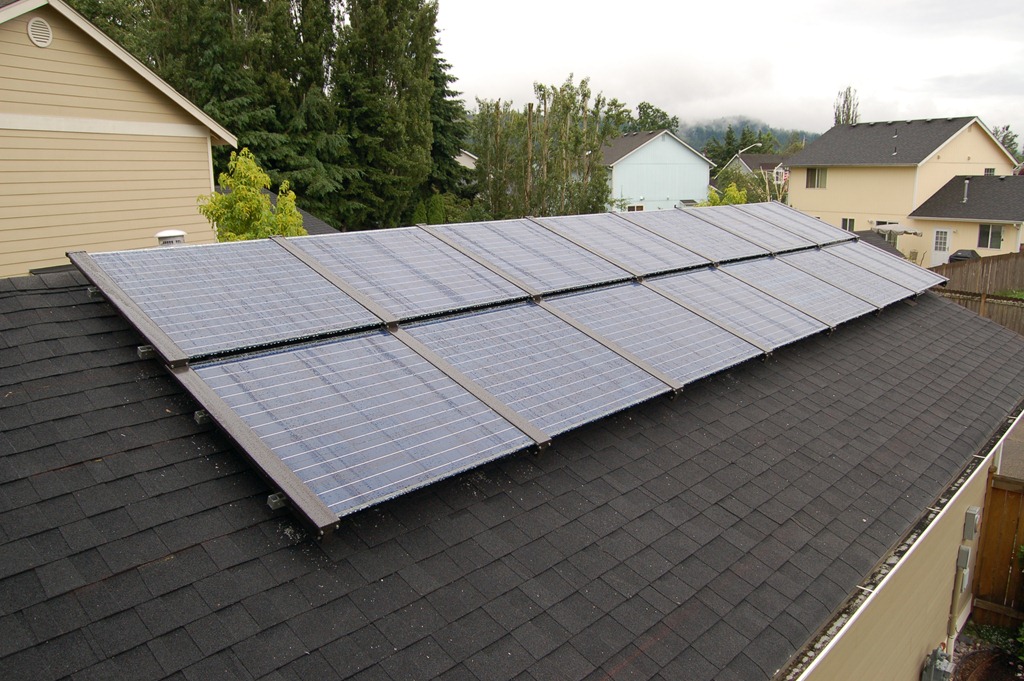
Okay, I’m dropping back out of evil professor voice now to give a few details on the system:
The What:
- 14 Silicon Energy SiE190 Modules
- 1 Silicon Energy SiE3840 Inverter
- Mounted on a ProSolar RoofTrac racking system
- Additional Hardware: 1 Eaton 50 Amp Manual Transfer Switch (this allows me to plug in a generator to my house during power outages and isn’t a normal part of a solar install)
- System Size: 2.66 KW
The Who:
- Installed by Artisan Electric of Vashon, Washington (please mention my name if you contact them regarding setting up a system of your own)
- Install took about 4 days
The Cost:
Normally I don’t like revealing issues to do with my personal finances, but here, I am breaking my rule, because cost is the one question everyone wants to know the answer to. Note that because I bought Made in Washington components, my costs lean towards the higher side of the spectrum, both because labor is slightly higher here, and because the Silicon Energy modules are of a very different construction than traditional panels being imported from outside of the US. I suggest you contact them if you are interested in hearing more about them.
- Installation and Components for above Solar Array: $21322
- Installation and Components for Transfer Switch: $2185
- IBEW Solar Rebate: –$500
- Approximate 30% Federal Tax Credit: –$6397
- Total Cost after Rebates: $16610
- Approximate annual electricity use offset: 24% (percentage of electricity use in my house that will now be produced by Solar)
- Annual savings from net reduction in electricity purchased from Puget Sound Energy: $258
- Annual WA State production incentive: $1353 (WA State Incentive is approved only through June 30, 2020)
- Approximate System Payoff (with no inflation on electricity rates) 8.9 years
- Approximate System Payoff (with 6% inflation on electricity rates) 8.3 years
- Expected lifetime of the system (to 80% generation capacity) 30 years.
The Why:
Well, this is the big one, isn’t it? Installing a system like this, even after the IBEW rebate and Federal Tax credit is still costing us a chunk of change. Yet, this is exactly why we wanted to do it: Change. Not the monetary kind. The societal kind. I wanted to plant the seed in the most visible way I could, that solar is a viable option in my area, and it is time that we all started considering it to help reduce our dependence on fossil fuels. In May 2012, over 50% of Germany ran on Solar Power, so why can’t we?
Early adopters always pay a steep price for new technology. In the year 2000, the price of a 25”-29” LCD TV was around $4000 (not that I bought one). Now, the same size TVs, with much better resolution, were available on Black Friday of last year for well under $150. That’s a 96% price decrease in 12 years. That doesn’t just happen because technology gets better. It happens because early adopters go in and start buying the $4000 TVs, and companies see that there is money to be made in that market, and then start to increase production, driving down unit costs and making more money on volume. As the products become commoditized, companies begin to differentiate their products by making better ones for which they can demand higher prices, which drives the whole cycle around again.
The good news in this cycle is that I expect that 10-12 years from now, solar panels to be much cheaper, and much more efficient. In the future, the components will be far cheaper than the labor to install it. But the initial demand has to be there now to encourage manufacturers to do the research and build out the infrastructure to produce the components. You’ll notice that the subsidies I listed above greatly reduced the cost of the system for me. And yes, they are subsidies. Opponents of government spending with decry this as a waste of taxpayer money. But if you read the article on Germany’s conversion to solar power, you’ll see that subsidies to the solar industry are still a tiny fraction of what goes to the Oil and Natural Gas industries, and that doesn’t include the 3 trillion dollars the wars in Iraq and Afghanistan cost the US Taxpayer, which we all know was more about oil and revenge than about weapons of mass destruction in Iraq or human rights abuses in Afghanistan.
I bought my components from a Washington State based manufacturer. I hired a Washington State based company, with Washington State based employees, who were trained by schools here in Washington State. The money I spent will have a multiplier effect in the local economy before we even consider the 25% reduction in electricity needs for my home. That’s good for me because the majority of the work I do as a software developer is for Washington State based businesses as well.
But that 25% savings on my electric bill is not negligible. If everyone who owns a home or business with a good southern exposure in the US installed a system like this, we could drop the US daytime power usage sent over power lines by 25% or more. See, distributing power from central sources results in about a 7% loss. So generating 25% on-site, actually results in closer to a 26.75% decrease in the production need during daylight hours. Currently, 45.5% of US electricity generation is done via coal, which, even if you call it Clean Coal, is still the dirtiest power generation method used today. Reducing our coal use by over 50% would be a tremendous improvement over today’s situation.
But we can go further. I left enough room on the roof of my garage to install a 3rd row of panels in a few years when I have the cash. That would bump me up to 40% of my electricity consumption, assuming the efficiency of the panels does not increase over time. But they will increase over time. The last number I saw for the record for PV efficiency (how much light energy from the sun can be converted to electrical energy) is 42%. The maximum theoretical limit is 86%. My current panels are rated at 190 watts / 16 Square Feet or 11.875 Watts/SqFt. I couldn’t find the efficiency rating for them, but lets assume it’s close to the current world-wide record (which is probably pretty optimistic). If we could double that in ten years to even 22 W/SqFt, each one of these panels would bring in 350 W, and, in all likelihood be 10% the cost. So in 10 years, a system like mine would generate almost 50% of my electricity, and cost well south of $10000 to install. Most of that cost would be labor, which cannot be done overseas. The subsidies could be greatly reduced, and it would be a lot more affordable for the average homeowner. And at 50% of electricity generation, there would be no need for coal fired power plants in the US at all any longer.
But lets say we didn’t want to wait 10 years to get rid of coal. We wanted to do it in 3 years. We could do that too, and boost the US economy. The Iraq / Afghan wars cost each person in the US over $6300. Those aren’t costs we will ever recover. But if we were to invest a fraction of that amount into solar by increasing the tax credits to home owners and businesses to fully cover the cost of solar panels (manufactured in the US) to allow each home / business to produce as much electricity as it consumes. We could pay for this by completely removing all subsidies from the Oil and Gas and Military industries. We could completely wipe out the need for massive power plants to run during the daylight, and eliminate the power lines that crisscross the countryside. Yes, the sun doesn’t shine at night, but by installing a few distributed power generators like BloomEnergy’s Power Servers (and encouraging more research into other types of localized generators), we could eliminate the need completely for massive, polluting plants.
Solar isn’t the only answer to the world’s energy crisis. But it has to be a major component of the final solution. It’s not perfect. The sun doesn’t shine every day. We need bridge generators to get us through the times where the sun is down or hiding. I worry that some components of the panels may come from rare-earth metals, or that the production of the panels may produce a type of waste we are not dealing with effectively. I haven’t done all that research.
But I do know that we cannot go on, sticking our heads (and oil rigs and coal shovels) into the sand and ignoring the climate crisis that we are causing by consuming so many fossil fuels. Little steps forward, like cutting our dependence by 25% are game changers in so many ways. 25% leads to 50%, and then to 100%. With more electricity readily and cheaply available, and made from renewable sources, electric cars will soon become more of the rule than the exception. At the very least, my next vehicle will be a plug-in-hybrid, fueled by the sun when it’s in my garage.
I could have spent some of that $20000 redoing my backyard, or saving it for my kids college fund, or given it to charity. I could have sunk it into the stock market, and worried about what that money was doing to the world. But I view the installation of these solar panels as a long term investment. Not just in my house value, but in my community, in Washington State, and in the Earth we call home. I think that’s an investment that will continue to deliver returns that exceed the monetary ones for years to come.
It is now too late to stop me. Soon, I will harness the greatest power in the Solar System, and you will all kneel before me! Tomorrow, I will enable my creation and destroy save the Earth!
One of my New Year’s resolutions was to do more to support local businesses. It’s become a real habit that I shop locally first before looking for an item on-line or driving to Seattle to find it. If a local business doesn’t have something I want, I see if they can special order it for me. It may cost a little more to shop this way, but then at least I know some of my money is staying local, paying local sales tax to support the services I need and depend on, and supporting the local businesses which are so desperately needed to keep the smaller towns not just surviving, but thriving.
This afternoon, I went for a short walk as part of my rehab from Guillain-Barre Syndrome, and when I returned, this was on my porch:

TerraOrganics is a local business (based in Orting, WA) that delivers fresh produce to your home on a weekly or biweekly basis. We signed up last Saturday. Inside the box was a package containing all of this:

That’s apples, tomatoes, asparagus, blueberries, lettuce, spinach, potatoes, nectarines, green beans and peppers. With what our garden is putting out this year (currently lettuce, peas and radishes), we’re going to be drowning in vegetables and fruit for the foreseeable future. I think that’s a good thing.
Besides the fact that I want to support local businesses of all kinds, supporting local farms is important to me. I grew up on a family farm, and I know how much hard work goes into growing the food many of us take for granted every day. Unfortunately, I didn’t grow up during the change to organic methods (though I have pulled more than my share of weeds in my life). I remember how many chemicals were used in the production of food back then, in the form of pesticides, herbicides, chemical fertilizers, and genetically modified crops that couldn’t be used as seed the next year without violating some ridiculous monopoly. None of those things turned out to be good for the consumer, the farmer or, most importantly, the land.
My hope is that by doing this little bit to turn to locally grown, organic food wherever possible, I help to push the world into a more sustainable pattern of health and prosperity for everyone, while at the same time teaching my kids how important it is to value the food they eat.
If you live in the Puget Sound Area, want to give Terra-Organics a try, please go to their website, and mention that I sent you. (No, really, please mention me.)
And for dinner tonight? Pasta with sautéed spinach. Or maybe sautéed asparagus? Would a salad on the side be too much?
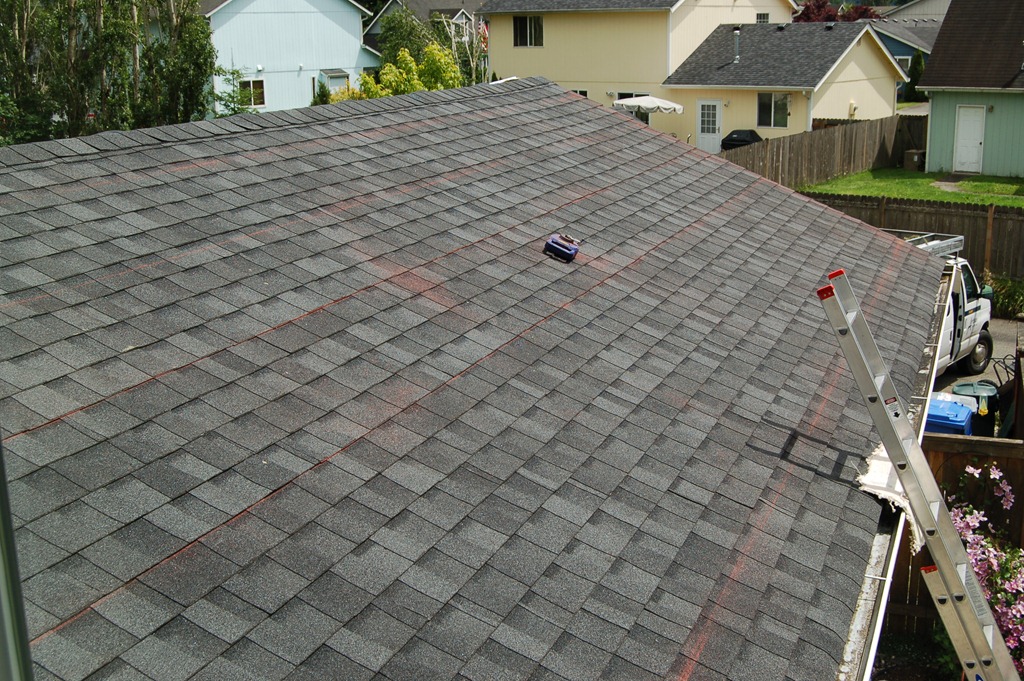
It’s starting to a look a lot like WORLD DOMINATION.


My super-sekret project begins. It doesn’t look like much now, but soon it will. And when it is complete, I will RULE THE WORLD!


 Joe Beernink