
Every fall, we have a family cider-fest out at my father-in-law’s orchard in Eastern Washington. This year, our two day total press was somewhere around 60 gallons. We also made vats of apple sauce, a pot of apple butter, two large pans of apple crisp, and racks of dried apples.
I wasn’t able to do much myself this year due to all my injuries and ailments, but I was an awesome supervisor / official photographer. Reece and Lorelai more than made up for my slacking off. I was absolutely amazed at how long they kept at it in very chilly temps.
Below are some of the action shots.
First apples of the season dropping into the cider press with my sister-in-law Katy, her boyfriend Bill, and friends Mia and Chris

Reece loading the press

Lorelai and Uncle Bill washing apples before they go to the press

Reece sampling the good stuff right out of the bucket

Friends Tracey and Dave picking (and eating right from the tree) with my Father-In-Law, Roger

How about them apples?

Back in January, before I got sick, I started a series of blog posts called The Writing Muse. You can read the first two by following these links: Dreams and Fear.
Today, in the matter of half an hour, I outlined an entire new book, inspired by a few connected events from the past few days. That led me to consider a new muse: Pain and Illness.
See, on Monday, while I was making lunch, I reached into the toaster oven to retrieve a bun I was toasting, and I accidentally touched the red-hot oven element with my fingernail. It was only for a fraction of a second, but for the next half an hour, the smell of burnt hair wafted through the kitchen. Luckily, the skin did not blister. That could have hurt. A lot.
Then on Tuesday, while picking up the kids from school, I twisted my foot, and apparently tore a bunch of ligaments in my big toe… on the same foot which I had surgery last week. Luckily, I had an appointment with my podiatrist on Wednesday morning for a follow up from the surgery. We did x-rays, and nothing looks broken, but today the toe is plenty of shades of red and blue and purple, and damn sore.
Then yesterday, to top it all off, I cut my finger while cutting a piece of ciabatta bread for a Panini I was making for lunch. I swore a few times, staunched the flow with a paper towel, and cursed a few more times. It took me a half dozen tries to get the band-aid on correctly. But after all that. I must say, the sandwich was, ahem, bloody good.
Yes, I am The Clumsiest Man Alive. But this is nothing new. I have an usually long record of odd accidents in my life. I thought about that as I climbed (carefully) into bed last night. And presto, the muse struck. It struck so hard, that I actually hunted down paper and pencil, and wrote a note to myself before I went to sleep so I wouldn’t forget it.
This morning, I wrote a four hundred word, point-form outline for a future book, based on the inspiration that struck last night as a result of all my accidents this week. I don’t know when I’ll have time to write that book, but now I at least have the idea written down, and can flush out the details as time permits.
See, the writing muse can strike at any time. You just have to decide to hear it over the sound of your own voice while it screams in pain.

Homer Hickam is probably best known for authoring the book Rocket Boys, which was made into the 1999 movie, October Sky starring Jake Gyllenhaal. Hickam is the son a coal miner who built rockets as a teenager, and grew up to be an engineer at NASA.
Crater is a mesh of Hickam’s mining past, and an interesting take on the future of living in space, as seen through the eyes of Crater Trueblood, a teenager working as a Helium-3 miner on the moon. Crater is asked to undertake a mission to retrieve an important artifact from an incoming transport. Crossing the moon to get to the nearest space elevator is dangerous in the best of times. But when Crater finds out there are plenty of people willing stop at nothing to make sure he fails in his mission, the danger is taken to a whole new level.
From a strictly science-fiction standpoint, there are dozens of fascinating ideas in this book regarding what it will take to live and work on the moon, and in space in general. Obviously, a lot of effort went into anticipating how current technology must change, and what new technology must be developed in order to meet the challenge of living in such a harsh environment. Hickam does a wonderful job with describing this technology: the adaptive space suits, the vehicles, the food processing, etc. For a details oriented reader like myself, this book fed right into my wheelhouse, and was one I bought months ago in anticipation of finally being able to read again (this is only the third book I’ve read since my vision has started to come back after my encounter with Guillain-Barre Syndrome).
Unfortunately, Crater really could have used another line-edit. A thorough line-edit would have caught major issues with repetitive use of passive verb tense (i.e. “were working” instead of “worked”, “There was”, “There were”), changes in point of view within paragraphs, and stilted dialogue. Critical passages of action were glossed over in just a sentence or two, while backstory permeated the entire novel.
Perhaps, because I am in the middle of line-editing two books of my own right now, I am hyper-sensitive to these issues, but I found myself injecting more active verbs into sentences as I read, just to keep myself from putting the book down.
What I hoped would be a Heinlein-esqe type book, quickly turned into more of a Johnny Swift type experience. A very simple edit could have greatly improved the entire experience, and fixed three or four of the above issues in just a couple of weeks. Yes, this is a “Juvenile-Fiction” book, but that does not mean the writing shouldn’t aim for the same quality as more adult type books.
I had very high hopes for this book, and it does have enough ideas in it that it could be a good book. We need books with the science of Crater to get teenagers excited about space and space exploration. But and science and ideas can’t support poor editing. Hopefully, these issues can be fixed in Hickam’s future work.
I realize the pace of my blog entries has varied wildly over the past few weeks. Sometimes I post twice a day. Sometimes I go a few days between posts. On the two posts a day, well, all I can say, is that surprising stuff just happens. Like this. And this. Normally, I do try to space things out a bit.
But just because you see no activity here, doesn’t mean I love you any less that day. It probably means I am writing, or more precisely, editing. I spent part of September line-editing my book Labeled and am currently in the middle of a line-edit of Army of the Risen. I call it line-editing, but what I’m really doing is getting the words out of the way of the story. Good words increase the enjoyment of the reader. Bad words cause the reader to stumble. Bad words slow down the reader’s pace. Even though the story may actually have a quick pace, poorly chosen adjectives, passive verbs, repetitive sentence structure, and extra sentences, slow the turning of the page. In the worst case, these artifacts can drive the reader to close the book altogether. This, for a writer, is a very bad thing.
So even though doing back-to-back line-edits greatly dulls my desire to sit in front of the computer, day after day, the result is that books I had ‘finished’ quite a while ago, are brought up to my new standard, and thus are ready to go back to beta readers for another go-around. If they say the book still needs work, I know it is a problem with the story, and probably not the words.
One of the side effects of editing so much, is that you become very picky when reading other people’s books. I’m reading a book right now that really could have used another round of line-editing, and it’s driving me nuts. A good story can be brought to its knees by poor writing.
During the last month, I’ve also been re-plotting Nowhere Home (the sequel to Nowhere Wild), so that I at least know where that story is going when I sit down to do the next round of edits on Nowhere Wild later this month. I’ve still got some major plot points to figure out, but it’s getting closer.
At some point in the next 3 months, I hope to wrap up all of these edits, and start on something new. Besides Nowhere Home, I’ve got two other books plotted out in great detail, and I can’t wait to get rolling.
But first things first. Back to editing.
I’d like to introduce you to Sleepy, Fishy, Fishalina and Buddy, the four newest members of the Beernink clan.

Our kids went to a birthday party today, and came home with 4 goldfish… which are now the first pets in the family.
As you can see by the picture below, the original little ones are quite pleased with today’s events.
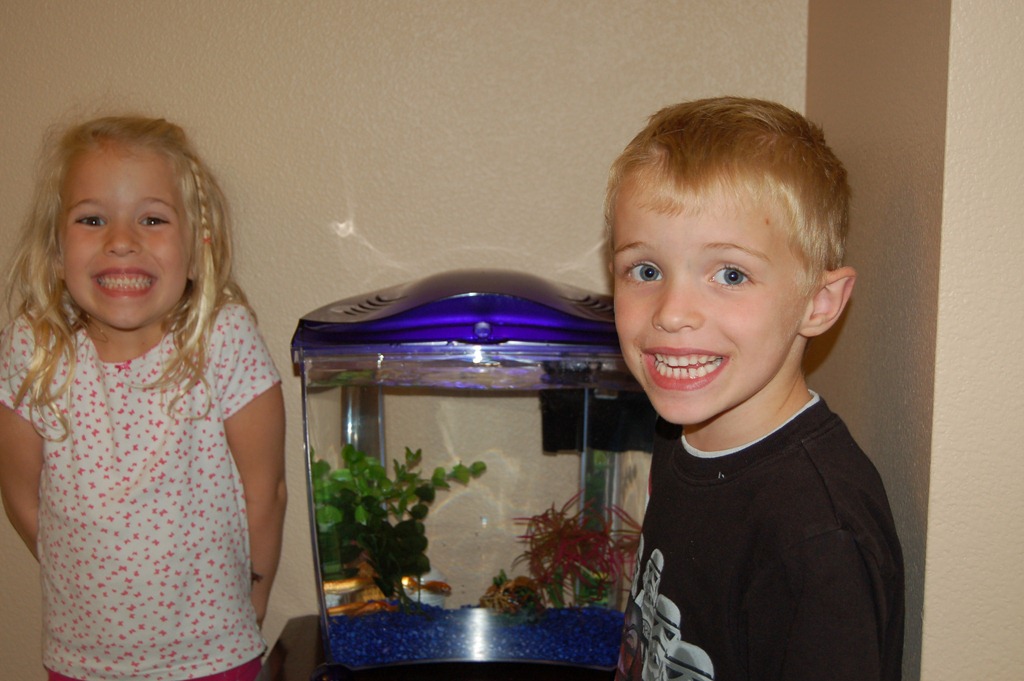
The bigger members of the clan have yet to decide how they feel about all this extra responsibility. Apparently, these goldfish can grow to be a foot long.
Yippee.
Ahem.
 It’s been quite a while since I’ve reviewed a book here, mainly because I haven’t been able to read much over the past 8 months due to issues with my eyes due to my GBS. But I knew that as soon as I could read, The Stalker Chronicles by Carley Moore would be the first off the stack. Carley is my wife’s cousin. I’ve met her a couple of times in the almost 10 years that I’ve known my wife. She’s absolutely delightful. Apparently, my wife and her were quite the pair back in their younger days. So I couldn’t not read this, even though it isn’t in the genre I typically read.
First, I must say, this book has one of the most apt covers I’ve ever seen. Whoever did the artwork created an impeccable match for the story, and an absolutely brilliant design. Before you even open the book, you have a pretty good idea of what is coming.
Cammie Bliss is a sophomore in high school who has a problem. She can’t seem to stop stalking the people she likes. And that habit has earned her a reputation in her high school, and, in fact, throughout the small town of Lakewood, NY where she lives. When a new boy, Toby Waxman, moves to town, he is one of the few who doesn’t know about her past. But since he’s cute, and doesn’t blow her off like all the other boys do, he’s bound to find out… the hard way.
Now, as I said, this isn’t my normal genre. While I do write YA, my books lean more towards the post-apocalyptic than the teenage angst. But I did really like this book. I’m not so old so as to not remember high school, and Carley nails the politics and the cliques and aforementioned angst. I’m absolutely positive that teenage girls would read this book and no doubt think “that is soooo me” and then tell all their friends to read it. Heck, a lot of teenage boys could probably flip the gender on the main characters and think “dude, that is soooo me”… but they probably wouldn’t tell their friends. “Cuz, dude, that pink book belongs to my sister. She forgot it at home. I’m just bringing it to her.”
At 230 pages, The Stalker Chronicles a quick, enjoyable read, and I highly recommend it. It’s like a teenage version of a Stephanie Plum book… not that I read those… Dude, I was just bringing them home for my wife.
Back in 1978, science .jpg) historian James Burke put together one of the best documentaries ever made—Connections. Through a series of 10 episodes (later added to with Connections2 and Connections3, Burke traces how one discovery, hundreds (if not thousands) of years ago, led to a chain of events and subsequent discoveries that revolutionized the world, and brought us to where we are today—or rather were in 1978.
historian James Burke put together one of the best documentaries ever made—Connections. Through a series of 10 episodes (later added to with Connections2 and Connections3, Burke traces how one discovery, hundreds (if not thousands) of years ago, led to a chain of events and subsequent discoveries that revolutionized the world, and brought us to where we are today—or rather were in 1978.
The concept of the series is fascinating for a history buff. But as a person with both an interest in history, and a history of science (since my degree many years ago was in Space and Communication Science), I found the series utterly absorbing, even a second time around. I had watched many of the episodes the years ago, but hadn’t seen the series end to end before. I recently watched the entire Series 1, and I am astonished at how relevant what he discussed still is today.
Whether it be how (and why) ancient societies developed technology to test gold’s purity, or water was used to power mills and looms, or how England’s need to survey Ireland led to television, each link in the chains demonstrated some simple science concept or experiment that taught me something. In fact, I think I learned more about science and engineering in these 10 episodes than I did in four years of university, studying it. I don’t say that entirely in jest, either. Had I watched these shows during high school, or even college, or had professors who spoke with the same kind of amazement and enthusiasm, and used the same demonstrative technique Burke does, I might have been able to put the theoretical concepts from my classes into perspective, and actually learned something that stuck. Not to say that my professors were bad, but in general, the method of learning through rote memorization does little for me. But give me a tangible application of a concept, and the light goes on in my brain.
When it comes time for my kids to start doing science projects, if I see they are struggling to find something interesting to do, I’m going to bring this show back out, and let them pick from any of a hundred mechanical devices to build that demonstrate a particular concept. I think they’ll learn far more from doing that than memorizing formulas. In fact, if I was a high school teacher today, I’d be showing these episodes to my students, and building entire curriculums around them. Of course, they’d have to get past the epic tan leisure suit and wide collars he wears in each episode, but once past that, I think the kids (and the adults) in the room would really learn something.
I highly recommend this series. You can get it either via NetFlix (unfortunately not available on Instant Watch yet) or via this site, which created a list of episodes available on YouTube. Go out and watch some of it. You’ll be glad you did.
This afternoon, I left my house on the way to a doctor’s appointment. I had 15 minutes to get there, which should have been more than enough time. As I drove down the street, just a block away from my house, I spotted two young children—girls, probably between the ages of 4 and 5—walking alone. On the sidewalk, perhaps fifty yards away, a woman lay on the ground. At first, I thought she was laughing, but as I drove by, I noticed her shoe was off, and she was in a great deal of pain. Another car passed me going the opposite direction. It did not stop. At first, neither did. I drove on to the end of the block. This part of the story shames me. I actually thought, “If I go back, I will be late for my appointment. I’m sure someone else will stop.” And then I turned the car around.
I drove back down the block, pulled up next to her, and rolled down the window. I asked if she was okay. But I really didn’t need to ask. Her ankle was already swollen up to the size of a baseball. She was a rather large woman, dressed completely in black. Her clothes were torn (either from the fall or from wear, I couldn’t tell). Her pant legs were covered in dirt from the sidewalk and grass. The pain rendered her nearly mute.
I got out of the car and asked if she wanted me to call 9-1-1. She said no. I asked if she lived close by and if there was anyone I could call. She said her husband was at work. I asked again if I should call 9-1-1. She said no again. She was in so much pain, I should have just dialed 9-1-1 there and then, but I knew what she was scared of.
See, we’ve all heard the horror stories of an unexpected medical bill draining people’s savings and costing them their homes. If I called 9-1-1, I could see that happening to her. What if it was just a sprain that would be better in the morning? A trip to the ER in an ambulance could cost thousands of dollars. Thousands of dollars she clearly didn’t have.
Another couple of cars drove by, and no one stopped. I couldn’t leave her there. I had to to something. I asked where she lived. She said close by. I told I’d turn the car around (so the passenger side was close to the curb) and her I’d drive her home. I got back in, and pulled a quick U-turn.
Luckily, I have two car seats in the back of the car. I asked her girls to climb in and buckle up. I asked if she could make it to the car. She said no. As I said earlier, she was a rather large woman—easily more than 250 pounds. I couldn’t carry her. Either way, I still have one foot wrapped in bandages after yesterday’s minor surgery, and I can barely walk myself. I tried to help her up, but I couldn’t support her. Luckily, a young, Hispanic man on a bicycle stopped and helped me load her into my car. Tears still poured from her eyes, and she struggled to give me directions to her house, which, as it turned out, was nearly a mile away. And she lived in second floor apartment.
Getting her out the car (now by myself) was not easy. I couldn’t help her beyond the bottom of the steps. I had to stay there and watch as this poor woman crawled, on her hands and knees, up the flight of splintered steps, wailing with each movement. I again asked if I should call 9-1-1, or her husband, or anyone. She said no each time. I held my finger over the keypad on my phone, wanting to call 9-1-1. She needed help. This ankle was not going to heal without medical attention. But she kept saying no. I couldn’t go against her wishes, could I? I watched her unlock her front door, then I got into my car and left.
In the end, I was 7 minutes late for my appointment.
On the way back from my appointment, I started to get very emotional. First, I felt so guilty for not stopping right away. I can’t believe I drove by, and had those initial thoughts. What has happened to me to allow “someone else will handle it” to be my default reaction? Is it my physical condition (i.e. yesterday’s surgery and my Guillain-Barre Syndrome)? Was it that I was in a hurry? Was it that irrational fear of someone I didn’t know?
What I do know is that I will struggle with the guilt from that initial decision for a long time to come.
Then I got angry with the United States, and the sorry state of health care insurance in this country. That every man, woman and child isn’t covered by single-payer health care is an atrocity. That corporations can make a profit from people’s tragedies is a disgrace. That a person can lose their life savings or their home because they tripped while going for a walk with their kids, is an abomination. That it is a popular opinion among a large number of people on the right side of political spectrum that “everyone for themselves is the American way” is despicable. By the time I got home, I was near tears for that poor woman, and her two children, and I was shaking with anger.
But I did one thing, after I got home, that helped me. I called up the headquarters of the East Pierce County Fire and Rescue Department, and asked them what I should have done. I asked them what would have happened had I called 9-1-1. Would all of those fears have come true?
The answer was no. In my district, if you are below a certain level of income (approximately 150% of the poverty line for a family of four), a call to 9-1-1 for a genuine emergency will cost you nothing. You will receive a statement, but with a few simple entries on a form. Either your insurance company will be billed, or the amount will be written off and paid for by the taxpayers. At the hospital, a similar plan exists for the very poor, though the paperwork is probably not as simple. Had I known this, I would have absolutely called 9-1-1. I also asked what would have happened to the kids in this case. They said the rescue rigs come equipped with two child seats, and they would ensure that the children were taken care of. Clearly, they could have handled this situation much better than I could have. I should have called. I will next time. I don’t know if this is normal policy for all counties in all regions of the country, but today, I am very glad I live where I do.
This is not a story I am telling out of pride or out of guilt. I tell it so that in case someone reading this finds themselves in a similar position in the future, whether it be in my town, or some other town, that they do the right thing. Stop. Call 9-1-1. Don’t worry about the money. Make sure the person gets the care they need. An injured person is not thinking clearly when they tell you they don’t want medical help. They’re hurt. They’re embarrassed. They don’t want attention. And they’re probably worried that they won’t be able to pay for it. If you are the person helping, you need to do the right thing. Call 9-1-1. Get them the help they need. Don’t wait.
I can only imagine what would have happened had I been the one writhing around in pain while my frightened children looked on. Hopefully, it never comes to that, but if it does, I hope that if someone stops to help, that they call 9-1-1 and let the professionals render the help I need.
I’m going to show off a little of my naiveté here today about how the real world works, and attempt to solve one of the biggest problems the United States political process faces today: Citizens United.
For those unfamiliar, Citizens United v Federal Election Commission is a very famous (and important) case that went before the US Supreme Court in 2010, forbidding the restriction of political expenditures by people or corporations in support of, or against political causes. Basically, it opened the taps for people like the Koch brothers and Sheldon Adelson to pour billions of dollars into a particular campaign, in order to drown out the opposition. What this also accomplished, was to remove ordinary folks, who don’t have name recognition and Super-PACs with millions of dollars, from the ballot.
It should be obvious that this is good for some people, but horrible for the idea of democracy as a whole. When money can prevent any aspect of society from being heard (no matter what their views, as long as they are not inciting violence or hatred), democracy fails, and a democratic society becomes an oligarchy. While Citizens United protected the democracy of free speech in the US, it also destroyed democracy as a whole at the same time. Money buys a louder bullhorn in the US, and that bullhorn now drowns out the voice of the silent majority.
Fighting Citizens United is pointless. The case has been made. Anyone can spend any amount of money to make their voice heard. It is their money. They can do with it what they want. The courts will overturn anything, even a constitutional amendment that prohibits that.
So an alternative must be found. I think (and this is where I demonstrate just how naïve I am), that it’s a pretty simple, two step solution:
1. Give those who want to pour their billions into the campaigns nowhere to spend it.
2. Compel (through legislation) media outlets that broadcast over public airways or use public infrastructure, that they must balance both their coverage and advertising.
How do we do #1? It’s simple, and can be done at a federal level. Pass a law which says all political advertisements on the US airwaves or on US Cable, may cost no more than $1 per minute. At a dollar per minute, any candidate with a reasonable support base could buy the ad time they need on TV, radio or Internet to present their case. By taking away the #1 advantage big money donors have over smaller candidates, the playing field is again leveled.
How do we do #2? That requires a bit more monitoring, probably by the Federal Election Commission. The FEC could collect the raw data from all media outlets on the number of advertisement and reporting-minutes run, and expose that data via a public data stream that any US citizen can access. Failure to balance the coverage (within a certain percent) would be a federal crime, and be subject to huge fines or imprisonment if the commission could prove intent to subvert the law. The key is to allow public watchdog groups access to the information of who paying for the ads. I don’t need to see your entire tax return, but I (as a citizen) do need to see when money is spent in support of a cause.
These two simple (and probably naïve) proposals will, for certain, have a huge impact on the viability of media outlets. They make billions on these ad campaigns. I wouldn’t doubt at all that the billions spent by the big spenders isn’t somehow routed right back into their own pockets, since they likely own the media outlets to begin with. Perhaps with less money at stake, media outlets will decide to air fewer political commercials. That’s fine with me. New media will pick up the slack in getting the news and views out. You can’t buy good word of mouth in social media. Sponsored tweets almost always turn out to be a failing proposition.
But with the field leveled, those who don’t have the big money backers and still seek to serve their country, can. Their ideas will matter once again—more than the size of their campaign war-chest. And we should all be better off for that.
Last year, I had surgery on both feet to correct some issues with my toes caused by Charcot Marie Tooth disease. Six of my toes were fused at the last joint, and two toes were removed completely (yes, ick.) But let’s not get hung up on that.
One of the results of this surgery is that I was left with threaded titanium pins in six of my toes… one and a quarter inch long screws meant to keep the toes permanently straight, even if the effects of CMT continue to try to bend them into little question marks.
A few months ago, I started getting some discomfort from one of those toes. I thought I had developed a corn or a callous or something on the tip of my toe that just wouldn’t go away. Again, ick.
Yesterday, I finally went the local podiatrist to see what was really going on. He checked the toe. It’s never a good sign when your podiatrist says “Hmmm. That’s not good.” We did a quick set of x-rays to confirm his diagnosis. Unfortunately, one of the pins had started to back out of my toe… that is, it was working its way through the tip of my toe, and was quite close to coming out altogether. This would be really bad, as it’s a direct path for infection to reach the bone, and it has to be dealt with, and immediately. This isn’t unheard of, and is a relatively quick procedure (about 10 minutes) to rectify, if you have the proper tools. What we needed was a special screw driver, and my podiatrist’s office didn’t have one that size.
But the local hospital does have the correct screw driver, and my podiatrist was headed over there yesterday afternoon to do another procedure. He could have me in and out in 15 minutes. No big deal.
But there was a catch. There is always a catch.
You see, hospitals have policies, and those policies have to be followed. No matter what.
In order to have this 10 minute procedure done at the hospital, here’s what had to happen:
- The hospital called me for a full medical background yesterday, during which time I had to tell them all about my stay in the very same hospital 8 months ago for my GBS.
- The anesthesiologist called me yesterday to reconfirm the information gathered an hour before.
- I had to fast for 8 hours before the appointment. Fasting makes me grumpy.
- My wife had to take the morning off work to drive me to and from the hospital because I can’t be trusted to do it on my own after any procedure.
- I had to show up at 8:15 AM for a 9:15 AM procedure.
- I had to review all my medical history (again) with the nurse checking me in, and again with the anesthesiologist.
- I had to completely change out of my clothes and into a hospital gown for the procedure.
- An anesthesiologist had to be present for the procedure, even though the only thing I would be getting would be a local anesthesia affecting one toe. In fact, I had to tell them that I didn’t need or want an IV or a sedative for the procedure—that the local was enough.
- Three, and sometimes 4 nurses were in the OR during the procedure
- They hooked me up to an EEG, O2 Sensor, and a gown warmer (which was actually pretty cool…er… warm.)
- The procedure itself took 10 minutes. I felt more pain from them removing the tape holding the surgical shield to my leg, than I did from the pin extraction.
- I spent half an hour in the recovery room, even though I was awake and fine the whole time.
Now, I’m not saying that I don’t appreciate nice, sterile environments for surgeries, but if you want any indication as to why medical costs are soaring in the United States, this complicated process is probably reason number one.
All for the want of a screwdriver.
And the offending screw… it’s pictured below.
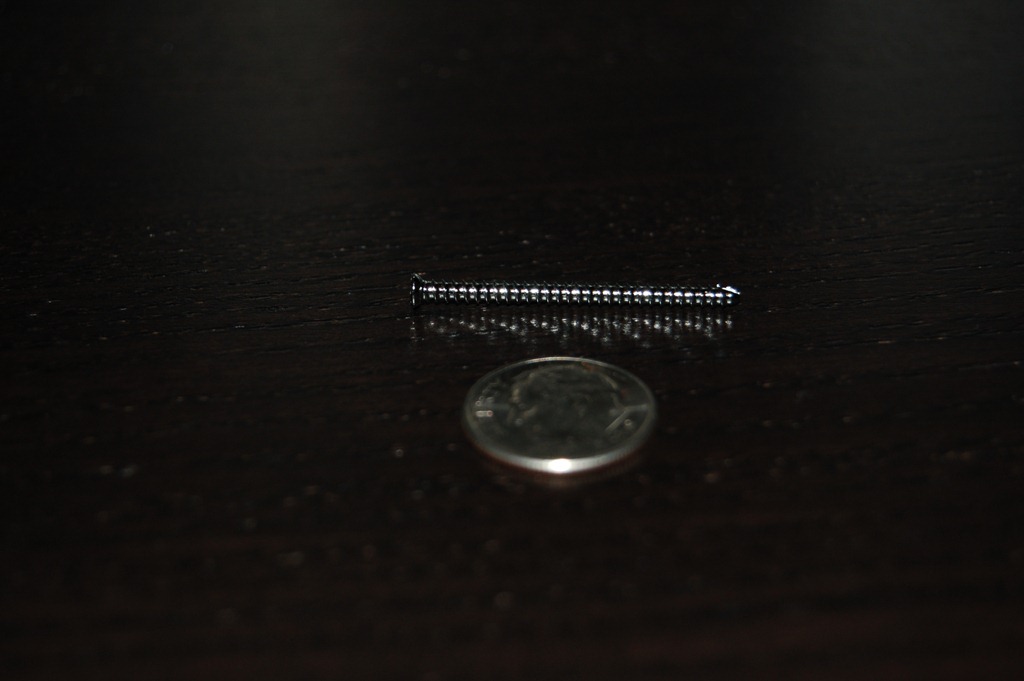
As someone said as I was leaving the OR “That a lot of trouble to go through for one little screw.”


 Joe Beernink