
The list grows shorter again this month, but that’s a little bit misleading since I watched nearly 230 TedTalks. I’d go into more detail about that, but that’s a whole other blog entry.
I just haven’t had much time (or inclination) to sit down and watch 2 hour movies lately, so for entertainment, I’ve stuck to watching episodic television, mainly Breaking Bad and more Masterpiece Mystery. There also aren’t a whole lot of movies left on my NetFlix queue that don’t fall into the following categories:
- Movies my wife and I added that both of us really want to see, but don’t have time when we’re both home to see right now
- Movies my wife added that she probably doesn’t even want to see anymore
- Children’s movies we added for the rainy weekends of winter
I expect next month’s report to get even slimmer… so slim that I might even start blogging about individual movies. Not sure I really want to get into that yet, as I have a ton of other topics I want to blog about. We’ll see.
So anyway, listed below are the movies and TV series I’ve been watching since Part IV of this series:
- [x] = Number of Episodes watched if TV show
- ( y ) = Rating out of 5.
- Items in bold = ones I highly recommend
Instant Watch
- A League of Their Own (4)
-
Breaking Bad [11] (4) Captain America: The First Avenger (3) Forks Over Knives (5) Inspector Lynley: For the Sake of Elena (3) Inspector Lynley: Missing Joseph (3) Margin Call (4) TEDTalks: [229] (4) The Cosmos:[2] (4) Weeds: Ssn 1: [3] (3)
DVDs
- 50/50 (5)
-
Game of Thrones: Season 1: [3] (2) Get Low (2) Inspector Morse 1: The Dead of Jericho (3) J. Edgar (1) - Red Tails (1)
Sherlock Holmes: A Game of Shadows (3) The Wire: Season 3: [5] (4) Tinker, Tailor, Soldier, Spy (1) Other
- Downton Abbey Ssn 2 [8] (3)
- Inspector Lewis Ssn 6 [4] (4)
Today, a simple, 5-word tweet wasted most of my afternoon. It was sent from my Twitter account, but I didn’t send it. Someone hacked my Twitter account, and that sent me scurrying to find out what else they had found their way into. Luckily, I was right by my computer when it happened, and I was quickly able to get on top of the situation before any real damage was done.
The first thing I did was to delete the tweet and change my Twitter password. I was about to start changing other passwords, when my coworker, Ben, who recently attended a hacker/security conference called DefCon, also noticed my rogue tweet. He volunteered to help me figure out what was going on before I spent a lot of time changing my passwords, only to still have the root cause of the issue leave me vulnerable.
I’ve been running Microsoft Security Essentials for a couple of years now, so I thought I was safe. But Ben scoffed at that, and said that “the biggest problem with anti-virus software is that it makes people feel safe.” And then they don’t do the other things that they should to secure their computers. So he started digging in to my computer and my network. There were a few things to improve.
First, we altered some of the settings on my router to remove open ports for an old version of my website that was no longer hosted here (I moved it to WordPress back in January 2011). We shut down remote access to my Windows Home Server since I never use that anyway. I also changed the admin password on my network and downloaded the latest firmware for the router. There wasn’t any evidence that any of these were problems, but they were all gaps that could have been exploited.
Next, we downloaded Malwarebytes Anti-Malware software, and began running it on all my machines. Ben trusts this software, and after seeing it run, I trust it too. It found some hijacking software running on my Home Server that Microsoft Security Essentials hadn’t. It didn’t find anything on my main PC or on any other the others I have, but I will be running it more often in the future.
Once I was sure that my PC was free of key loggers, I started cycling through my email accounts and changing those passwords, and making sure that each one has one of the other accounts set up to notify it should someone try to change the password there. I also checked the sent mail folders and trash folders to see if anything had been sent I hadn’t done myself.
Once that was done, I started cycling through all my most important accounts—anything to do with banking / money first, then the rest. It’s a slow process. I use an encrypted password vault type program that generates random passwords for each site, so that even if someone decrypts one of my passwords in a site’s database, it’s highly unlikely that’ll get them into any other sites. However, I wasn’t always this neurotic about passwords, and getting them all changed to different passwords has been long overdue. This event forced my hand.
So what caused all this? We suspect that a site I went to yesterday to buy a cookbook was not properly secured, and allowed some session hijacking software to run during the registration process. When I moved from this site to another (probably Twitter) it tracked my activity and cookies and logged my account info back to another server, which then provided the needed information to hacker to complete the hack. Ben did a scan of the site and found numerous vulnerabilities and told me to stay far away from the site. I notified the site via email to give them an opportunity to fix the problem before anyone else is affected. We’ll see if they respond. I’m a little reluctant to name the site, as I have no proof that that site was the cause. I’ll just suggest to you that if you see your browser this icon in your browser (I use Google Chrome), that you not trust the site.

If you then click on the site, you can see the full warning.

One of the other lessons I learned was that if you end up at a site like this, close the browser. Once you close the browser, the session should end, and the JavaScript that was running should unload and end the threat.
So in all, I’ve spent at least four hours so far, and by the time I get to the rest of the sites that need a password change, it’ll take me another four hours. This is not only a gigantic waste of time, it’s a colossal waste of my limited energy. No damage has been done (as far as I can tell) to anything beyond my health, but it sure did put me in a bad mood. If, earlier today, you had asked me if hackers deserve time in prison for these stunts, I would have said “No, a bullet is much cheaper.”
As a software developer and a parent, the idea that so much time and energy must be spent by humanity on preventing cyber crime is galling. There are so many more productive things we could do with these creative (and resourceful) people’s time. But I know that international organized crime syndicates now have a leading role in the recruiting and hiring of professional hackers, and that this scourge is unlikely to end any time soon. Why? Because it’s a ridiculously easy way for people to make a large amount of money in a very short time, and they really don’t care who they hurt or what damage they do. Sure, there are altruistic hackers out there, determined to ‘take it to the man’—to dole out their own brand of justice in an unjust world, but I sincerely doubt whoever hacked me today had such lofty ambitions.
No, they probably did it for fun, and likely for the money (I’m sure the tweet they sent from my account was rigged to do even more damage). But what they really did was to cost me hours of my time, and all of my energy for the day.
I could have blogged about something I really wanted to blog about today, but I blogged about this instead in the hope that this will remind other people of some steps they need to do on their computers and network now, so they will be safer in the long run. Whatever steps you can do, you should, and as soon as possible.
Learn from my mistakes, people, and give these hackers a smaller target to hit.
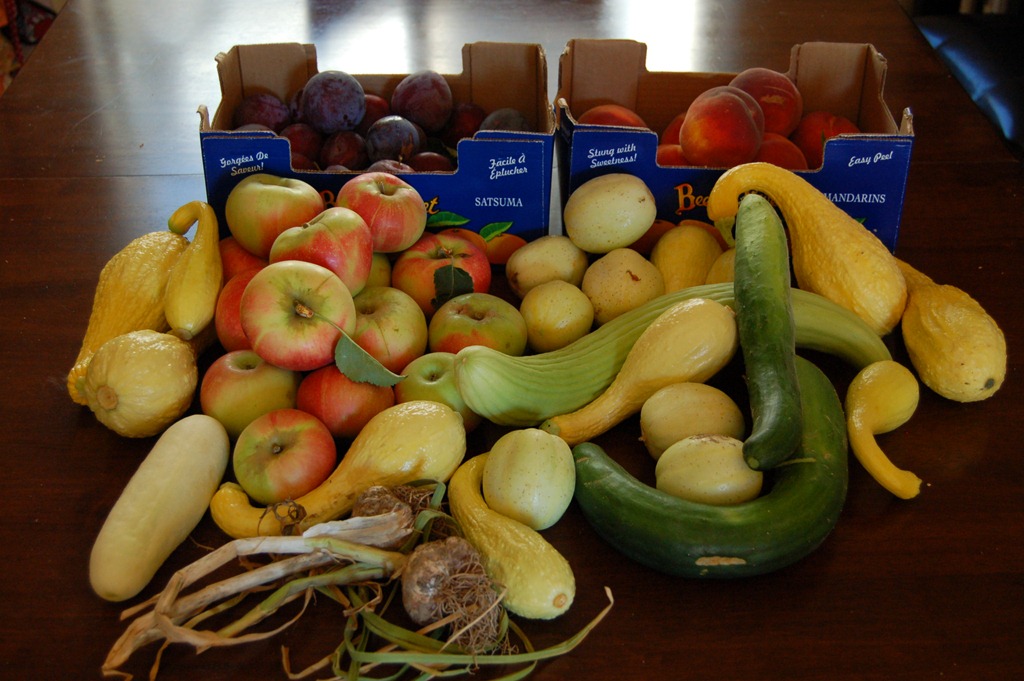
… from my in-law’s garden in Eastern Washington. I guess I will be eating more vegetables / fruit this week.

I’ve never been one to worry about my diet. Controlling my weight has never been a problem. In fact, I’ve often been dramatically underweight. When I started college, I was a very slender 5’11”, 118 pounds. By the summer of my 3rd year, I was just over 6’ 1/2” and 127 pounds. I worked out. I played lots of sports (though poorly). I drank my fair share of calories as well. But my metabolism was ruthlessly fast, and I remained a skinny, little twig.
That changed in the summer of that 3rd year. I had an internship at a company that made parts for satellites that summer and moved into a townhouse with 3 other people. One of the girls had a boyfriend who was a bodybuilder. He took one look at me, and told me “Boy, we’re going to put some weight on you this summer.” And we did. I ate four full meals a day. I downed protein shakes twice a day with a dozen raw egg whites, half a liter of whole milk, a banana and a little chocolate sauce for taste. My morning and afternoon snacks would have been meals for most people. But I wasn’t eating junk. I ate ‘healthy’—a ton of protein and lots of carbs. I didn’t eat many vegetables, unless baked potatoes or white rice count as vegetables. I did put on weight, and, because I worked out like a fiend, and most of that was muscle. By the end of the summer, I was up to 153 pounds, and I felt great.
But it was impossible for me to keep that weight on once I got off the diet and back to the crazier diet of college in September. After college, and for most of my twenties, while working 60-80 hours a week and eating low-cost food (often a can of tuna with mac and cheese, or ramen), I hovered between 135 and 142 pounds.
When I moved to Colorado in 1996, I began doing a lot of long-distance cycling. My caloric intake went crazy again, mainly with pastas and rice and Power Bars, and Gatorade by the gallon. While I was riding, I was in the best shape of my life, and even attempted the 1997 Denver to Aspen Classic—200 miles of riding in 1 day, with 4-9000+ foot passes. I did not finish the ride. I wasn’t in as good of shape as I thought, and when brutal winds smacked us in the face for the first 80 miles, I knew I was done. I made it, I think, 109 miles that day. Certainly nothing to sneeze at, but not as far as I wanted to go.
But the crazy riding and working schedule took its toll. In the fall of 1997, I came down with a severe bout of Mononucleosis that took four months for basic recovery, and over a year to regain my long term stamina. My weight dropped back into the upper 120’s, and I never really felt good.
In 1999 I moved to Washington State, and I started to gain weight. By 2004, I was up to 175 pounds, with occasional glimpses of 180, and as high as 185. I no longer rode my bike much. I hiked instead, but I also spent a lot more time inside in front of a computer. The biggest contributor to my weight gain though, was the amount of fast-food I ate. I had more money, so instead of packing leftovers in with me, I went out for lunch and grabbed a burger or a slice of pizza or some mall-food. While I felt more confident about my body (being skinny always bothered me), my doctor raised concerns about my cholesterol, and even went so far as to put me on niacin for a while to lower the levels.
Over the past few years, I’ve found my most comfortable weight to be around 172 pounds. At that weight, I have the most energy, fewer aches and pains in my joints, and a positive self image. Sometimes, due to illness, I would drop down a few pounds, and even after recovering from the illness, I wouldn’t feel right until I worked back up to that weight. If I got above that mark, I could feel it too. The incentive to work out again would quickly rise and I would get back to that ideal weight.
The last year or so, with so much time spent on the couch due to foot surgery and GBS, has caused my weight to balloon. At one point, a few weeks ago, I weighed in at 182 pounds. I began to wonder if my recovery was being impacted by my weight. I’ve been quite inactive—that’s just a fact of life right now—and I have to let things heal.
Last week, my wife and I watched the excellent documentary on food and diet called Forks Over Knives. It discusses the benefits of a whole-foods based diet as it applies to health and disease. It challenges many of the basic assumptions of the American diet that I have never before questioned. Not just that processed food is bad for you (I already knew that), and that large amounts of red meat is bad for you (I also already knew that, and eat relatively little of it compared to the average American), but also that any meat or dairy is, in fact bad for you. Wait, what? Dairy is bad for you? I though milk and cheese and yogurt were good for you. Doesn’t the United States Department of Agriculture say that meat and dairy are key parts of a balanced diet? Yes, in fact, they do.
But Forks Over Knives goes deep into the mythology of the various food pyramids created by the USDA over the years, and discusses the reasons why these were set up the way they were. The USDA is, by definition, primarily an advocacy group for American food producers, not for the American consumer. The USDA is in place to ensure that the US Farmer has markets for the goods they produce, whether they are good for people or not. The policies they set greatly influence the choices of American consumers and American politicians. Forks Over Knives discusses how these policies are, in turn, greatly influenced by the corporate and lobbying organizations it represents. In fact, just a couple of weeks ago, a plan by the USDA to have its cafeterias offer a “Meatless Monday” menu was derided by the National Cattlemen’s Beef Association and eventually the plan was cancelled.
Now, this is not an announcement that I am becoming a vegan, or even a vegetarian. But after watching Forks Over Knives, I have come to realize that I can do a lot better in my diet, and doing that will have many positive effects. By consuming a more plant-based diet, I should be able to better manage my weight and my cholesterol. Reducing the amount of meat that I consume is also better for the environment as the production of meat is an incredibly inefficient use of energy and creates a huge amount of carbon emissions which, as we all know now, is directly linked to global warming.
So what’s stopping me from becoming a vegetarian? Well, first of all, I still like the taste of perfectly cooked meat. I’ll just eat a lot less of it, buy it from sustainable farms, and treat it as a side on my plate, instead of the main course. But on some days, we are going meatless. Last week (not counting dairy), we had meatless dinners 3 times. I think that’s pretty good as a start. As we find more recipes we like, that’ll become more common.
I’m not going to be all preachy about it either. I hate it when other people try to cram their beliefs down my throat. If you want to talk to me about this, fine. I’ll tell you about our experiences. I’m not going to be religious about it either, so if you see me with a burger in my hands some day, it’s not a ‘gotcha’ moment, or weakness on my part. It’s probably that wherever I was, there was just not the opportunity to eat healthier at that moment.
So if I’m not going to commit to being a full-time vegetarian, and I’m not going to be preachy about it, why even talk about doing it? Well, in this case, I just wanted to pass along the information about this excellent documentary in the hopes that someone else watches it, and can, from that, make better choices that have a positive impact on their lives.
Criticizing the consumption of meat in America is something akin to criticizing the Pope in the Vatican. But before you comment as to the rightness, or wrongness of our desire to reduce our meat consumption, I ask that you watch the documentary. I think it’s really worth the time and effort, and after that, I will be happy to engage in a conversation that will, hopefully, enlighten us all.
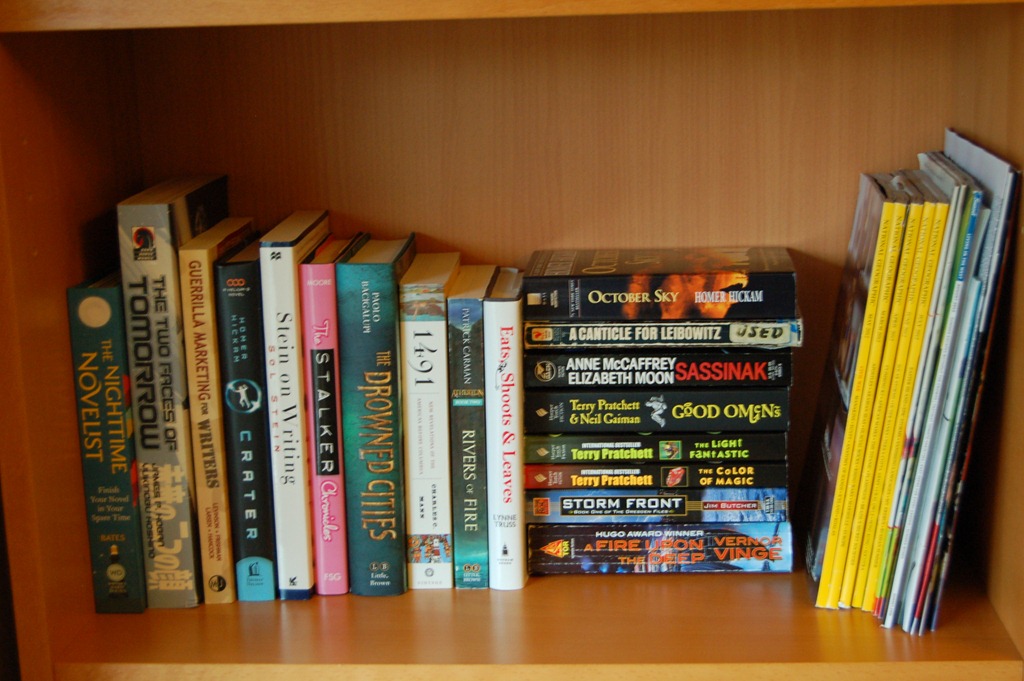
Last year, when I was laid up with foot surgery, I really caught up on my reading. For the last few months though, I haven’t been able to do much reading, but I haven’t completely been able to stop the books (and periodicals) from coming in. I also haven’t been able to stop my wife from reading, so there are probably a ton of books on my wife’s Kindle that I haven’t read as well.
Here’s a quick picture of my current shelf. Of course I can’t take a picture of all the books on the Kindle, nor have I really looked, but I’ve seen the frequent charges to our Amazon account, so I anticipate a bit of a shock when I finally do chance a gander.
My wife and I took the kids over to Vashon Island today for their first ferry ride and a little exploring. We all loved the island, and halfway through the trip, my kids were asking if they could move there. Perhaps someday. I’d love to have a water view out my office window, a place to ride bikes and to walk on the beach. If I could be sure neither of us would ever have to commute to work, I think we’d move in a minute.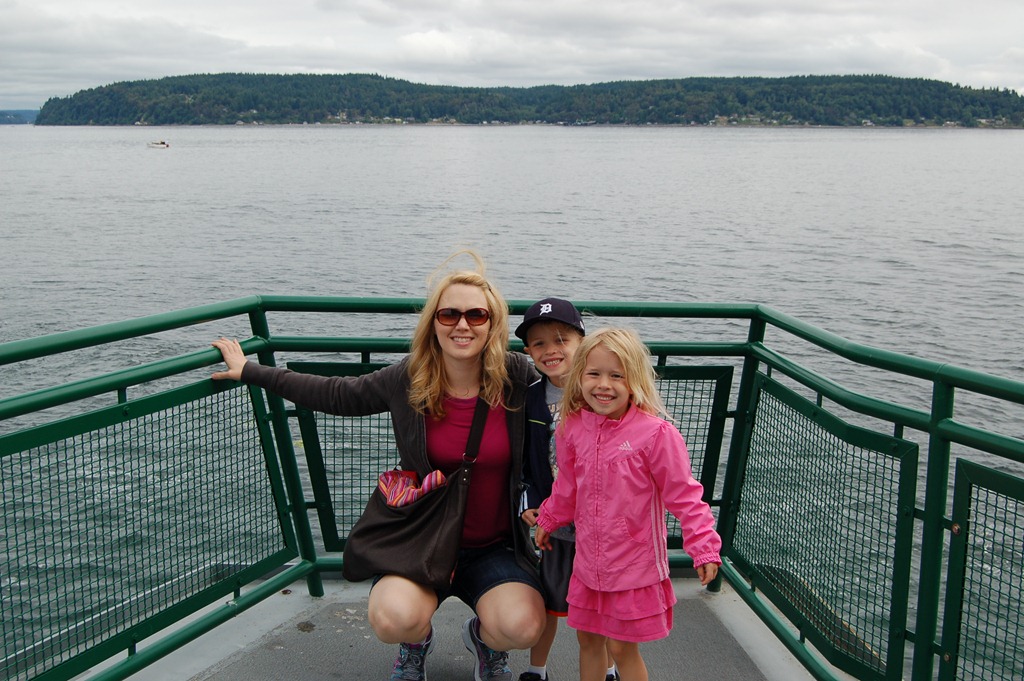
For now, we’ll just have to take occasional day-trips, and perhaps rent a place there for a weekend or two a year, just to get a better feel for the island life.




This year is my first federal election since I became a US Citizen in May of 2011. Last year I voted in the local elections for the first time. Voting in local elections is a little bit easier. You read the bios in the Voter’s Pamphlet, read the local newspaper, and read the city newsletter, and you get a pretty good idea of what’s going on.
But in the State and Federal election cycle, things are harder. Someone once said that democracy is not easy—and it shouldn’t be. Unfortunately, in this day and age, you can’t just vote for the person who you think has the best platform. You have to also be mindful of the other other candidates, and their platforms. These days, with two strong. well-funded parties (and the Top-2 primary system we have here in Washington State), you have to vote to ensure that at least one acceptable candidate makes the final ballot.
For those not aware of what the Top-2 Primary involves, let me go into a little bit of detail. For every ‘primary eligible’ position (i.e. everything from Governor to US Senator to State Insurance Commissioner ), you vote for a candidate, regardless of party affiliation. The top two candidates go to the November elections as the only two on the ballot. In a district (or state) where the region leans heavily to the left or right, it’s likely that both candidates will be from the same party. But in a split district, there is the chance that splitting the vote on one side (or both), could result in two candidates from the same party (or side of the political spectrum) being on the ballot, and the other side not represented at all.
For example, imagine your district is a heavily fragmented district with lots of candidates, where you like any of candidates A, B, or C, but you don’t like candidates D or E. If we assume A, B, and C split the votes on the left roughly equally, they’ll get 18, 16, and 12 percent. Then the other two split their half roughly equally. They get 27 and 23 percent, respectively. For the person who voted for candidate C (who let’s say was the farthest to the left in the political spectrum), this is a nightmare. Not only did their candidate not make the final ballot, the only two remaining are completely unacceptable.
So this means that the voter must choose the candidate they like that has the best chance to win, not the one they like the best. These are not equivalent concepts. The one with the best chance to win likely has the most amount of money, the backing from one of the two major parties, the best name recognition, the “right” gender or “right” race for the region. But they don’t necessarily have the best platform.
I think a much better voting system for primaries would be a ranking system where the voter ranks their preferences from 5 to 1 (but doesn’t have to give all votes out). So in the case above, the voter could give candidate C 5 points, Candidate B 4 and Candidate A 3 point, and not give any to D or E. The top 2 go on to the General Election. This should result in voters voting closer to their ideals, and steering the discussion more towards the direction they want the region / country to go, as opposed to “peer pressure” voting.
One of the other difficulties I had in filling out my ballot, was selecting people for the less publicized positions like Superior Court Judges and Insurance Commissioner. Coming from Canada, I don’t remember ever having to do this before. The Parliament appointed these positions, and I don’t remember that causing a lot of controversy. But maybe it did and I didn’t hear about it (entirely possible). What I worry about in selecting these positions is that a) you have an untrained electorate making decisions regarding law, and b) these positions become necessarily political because judges must make decisions that get them re-elected. This leads to the “legislating from the bench” syndrome we hear about on the media frequently. What’s a better solution? Well, I’m not sure. I just know that I felt unqualified to make these decisions.
It took me three evenings (about 2 hours total) to get through my entire ballot, reading the biographies in the voter’s pamphlets, and occasionally doing a little research on-line. There was one candidate I wanted to vote for, but knew that issue I raised above about splitting the vote could leave me with no one to vote for in the General Election. Luckily, the candidate I did vote for is a good candidate. They just don’t quite line up with my beliefs on all parts of their platform.
Even though I spent two hours voting, it still seemed like I was short-changed the process, especially on the lower profile positions. I don’t quite know how to rectify that personally, given the limited amount time I have available to do everything I need to do in an average day. You can’t know everything about every candidate. Democracy requires effort and honesty on everyone’s part. All I know is that I’ve done my best this time around, and hopefully, that inspires others to do the same.
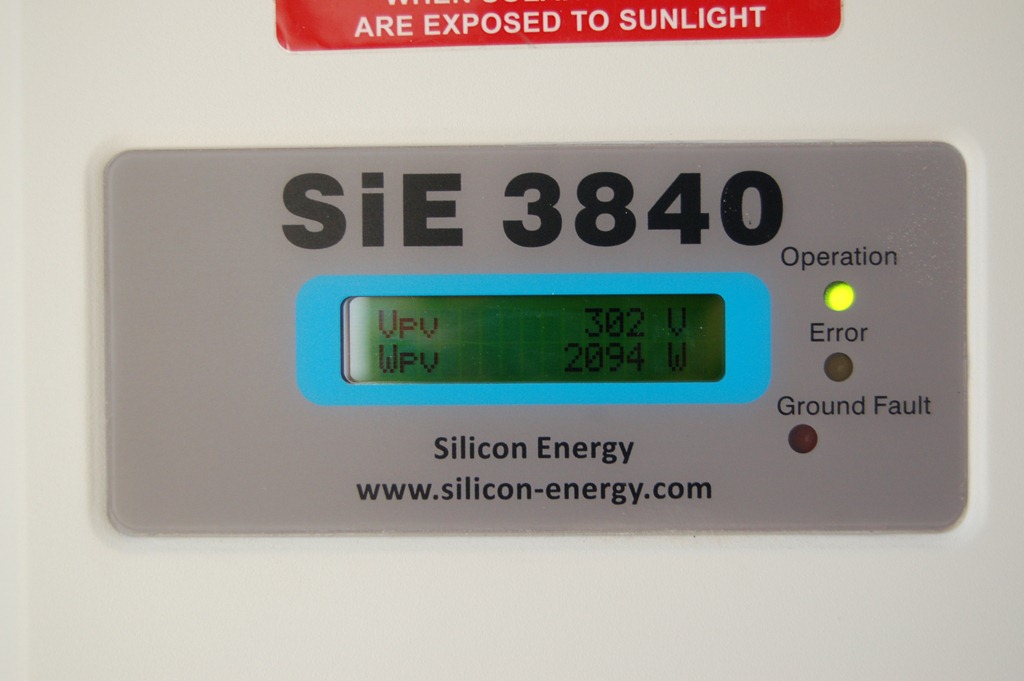
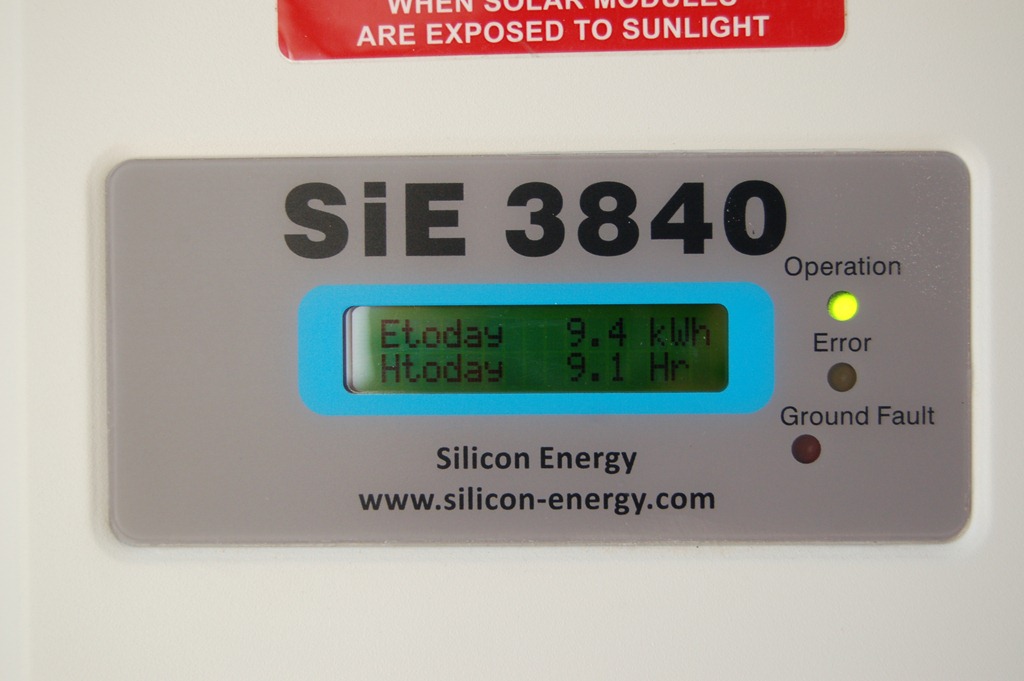
2094 Watts on a the meter a couple of minutes ago. A minute before that it was at 2099, which is the highest I’ve seen it thus far. It could have been higher, but I haven’t been standing by it all day long. There is a monitoring system available for it, but that runs about $600. Seems a little high.
Anyway, so far today, it’s generated 9.4 kWh. Not bad for something that was just a rooftop a month ago.
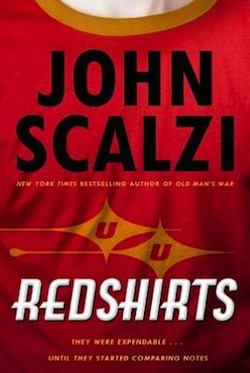 Those of you who have been following this blog for the last few months, know that I have been unable to read much of anything lately due to issues caused by my bout with Guillain-Barre Syndrome. Those of you who have read this blog for the last couple of years, know that I am also a huge fan of John Scalzi’s writing. So when Scalzi released his latest book, Redshirts: A Novel with Three Codas, I found myself with a dilemma: I could forgo reading the book for months, hope that I didn’t stumble across any kind of spoilers, and I could refuse to talk to my wife (who is also a big fan) about it. Or I could read it at a ridiculously slow pace, hope I didn’t damage my eyes any further, and hope that the slow pace didn’t detract from my enjoyment of the book.
I split the difference.
First, I delayed starting the book until I had talked to my vision therapist about how to go about reading when I absolutely had to. He gave me a few tips and a device that allowed my eyes to focus on a single line of text at a time. This miracle tool? A colored piece of translucent plastic attached to a piece of cardboard. But even with this device, I could only read for ten minutes at a time, and at most, a half an hour a day, and only on days where I wasn’t already fatigued from my day job. Which meant weekends only. Ten minutes is barely long enough to get comfortable in a chair, let alone get engrossed in a book—especially a fast paced book like Redshirts.
And Redshirts is fast paced… driven by witty dialogue that probably accounts for 90% of the text. This science fiction tale is based on the legacy of the Star Trek, and it’s tendency to make the junior—and very unknown—away-team members, expendable. They always wore red shirts, and while the main characters came back with a few scratches, many of the ‘redshirts’ never came back at all. But in Redshirts, the redshirts start to notice this pattern, and in doing so, become the story.
Redshirts is a bowling ball that rolls right down the center of an alley filled with ComicCon goers and cosplay enthusiasts, spinning hard and fast, with a little English on it at the end to take their feet right out from under them. Other folk (i.e. people not previously aware of the term ‘redshirt’), can enjoy this book, but there are definitely Easter eggs hidden about for the more-than-casual fan of the genre. While I have seen most of the episodes of the various Star Trek series and spinoffs, I wouldn’t call myself a true-Trekkie. I’m sure I missed a few things a more die-hard fan would have picked up. Scalzi didn’t write this just for Trekkies… but there is no doubt they will get the most out of this book.
The dialogue in the book does tend towards, well, “adult-realistic”, so be a little bit careful giving this one to someone who may not be completely up on the birds-and-the-bees. Read it first, then decide if it is appropriate for your youngsters. Otherwise, you may find yourself being asked a few questions you weren’t quite ready to hear.
I have no doubt that I had I been perfectly healthy the day this book launched, I would have finished it before bedtime. Spreading out the reading did, probably, taint my enjoyment of the book. Perhaps ‘taint’ is too strong a word. I just wasn’t able to connect with it as well as I wanted to because I couldn’t stay in the story due to my condition. It took me over a month to read it, ten minutes here and ten minutes there, weekends only. And there were definitely days I regretted reading because even those few minutes hurt.
But I did enjoy it, and if Scalzi released another book tomorrow, I’d buy it, and start reading it next weekend. I’m a fan, and he writes good stuff. If you’ve ever enjoyed an episode of any Trek series, I think you’ll enjoy this one too.


 Joe Beernink