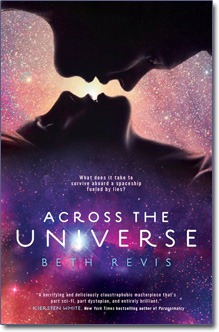
 I mentioned Beth Revis’ book Across the Universe in a previous blog entry as a book my wife told me I needed to read. She had bought it on her Kindle, and since we generally don’t buy the same book twice, I decided that I would steal my wife’s Kindle for a couple of days and read this book. I have never read a book on a Kindle before, so this was quite a new experience for me. I’m going to cover the e-book aspect in another post so I can do both this book and the e-book experience justice.
Across the Universe is a Young-Adult Science Fiction book about a journey to the stars. Seventeen year old Amy Martin is dropped into a freezing creche next to her mother and father and put onto the spaceship Godspeed, with the goal of being awoken 300 years into the future at a new planet which the ship will terraform. While a large number of people are frozen, a large number are left awake to run the ship during the trip. It’s a generational spacecraft, and by the time Amy is awoken, things have changed dramatically on the ship, and she is caught in a web of deceit and danger that threatens the entire ship.
I really liked this book. It flowed very well, and I didn’t really want to put it down. The point of view alternated between two first person characters, and at first I thought that would be distracting or confusing, but I got used to it pretty quickly. I can’t recall ever having read a book done in first person from two different point of views (I may have read one, I just don’t remember it). I actually debated this technique with Ben Newland a few months ago when we were plotting out our next books. His books has multiple main characters and I told him it would have to be done in third person because of this. Clearly, I was wrong. Sorry, Ben, if I led you astray.
Revis covers a lot of hard science fiction in this book. Not the kind of hard science that has you double-checking her equations, but the kind that tells you she put a lot of thought into respecting the reader’s ability to see the ship and the future as characters. This is not a YA book on a spaceship. It’s a true-science fiction book which just happens to have two teenage lead characters. The problems they have are not just teenage problems. They’re deeper issues that any adult would have problems dealing with, and the stress of being the youngest only makes their lives more difficult and makes you root for them more.
If you like science fiction, you will like this book. If you are willing to read Sci-Fi and like YA books, you will like this book. Revis hits a sweet spot in combining genres, and she should be very proud of the results.
You would think that being stuck at home recovery from surgery would offer me plenty of time to write. Heck, I even thought that. I thought I would get writing done in the morning, work my cushy day job from the comfort of my home office, then flip the switch and write some more, and presto, two thousand words a day and a novel in six weeks. I might even write two.
Here’s the dirty little secret about working from home. If you’re like me, you work a full eight hours, and then you work a little more because you took those ten minutes to throw a load into the laundry and to run the dishwasher. And then you work a little more because stopping at 3:30 in the afternoon seems a little early, even though you’ve been at it since 7:00AM. So eight hours creeps towards nine. And then you’re so exhausted because you’ve probably only gotten up to go to the bathroom, once, maybe twice, and you ate lunch standing up at the counter in the kitchen because that might be the moment someone sends you an urgent email. And your breakfast dish is still next to the mouse pad with dried on yogurt and granola and you’re trying to remember “Was that from this morning? Or yesterday?”
So you’re tired when four o’clock comes around, and you can’t possibly spend another moment in front of the computer. You’ll just take fifteen minutes, and sit on the couch and zzz… wha? The kids are home already? Dinner? I was supposed to have dinner ready? Right. I’ll write after dinner. Except I’m not a night person. I can’t write at night. I can barely walk at night. And the wife, she wants to watch another episode of Eureka on Netflix. And since we’re watching it together, I can’t miss it. So no writing gets done that day. But tomorrow will be different. What? A doctor’s appointment? I have to go in to the office? I can’t take the train? When am I going to get to write?
That was my first week or so of working from home. I managed to get a few thousand words into the cracks in the day, mainly by getting up a little earlier, or staying home while my wife took the kids somewhere on the weekend. But it wasn’t consistent, and I started to… gulp… miss my regular commute with its 70 minutes of guaranteed writing time.
But the last two mornings, I set the alarm for my normal, get on the train wake up time (5:20), splashed some water on my face, and headed down to the comfy chair in my office to write before the work day began, and got in a solid 90 minutes of writing before breakfast. This morning, that led to about 1500 words. Not bad. But seriously, I thought working from home would mean I could sleep in and be there when my kids came in for their morning cuddle. That’s not happening either.
The current work in progress is around 28000 words now. The plot is a little different than I first thought it would be, and I’m really starting to wonder if I haven’t got another two-parter, or maybe a series. I mean, I‘m creating a pretty big world here. It would be a shame to waste it on just one story. But as my agent said (I love that I can say that), if you haven’t got the first book, you haven’t got the second. Right now, the story feels a little choppy, but there is definitely room for it to grow, both in what I have already written, and where I need to get it in the next 50000 words or so. Maybe it will go a little shorter than 80000. I don’t know. I’m just going to keep writing to see where these characters end up. It feels a little dangerous, and I do worry, constantly, that its not as good as my last book, but I remember thinking that about my last book too, and it seems to have turned out okay.
Let’s see if I can’t get 2000 tomorrow.
 I’m rereading Harry Potter and The Sorcerer’s Stone this week, and since I’ve read it before, I’m not going to do a full review of it. I have, however, been thinking of how it changed the literary landscape. I’ve talked it over with my wife, and several co-workers, and while that sample size isn’t going to compete with Nielsen, I think I’ve got a pretty interesting idea. My thesis is that the Harry Potter series pulled in millions of young readers at a time when it was believed that video games had destroyed the ability for kids to sit down and concentrate long enough to read anything longer than a comic book, and those readers have, in turn, powered a general Renaissance in YA Fiction as they’ve aged. Not only did they revitalize it, they are responsible for driving waves of development and change in YA Fiction during the last ten years.
I can remember the NBC Nightly News covering this ‘Harry Potter Phenomena’ back in 1997 and they wondered, even back then, what the long term impact of that particular fad would have on the world. They openly asked if it would rescue the struggling publishing industry, or if it was a momentary flash caused by an exceptional book. Fourteen years have now passed since it hit the shelves, and I think it’ pretty easy to see that publishing is alive and vibrant. YA / Children’s books are selling like hotcakes and they lead the way in innovative and engaging stories.
The first readers of Harry Potter back in the late 90’s were between the ages of 8 and 12. That would mean that those early readers are now just entering their mid-twenties. I don’t have any scientific studies, but I would think the increasing demand for YA titles during this time is pretty easy to tie back to the readers who were pulled in by the Potter series. As the readers aged, they evolved, and asked for more complicated, darker books. YA Paranormal. YA dystopian and post-apocalyptic fiction. YA SteamPunk. And yes, in some regrettable cases, glittery vampires.
 But I’m starting to see something else now as well: a resurgence in available YA Science Fiction. Ten years ago, to find YA Sci-Fi, you’d have to go back and find the boy books of Heinlein. If you got lucky and found Ender’s Game when you were young, you struck gold. I didn’t find that one until three or four years ago. But now, more YA Sci-Fi is appearing on the market, and you don’t have to look hard to find it. My wife has recently pointed me to some interesting ones I hope to read soon, like Across the Universe by Beth Revis.
But how does Harry Potter tie to Science Fiction? Simple. Dreams. Harry Potter was about dreams and nightmares and fitting in and choosing to live the life you want, not the one you were condemned to. Every child identified, in some way, with being the boy locked under the stairs, and trying to escape to save the world. Those children, reading those books at that time, needed that story to show them that anything was possible. But at that age, magic was barely a metaphor. They didn’t understand the world they lived in, and the idea that great things were possible must have required some kind of magic.
Then they started to grow up, and hormones took over, and they went to high school, where they still didn’t feel like they fit in, and the world was strange and there were cliques and gangs and horrors parents could never understand, and those kids read about glittery vampires and watched Buffy kick some ass. They could identify with every outcast, and every conflicted character.
And then the glittery vampires weren’t enough. The reality of the world set in, with two wars raging and politicians as crooked as mafia bosses, a dying planet, and a corrupted financial system. The kids whose worries revolved around sex and acne, became bigger, more global, and the books they wanted showed them a world without adults, where kids survived an apocalypse to take over, and do it the right way. Their way.
And now, having aged a little more, they begin to dream a little more. Perhaps a little more optimistically. About a future they hope will someday come. And that leads us to a more pure science fiction, where explorers have broken free of the bonds of earth and breached the heliosphere and begin to make their mark on the galaxy. They wonder if their children will be able to have a better world than they had, or will this be the best it will ever be? And they look to science fiction to show them what might – what could – be.
Scott Hanselman, a technical blogger I follow, recently posted about how Young Adult eBooks Will Save Science Fiction. I agree that Young Adult Fiction will save science fiction. I disagree that it has anything to do with ebooks, except that ebooks will be the medium. What saved science fiction was Harry Potter. Harry Potter saved science fiction by getting a whole generation to pick up a book, and then another one, and another one and another one. And they kept on reading, even in their darkest hours. They read, and they bought books that spurred more talented writers to write (young and old) and that quality spurred more reading, and more writing.
I won’t say Harry Potter got me to write. I’m too old for that. But Harry Potter kept the industry alive so that I would have the chance to do what I am now doing.
And I , for one, am so very glad. Thank-you, J.K. Rowling.
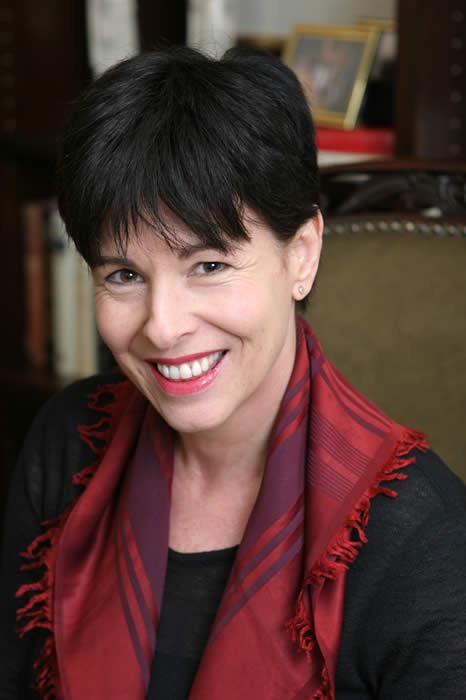 Today, I am proud to announce that I am now client of literary agent Sally Harding and The Cooke Agency. I’ve been sitting on this news for quite a while, but deals like this take time to get done, and get done right. To all those I have kept this news from over the past few weeks, and to those I have outright not told the truth to when they asked “How’s the agent hunt going?”, I apologize. I did not want to jinx this by counting my chickens before they hatched. I hope you understand. To those few I did tell, and who kept this a secret this long, a huge thank you.
Sally and I first met at the PNWA Conference in July 2009. In fact, she was the very first agent I pitched to there. I was very nervous, and I knew almost nothing about the process of pitching to an agent. I almost blew it by talking beyond the point where she said ‘yes’ to reading a sample of my manuscript. But she did say ‘yes’. And that’s where the real story begins.
It was at this conference that I discovered that my manuscript Nowhere Home was too long and targeted to the wrong audience. I’ve blogged about that experience before, so I won’t go into much detail here. But I do want to thank Pam Binder, the PNWA President, for all of her encouraging words that day that saved a new writer from the depths of despair. I took her advice, and did the rewrites on Nowhere Home, which became The Forgotten Road, and I began sending samples of that out to agents. My first version was sent to Sally in December of 2009. We exchanged a few emails over the next few months and she requested the rest of the manuscript, but it wasn’t until the next PNWA Conference in July 2010 that we had another chance to really connect and talk about the book. She was very positive about the book and said very kind things about my writing style. She wanted me to do another major edit on the manuscript, and then to let it sit on my shelf for a while, then to resubmit to her. And that’s what I did.
One of the smartest things I did over those next few months was to work with Book Doctor Jason Black. Jason provided me with a very detailed review of the manuscript, with dozens of changes to make. I highly recommend Jason’s services. He taught me so much about how to not only improve that story, but also how to improve my style, and what to look for when doing my own editing. Had I not worked with him, I have no doubt I would not be writing this blog entry today.
I resubmitted the manuscript to Sally in December 2010. We exchanged a few more emails through January and February, and the longer it went without her saying no, the better I felt about having a shot. And then she asked to speak to me on the phone on Friday, March 4. We talked for about half an hour about the story and about the Cooke Agency, and at the end, she made the offer for representation. It was a heck of a way to end the week. I believe I did a double fist pump after I hung up.
Since that call, there have been more calls and more emails as we worked out the contract, and she introduced me to some other members of the Cooke Agency Team. We also talked about some changes I will be making to The Forgotten Road. We’re still planning those changes out, and it will take a significant effort on my part to get them all done. But Sally has agreed to be my agent because she believes I have not only a book that can sell and sell well, but because she likes my writing style, and sees the possibilities beyond this manuscript. This is the kind of encouragement, feedback and commitment I wanted from an agent, and I can’t express how happy I am to be working with Sally and her team.
So what does this mean? Am I now rich and famous and a full time writer and can quit my day job. No, No, No and Definitely Not. Getting an agent is only the next step. For a new writer it is a big step. But now writing takes on a slightly bigger role in my life. I now have obligations to people other than myself. At some point, there may be –gasp – deadlines. But not yet. I haven’t made a dime yet from writing since I was 14. No one is paying me to write. And even if I did sign a publishing deal tomorrow (which is not going to happen), it would likely be 18 months before the book hit the market. And like I said, the manuscript needs lots of work before we even get to the point of hunting for a publisher. There’s a long road ahead, but this is a very good start.
I’d like to thank a few other people for helping me to get to this point. First, of course, is my wife, Lisa, for all her support and encouragement. Without that, I never would have even tried to write again, and would have stopped a dozen times along the way and gone back to watching TV and playing video games with my spare time. She has read and reread my novels a dozen times, and she is probably tired of them, but she never says no to another re-read and always finds ways to make them better.
I’d also like to thank my writing buddies, Ben Newland and Teri Towne for being there to bounce ideas off of, and for reading the earlier versions. And a special thank you to those people who read the first draft of Nowhere Home: my Mom (of course), Carolyn Coene, Mike Barsoski and Eric Briggs. I almost feel bad I made you suffer through that. But your feedback, and your encouragement really helped.
What’s odd is that making this announcement feels a little anti-climactic for me, since I’ve been keeping it a secret for so long. My mind and body have already processed the initial endorphin rush and I have moved back on to the work. But I am truly excited to make this announcement, and am really looking forward to working with Sally, and to bringing you more good news in the future.
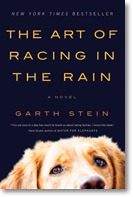
Sometimes a book is perfect. It might just be that the book hits you when you were just really in the mood to read. Or maybe the topic is something dear to your heart. Or maybe you just really like the style. Or maybe it’s all of the above. Garth Stein’s wonderful The Art of Racing in the Rain hit that sweet spot for me over the weekend, and I read it in two days (less that 24 hours), while I was supposed to be hanging out with my in-laws at a family retreat. I really wasn’t feeling very well, and needed to be sitting somewhere that I could rest. And so I read. And I read.
As you can see by the cover of this book, it’s about a dog. Actually, it’s not really about a dog; it’s told by a dog – Enzo – about his master, Denny Swift, a semi-pro racecar driver in Seattle, who has hit a rough patch of road. But Enzo is there, as more than just man’s best friend. Trapped in a dog’s body, unable to speak, and only capable of basic gestures, he must do what he can to comfort Denny and save his family. It’s a wonderful story you will not be able to put down. It’s not ‘Old Yeller’. It’s philosophy and religion and life and love and legacy. And even if you are not a fan of either dogs or racing, you will ‘get it’. And it will make you cry. If you dare to read this in a public place, be prepared for that.
I had briefly heard about this book prior to hearing Bill Kenower of Author Magazine rave about it at the March PNWA meeting. I picked it up the next weekend while grocery shopping, not really knowing much about the story, but knowing the story behind it was interesting. Apparently Mr. Stein had some issues getting an agent to represent this book because, well it’s “From a dog’s perspective”. But he finally found the right agent, and now the book is a New York Times Best Seller and translated in 30+ languages. I’d bet those other agents who turned it down are slapping their foreheads now.
Sometimes I’ll be a little suspicious of books that get ‘too popular’. Maybe my tastes don’t follow with popular trends, or I’m a little more of a harsh critic for books that get too much praise. But I don’t think you could heap too much praise on this one. It’s truly one of the great books to have been published in the last few years, and something I think everyone should read. Buy it. Enjoy it. Tell your friends.
My mother-in-law left this book lying on my bookshelf the last time she visited.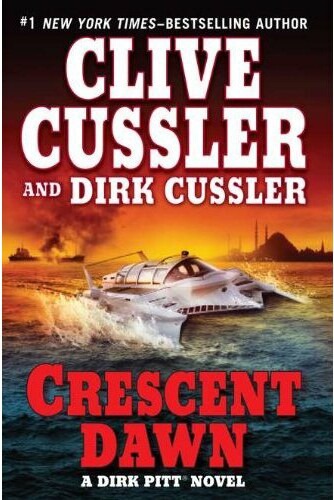 I’ve never read a Clive Cussler book before, and since I’m kind of laid up these days, I thought I’d give it a read. I think I picked one of his books up a couple of times at a book store, but I never bought one. Not sure why. Maybe it’s the name of the book’s hero: Dirk Pitt. Sounds like some kind of Harlequin romance character that I suspected would at some point have to do something with his ‘throbbing manhood’.
Clive Cussler has written 42 books, which is quite impressive, and his son Dirk has co-authored three or four of those, including this one. I’m not sure how co-authoring works, period, but I’m suspicious that in this case, Clive wrote some of the chapters, and Dirk wrote some. Some flowed pretty well and obeyed the basic laws of story telling. Some did not. If I were to read a pure Clive Cussler book, I would probably be able to pick out which sections he wrote in this one. The voices definitely change from section to section.
But reading another Cussler book (by either father or son) probably isn’t going to happen for me. The plot is definitely imaginative and high concept: if Dirk and his children Dirk, Jr. and Summer don’t stop the terrorists, the world will explode into World War III. But in order to make the plot work, there are a startling series of coincidences that involve Dirk, Dirk Jr. and Summer finding clues to the mysteries they didn’t even know they were working on. The villains are paper thin and do the stupidest things, constantly. They show no mercy in killing people, but always – and conveniently to the plot – leave Pitt’s family alive and ‘unconscious’, so they can come back to foil their dastardly plans once again. And it’s not just the villains who do stupid things. Pitt, at one point, leaves the villain – who has just killed two of his friends – locked in a closet instead of killing her and putting an end to the story right there.
But the low point of the story is Dirk and his wife – a US Congresswoman of course – are trying to escape henchmen who are chasing them around Turkey. They meet up with a man at a classic car show, and steal his antique car to get away from the men with guns. The man’s name? Clive Cussler.
Dude. Seriously? I know Cussler has gained a lot of fame and fortune from his writing. But holy cow.

Richard Kadrey’s Sandman Slim is one hell of a book. Literally. The kind of book where Lucifer is a character, and life ‘Downtown’ is something the main character, James Starks, doesn’t worry about. He misses it.
Life in Hell was simple for Starks. Then he escaped back to Los Angeles; a place that rivals hell for creating one shit-storm of violence and dark magic after another. Now, caught in a battle between angels and demons, Starks finds a middle ground as he tries to kill those who sent him to the fiery pits in the first place. And even the angels aren’t safe – or innocent – in this mess.
If there is one word I can use to describe Sandman Slim, it’s Irreverent. With a capital ‘I’. Kadrey writes like he doesn’t care about your sensibilities, and there are no sacred cows he won’t slide a pitchfork into and roast over a good pyre. This is not a book for the faint of heart, or the easily offended. Run away from this one you think that might describe you. But if you enjoy a good tale, a unique story like nothing else you have ever read, and can take violence and startling imagery, you will like this book.
I can’t tell you how many times Kadrey blew me away with a metaphor or a simile that fit perfectly into the story. Open up just about any page, and you’ll find one. For instance… On page 62:
“The vacant land looks corrupt and out of place in the perfect landscape, like a starlet showing rotten teeth behind her million-dollar smile.”
And it’s not just the images he creates. The dialog fits perfectly to the characters, and the characters are all sublimely nasty and well-developed. There are no cardboard cutouts in this book. Every one of them has a pulse. Well, not every one of them.
This is a great book, and I will be picking up more of Kadrey’s stories. I’m just going to give it a few days, so my soul can heal, and I won’t immediately be tagged for a one way cab ride ‘Downtown’.
I find it a little funny that I am writing this blog entry as I procrastinate from actually working on my next book. When I’m really in the writing mode, I get up early, shower, head straight downstairs, don’t look at email, don’t read twitter and don’t surf the web. I knew as soon as I sat down this morning that I was in full procrastination mode. I’ve checked email, surfed the web, tried to fix a problem on my computer, read twitter and tweeted a few times. And now I’m writing a blog entry about blogging about procrastinating. Yikes.
I’ve got a lot of time to write these days. Far more time than normal. No, I didn’t quit my day job (or lose it). I had some surgery done on my left foot on Wednesday, and I’m going to be hobbling around for the next 6-8 weeks. So far, hobbling has meant sitting on the couch with my foot up, or sitting at my desk with my foot up, or lying in bed with my foot up. I can move pretty well on crutches, and the pain is definitely better today than it was on Wednesday-Thursday, during which time I was popping Oxycodone every 3 hours and trying to balance the nausea it induced with the burning pain in my foot. It seemed like that 24 hour period was actually two days long, and everything is a little fuzzy. Now, Tylenol seems to be doing the job, and I’m very glad for that. But I won’t be running any races, or cutting the grass, or painting in the next few weeks. I do have to work from home for my regular job, but I won’t have to commute, or even get dressed if I don’t want to. (Yay, time savings!) So I’m hoping to write, a lot. Ideally, I should be able to finish the first draft of my next book. But that means I have to stop procrastinating. What a vicious little circle.
Before my surgery I did get some writing done. My current work in progress is over 16000 words now, which means I added about 3000 words in the two days I did write. I also did one very short editing pass on Army of the Risen to fix some typos my wife found while doing a re-read.
So anyway, hopefully I’ll get some serious traction this week on the next story. We’ll see.
Yes, I am back to writing. I wrote about 3000 words this week, which isn’t a heck of a lot, but when I did write, the sessions were very productive. I’ve been bouncing in and out of my latest novel Labeled now since January 2, and though it doesn’t feel like I’ve gotten any traction, I am over 13,000 words total. When I do sit down, the words come with amazing ease.
I had two interruptions to my writing schedule this week. On Thursday, I attended the monthly PNWA Meeting in Bellevue, WA, where I heard a very energetic and inspiring presentation by Bill Kenower, the Editor-in-Chief of Author Magazine. Part of Bill’s presentation included some wonderful video clips, including this one:
I joined the PNWA in 2009 to enter their writing contest. I didn’t win. But I got some extremely helpful comments on the entry response, and that was my first true feedback from someone in the ‘publishing world’. I went to PNWA Conference in 2009, and though I had my soul nearly crushed by an agent who wouldn’t even let me finish my pitch (My book was too long and I didn’t even know I was writing YA Fiction), I learned a lot there, and met some really great people. That agent turned out to be right, of course, and because of that feedback, I really did realize that there is more to writing than just putting words on the page. It is a craft that needs to be studied.
As a result of the 2009 PNWA Conference experience, I went back in 2010 with a better manuscript and a more professional attitude. I also did a little volunteering, helping out with one of the service areas, and moderating one of the sessions. I think I got far more out of the conference because I volunteered, both personally and professionally, and I’m going to be even more heavily involved in the conference again this year.
Before the meeting on Thursday, I met with the fantastically dedicated and funny Anne Belen of the PNWA and fellow author Tracey Shearer (who was also a volunteer at the conference last year and got her agent partially because she was a volunteer… there are perks to volunteering you know.) We went over some of the conference session plans and what we would be coordinating this year. I realized, while on my way home that night, that one of the reasons why I love writing so much, is that because of my involvement with the PNWA, writing is not a solitary lifestyle. I’ve gained good friends and participate in writer’s groups and volunteer work through the PNWA. I highly recommend that every writer try to find a writer’s association and put their full effort into it. You will get back far more than you put in.
I said earlier that two things interrupted my writing this week. The second was head trauma. As in “head, meet sidewalk” kind of trauma. I was running to catch my train on Tuesday night, came around a corner too fast, lost my footing and face-planted into the concrete. And yes, there was blood (from the teeth stuck through my lip) and there was pain (I thought I had broken either my jaw or my chin… neither one was actually broken, just bruised). I didn’t even notice all the points of pain in my body until the next day when the scrape on my knee and stiffness in my neck really kicked in. Running on wet cement is a stupid thing to do. Riding the train home, holding my mashed-up chin and bleeding lip was no fun. A trip to the urgent care center and a Tetanus shot made the evening even less enjoyable. Luckily, there were no stitches involved. Just an embarrassing swollen lip and a scraped and bruised chin. Of course, as a writer, I will make sure that the experience finds its way into my writing. If one of my heroes happens to find themselves falling onto cement, if they do get up, it won’t be without a banged chin and a bloody lip, and they won’t be running a marathon the next day either.
 My wife picked up Graceling by Kristin Cashore on the recommendation from @Sundry, someone I follow on Twitter and who’s blog we have read for over five years now. I like to give credit where credit is due, and since I really did love this book, a hearty “Thank You” goes out to Linda for her recommendation.
Graceling is set in the world of The Seven Kingdoms. It’s a medieval world filled with, well seven kings, and horses and noblemen and princes. Katsa, a young girl with a special gift is King Randa’s not-so-secret weapon – his assassin and his enforcer. In a world where some people have been graced with special abilities, Katsa’s ability is to be able to kill. And she is very good at it. King Randa has used her for years to intimidate the people of his kingdom, and made her a true ‘Lady Killer’. But she is also having a crisis of conscience, and when a mysterious visitor from another kingdom demonstrates the ability to challenge her both physically and mentally, she has a choice to make: one that could see her become and outlaw, or be caged forever in the dungeons of her king.
This is a wonderfully written book for young adults and adults alike. The characters are perfectly drawn and the scenes masterfully set. There are twists and turns that make every page brim with action. It’s a deep story, but not dark, and it’s filled with hope and emotion. It’s also a coming of age story for a young woman as she escapes the burdens placed upon her by others, and finds her own way in the world. I really liked this book. If I was giving out stars, I’d give it a four out of five, docking it only just slightly because the action climax of the story flew by so fast I almost missed it, and the denouement seemed a little long. Having said that, with the story she wanted to tell, I’m not sure there was another way to do it.
According to Wikipedia, Graceling received numerous awards and nominations, and I can understand why. I will definitely read more of Cashore’s books, and look forward to another raining Sunday afternoon deeply engrossed in one of her stories.
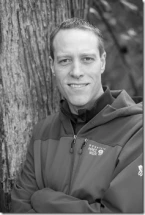

 Joe Beernink