Today, something a little different: a guest blogger! A few weeks ago, I reviewed The Gutenberg Rubric by Nathan Everett. Nathan is currently crisscrossing the United States on a book tour, while simultaneously crisscrossing the blog-o-sphere doing a blog tour. Today, Nathan drops by my little corner of the internet, and talks about the ‘where things happen’ of story telling. Enjoy!
 Some 30 years ago, my mother was my only fan. She read everything I wrote, which kept me on the straight and narrow, though she never complained if I had a moderately erotic scene. It was when she read my description of the Meteora in Greece, however, that I got my most sincere compliment from her. She had visited the site a few years before and could not believe that I could describe it so well that she “felt like she was walking between the peaks” as she read, even though I’d never been there.
That’s what location is supposed to do for the reader. It grounds you with a sense of stability while the action takes place around you. It gives you reference points, distances, landmarks.
But my mother was right. I’d never been there.
Most of the locations I’ve used in my books are real places that I’ve walked through or visited. But like the Meteora, or Mount Nemrud in The Gutenberg Rubric, sometimes I have to write about places that are out of my reach for primary research. How do you make a location real and believable even if you haven’t been there?
I certainly don’t have an answer for every situation, but there are some things I do to make locations believable. And I have to admit that some of them make me look pretty ridiculous at times.
When possible, I use real locations that I can visit and observe. In For Blood or Money, I set the story on the Seattle Waterfront. I walked the streets downtown and climbed the steps from the Waterfront to the Market taking lots of photos. I had once visited a downtown penthouse condo where action could take place. I scouted how long it would take to walk from Lower Queen Anne down to the Pier. The location was very real. In fact, even the cover photo, was taken by my daughter a block off the Seattle Waterfront.
 I often use places that are amalgams of several places I’ve been. For example, the library in the first chapter of The Gutenberg Rubric is a combination of a library I once visited in Vancouver, a picture of a library I found on-line, and the Rarig Center for the Performing Arts on the University of Minnesota campus. The prestigious university where the book’s Kane Memorial Library is located went unspecified, though there were details based on places that I knew—how far from the bridge to the library, an interesting reflecting pool, even an apartment where I once lived. There was no reason to indicate at what university or where in the country this library was located. What was necessary was to make it believable and real so that as Keith crossed the campus to the library, the reader could walk with him.
Finally, when the location is a real place that I cannot physically visit, I do research. Of course, I do online research, often letting the links that appear on pages lead me miles from the search page that got me started. In the library—a real physical place—I am one of those who uses the card catalog (or computer lookup) to get a starting point and then browse the shelves all along the aisle where a single reference work might be located. I pull book after book off the shelves, scan through it, and carefully re-shelve it. I carry a notepad and jot down references, occasionally checking a book out of the library if I believe it has material beyond a sentence or two or a photo. My first task is to make the location real to me.
The biggest pitfall for me in doing location work is attempting to “tell” the readers about the location instead of “showing” it to them. Showing the location requires action and action can make you look funny.
There is a 2-acre park next door to my house. When I am getting ready to write a scene in which the location is important (almost all of them), I go to the park and visualize where the action occurs. I don’t attempt to describe the height of the buildings and the width of the street. I focus on how winded I am when I climb the hill, how fast I can get from one location to another, what I have to go around in order to go forward. Obstacles are a great way to put the reader in the location where the action is. Take this example: “The crowd forced him to the edge of the sidewalk and he jammed his knee painfully against a fire hydrant as he fell off the curb.” There is no need to tell how many people were in the crowd, how wide the sidewalk, or what color the fire hydrant. We fill those details in from our own experience.
Location is as important in story-telling as it is in real estate. Like my mother, the reader needs to feel like she is walking between the peaks.
Links:
The Gutenberg Rubric: http://www.gutenbergrubric.com
The Rubricant Blog: http://www.gutenbergrubric.com/blog
Author Central: http://www.amazon.com/-/e/B004QVVE1S
Author Info:
Nathan Everett
nathan@nwesignatures.com
 Back in the summer of 1998, I was living in Colorado. I had no air conditioning, so I often spent Saturday afternoons at the movie theatres. One particular afternoon, I watched Saving Private Ryan. I walked out of that theatre, back into the blazing afternoon sun along with a large crowd of gob-smacked people, and wondered if any other movie would ever come close to what I had seen on the screen that day. The effect was profound, and it was quite a while before I watched another movie without saying to myself “Meh, it’s no Saving Private Ryan”.
What does this have to do with Paolo Bacigalupi’s Ship Breaker? Partway through Ship Breaker, I had a Saving Private Ryan moment. It wasn’t that I thought I would never be able to read another book. No, I wondered if I would ever be able to write another book. From the first paragraph on, I was jealous of Bacigalupi’s skill – his ability to find the perfect word to create the perfect image at the perfect time. Ship Breaker is a masterpiece of Young Adult Literature.
The story is set in the future, after the polar caps have melted, and the ways of the ‘Accelerated Age’ are left behind like the relic ships grounded on the beaches of the Gulf of Mexico. Nailer is a teenage boy, still small enough to crawl through the vents of these rusted wrecks to help salvage the bits of copper, brass and aluminum that can be sold to turn enough of a profit to earn him his next meal. But Nailer has some big problems, and when a hurricane pushes a new wreck onto his beach, his problems multiply, and his simple life of survival gets capsized by the storm’s waves.
The story is fantastic, well plotted and paced. The characters are perfectly named, and the conflict very well done. But it is the words Bacigalupi uses to paint Nailer’s world that are truly spectacular. Ship Breaker, though eminently readable, is Literature, with a capital L. The story is commercial, and fits in nicely with the post-apocalyptic craze in publishing. But the words… the words are amazing.
As I read the book, I thought about my own manuscripts, and their various states of being. I had a difficult conversation with my agent over the summer about how some of my chapters were perfect, and some were just carelessly thrown together as I rushed to complete them. I read Ship Breaker, and I compared Bacigalupi’s prose to my own. I wondered if this style, this vocabulary, came naturally to him, or did he spend long, tedious hours polishing every paragraph, every sentence and every word? I wondered if I had that effort in me. Was it a talent I just didn’t have? Was I willing to do the work needed to get to that level? Was it even a goal I should try to reach? Maybe my style is just different – simpler. Or is that just a cop-out?
For a day or two, the book weighed on my mind, and sank me into a mini-depression about my writing career. Then, this morning, as I began plotting out the changes for my novel Labeled that I wrote earlier this year, I started to get excited again. The rush of creating – of coming up with the story and making it better each time – was something that I would miss if I stopped doing it. I realized that I was / am willing to do what it takes to make the story the best I can make it, because the stories I have… they have to be told, and I know people will like them.
So instead of looking at Ship Breaker as an impossibly high standard, I’m going to look at it as a source of inspiration, and as a model of what I should be aiming for, while still holding true to my own style. Maybe someday I’ll win some of the awards Bacigalupi has won, and maybe someday, some writer will turn to my words for inspiration. But that will only happen if I keep writing. So I will.
If you haven’t read Ship Breaker yet, do it soon. You won’t regret it.
Anyone who has ever seen me try to nail together two-by-fours knows that when it comes to construction work, I should be kept far, far away from even building a doghouse. Luckily, when I talk about building my platform, I’m talking about enhancing my ability to successfully market my writing to potential buyers, not about building a physical structure.
Of course, the first thing in marketing is to have something to market, and it helps to have something good to market. Since I haven’t actually published anything yet, it may seem a little premature to worry about marketing. In the software development world, we call marketing something that doesn’t exist yet as ‘selling vaporware’. Vaporware may never be finished, let alone may never work, and a potential buyer’s time is wasted if they become too wrapped up in the product before it ships. A manuscript may never be published, but the interaction with the author can be a product in itself for the potential reader.
When marketing books that aren’t yet ready for publication, the goal is to attract potential readers to the author; to make them aware the author exists in the first place, and to make them aware of the author’s style. As an author, you want to maintain a consistent presence that keeps people coming back to check to see if the novel is ready yet, and keeps them spreading the word about the author to their friends. When the book is ready to be published, a market (hopefully large) would then be aware the book is being released.
Building a platform isn’t something you can do overnight, but there are a hundred things you can do to add to your platform. My approach has been a little bit scattershot over the last few years, but here are a few things that I have found that I enjoy doing. I can’t say they’ve been completely successful, since I have no product to actually sell yet, and I know I have a long way to go before I realize what I would consider critical mass in my reach. Right now, I focus on doing what I enjoy, and adding to that as I find other ways to expand my platform.
- I built this website a couple of years ago, and it has slowly evolved to be the epicenter of my on-line presence. If you search for “joe beernink” on Google, this is the first place you come to. Make sure you get a web site that ties closely to your name (or your pen name if you have chosen to go that route).
- I try to provide new content to this site every-other day. That changes when I am actively writing a new book, but I try to stay consistent to give people reasons to come back to the site on a daily basis. Notices of new posts are distributed to Twitter, Facebook, and via subscription on the site.
- I joined Twitter in October of 2009, and while I am not a really frequent Tweeter (compared to some people I follow), I do understand the power that medium provides, and see a great potential in driving people to both my site, and to my friends sites.
- I’m an active member of the Pacific Northwest Writer’s Association. I can’t stress enough how important it is to be a member of a great organization like the PNWA. Going to the classes and lectures has helped my writing and inspired me, but the network I have made through the PNWA has helped build my platform more than anything else I have done.
- Ben Newland came up with the idea for the Puyallup Writer’s Co-op, and while the group is still gaining traction, participation in that has exposed me to new local opportunities within the public library system, and from there, to the local Arts Commission, which has led to even more opportunities.
- Reviewing Books. I started reviewing books so that I could make recommendations for good books to friends and family. That evolved into what writing lessons I’ve learned from books. Documenting those lessons really helped me to become a better writer as well. A large percentage of the traffic to my web site comes from people looking for reviews on these books, and from authors of those books linking to them. Those visits add up, and if even a few of them browse to my other pages and other blog entries, I have gained another opportunity.
- Writing short stories is something I hadn’t done in quite a while. I have always been focused on novel length work, thinking short stories would be a distraction from that. I’ve discovered that this is simply not true, and that short stories are a great way to not only hone my craft, but to also gain exposure for my writing. Entering contests and simply publishing a story on your blog on a regular basis is a great way to extend your platform.
- Have a signature on all the personal / writing related emails you send out. It’s a simple thing, but let’s say you’re sending a question to the city about a swim class for you kids, and you include the signature. The reader of that email sees that you are an author and passes that on to the city arts commissioner who is looking for authors to sit on a panel at a writers event. Bingo.
- Get professional looking business cards that clearly state that you are an author. Having something to hand out every time you meet someone new is absolutely necessary.
I don’t want you to think that I do all of these things only as part of some grand marketing scheme. I do the things I enjoy first, and when there is an opportunity to both do something I enjoy, and to expand my reach, I take that opportunity. Perhaps when I am much closer to being published, and my family’s well-being is at stake, I will shill more frequently in self-promotion. For now, I’m satisfied with a go-slow approach that is fun.
There are a few things I have planned, but not yet done:
- Tune up my Facebook presence so that my author page is easier to find, and includes updates from my blog
- Create an email list so I can send out push updates when something really big happens. I’m a little bit split on this, because I generally don’t sign up for emails, but enough people must sign up for things like this, because I hear about email lists often enough.
- Market short stories to magazines
Anyway, this is one of those posts I’ve wanted to do for a long time. I hope it helps other people to come up with ideas on how to build their platform. If you have any suggestions, or questions for me, please let me know!

Cut, Paste, Kill is the fourth book in Marshall Karp’s Lomax and Biggs series. My wife and I have read the other three, we really looked forward to this new one when we heard it was coming out.
Mike Lomax and Terry Biggs are police detectives in Hollywood, where even the murder scenes of their latest case have special effects. Okay, not special effects so much, as bizarre clues… mementos left by a serial killer, detailing all the evil perpetrated by the victims. Yes, this mastermind is a murderer, but they are a murderer with a vengeance complex, and a talent for making beautiful scrap books.
If you like funny, easy to read mysteries, this is a pretty good tale. It’s a touch more serious than the Spellman Files that I reviewed recently, and a pretty substantial step up from Stephanie Plum. But it’s not Sherlock Holmes. There are a couple of sub plots that seem to just be filler, but they’re funny, and they appear to be set ups for the next book, so they’re not causing any issues.
I did like the previous three books in this series a little bit better, but this one is still good. It’s just not quite as good. Again, like the The Spellmans Strike Again, it may be series fatigue. The characters are easy to like, and most of the crises in their lives have already been solved, so the new ones have to be self-inflicted / contrived.
Cut, Paste, Kill is any easy read you can sit down with on a nice summer day and get lost in, and that worked just fine with me this weekend.
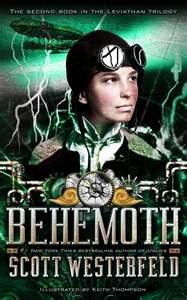 Behemoth, by Scott Westerfeld, is the second book in the Leviathan Trilogy. I reviewed the first book, Leviathan back in January of this year, and the third book in the series, Goliath, will be released on September 20th, just two short weeks from now.
Behemoth picks up where Leviathan left off. Deryn Sharp is a girl acting as a boy midshipman on the airship Leviathan, a strange beast of a craft, filled with other strange beasties, like shrapnel toting bats and hydrogen sniffing dog-like creatures. The Leviathan is a war ship, smack dab in the middle of the beginnings of a war between the British Darwinists and the German Clankers. And on the Leviathan is a boy prisoner with a secret of his own. Alek is the son of the deposed Austrian Archduke, and heir to the Austrian Empire.
At the end of Leviathan, the damaged ship is drifting southeast from Austria, and heading towards the Mediterranean, where another battle is about to take place. A neutral Empire is being coerced into taking sides in the coming war, and Alek and Deryn hold keys to determining which side it joins.
I’m assuming at this point that you have already figured out that this is not a Tom Clancy thriller. This is steampunk, alternate-reality history and if you pick it up, you had better do it with an open mind. There is some crazy stuff happening in this book. The machines are massive. The world is darkened by the soot of an over-industrialized world, and man has tampered with nature in ways no one could imagine. Okay, one person has imagined: Westerfeld.
The book is boy adventure at it’s best, and for a large part of the story, I forgot that Deryn was actually a girl. The action through most of the book is fast and furious, and the plot very, very well done. Lesser authors might throw in steampunkish devices that have little to do with the plot, and call it steampunk. But Westerfeld weaves the world of the Darwinists and the Clankers in to every scene, where you can’t really imagine this world without all the strange vehicles and creatures. There were a few times where I wondered why no one saw that putting a freaking wheel on something wouldn’t be more efficient, but Westerfeld is consistent in how he builds the world, and you just begin to assume that that is the way it just has to be.
This book seems to have a faster pace than Leviathan, probably because he doesn’t have to cover quite as much backstory, and the characters are already in conflict from day one.
I couldn’t help but notice a very strong similarity between this series and one of my all-time favorites, Horatio Hornblower. I would be very interested to know if Westerfeld is a fan of C.S. Forester. If you liked this series, I strongly recommend Forester’s books. They’re not steampunk in any way, shape or form, but they are adventures in the same vein, and Horatio also starts out as a middie, though in the British Navy during the Napoleonic Wars. Reading about massive ships like Leviathan makes me want to go back and re-read the Hornblower series now (as if I don’t still have enough to read.)
If you’re a steampunk fan already, you’ve probably already pre-ordered Goliath. If you’re just getting started in the genre, pick up Leviathan and this one at the same time. You won’t be disappointed.
I turned 40 last month. It felt different than turning 20, or 30, or even 39 for that matter. Perhaps it was that I was still recovering from dislocating my shoulder the week before, and my body still hurt. Maybe it’s a normal thing for guys my age. Forty is a bit of a milestone, after all. Some men see it as a perfect time to manufacture a mid-life crisis. If I hadn’t had at least a half dozen other life-crises in the last ten years, I’d admit to the concern that was possible for me as well. But I think I’m actually well past my mid-life at this point—at the rate my body is falling apart, eighty looks to be an optimistic goal.
I think I’ve always been a bit of a gerontophobe. When I was in my twenties, I always tried to set high physical goals, in the fear that it wouldn’t be long before trying those things would be beyond my body’s capability. I cycled a hundred miles in a day multiple times. I played fairly competitive soccer and softball on corporate teams (though not very well). I hiked in the mountains and biked in the desert on solo trips that I would honestly think twice about now. I travelled around Europe for a couple of weeks by myself. I wish I had been more wrong than I was, but I’m glad I did those things. There’s no way I could do those things now, and I don’t regret any of that, even though some of those things brought me very close to never seeing my next birthday.
I did a lot of those things because I doubted I would be able to do a lot of them later in life. Similarly, I didn’t do a lot of things earlier in my life because I feared how it would limit me later in life. I refrained from taking public stances on political issues because I was never sure if politics was in my future, and I didn’t want anything people could hold against me. I refrained from taking a stand (for the most part) when faced with moral and ethical decisions at work for fear of losing my job or endangering my abilities to get future work. Every time I look at someone who has blown the whistle on Corporate America I shake my head and wonder how they ever got the nerve to do that. Not because I thought they were crazy, but because they were incredibly brave.
One of the thoughts that struck me the other day, while I was contemplating the meaning of forty, is that I’ve been in the workplace now for seventeen years (not counting the jobs before and during college). My first day of work after college was September 6, 1994. Based on my current life expectancy, and my prospects for retiring early due to some sudden windfall (very low), I’ll probably be working for another 25-30 years.
That’s a long time to be scared.
Seriously. That’s what I was thinking. I was no longer thinking about what I will or will not be able to do physically. I was thinking about how long I will be afraid to take a stand, and how those decisions will impact my career, my life, my family, and my writing. Not that I have anything that I am super-passionate about that is controversial about at this time, but I suspect that I have long closed my mind to becoming passionate about issues because I am afraid of the consequences. I am one of the mindless millions, commuting back and forth to work to keep the American cash registers ringing so we can go out and buy the next electronic toy we’ve been told we all can’t live without, and hoping that someone else will solve the world’s problems.
In a round-about way, this fear has affected my writing. At times, I find my own writing dull and cliché, as if it is a copy of every ordinary book I have ever read. I write books I would want to read. Books that are entertaining and comfortable… and safe. I don’t write deep investigative journalism, because that might put me in harm’s way. There’s no sex in my books, because, OH MY GOD MY MOTHER WILL READ THIS! My characters play it safe (more often than not) because I overthink the consequences of their actions, and hence, they do too. Emotions are left out of the decision making, because that would lead to illogical decisions, as if every character in the book is some sort of Vulcan.
What I need to remember, as I write characters of different ages, is that fear is a great motivating, and sometimes debilitating factor. A young character may be afraid of not doing something. They may act with more emotion. An older, and supposedly wiser character, may be afraid of acting because they see the consequences. They may have more to lose. They’ll rationalize their decisions. Both characters will fear something. But their fears will change their motivations.
Understanding what the character is afraid of, helps to sketch out their profile, and may be far more important than their height, weight or gender. Going forward, I’m going to make sure I document those fears for all of my characters, so I know their motivations just a little better.
So what am I going to do about my own fears? I didn’t say I had a plan. I just said I knew I had a problem. At least I’ve gotten that far. And it only took me forty years.
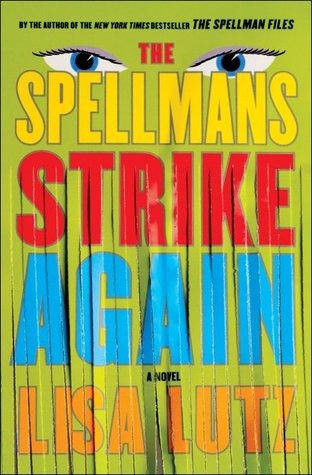
The Spellmans Strike Again is the fourth book in the Spellman Series by Lisa Lutz. If you haven’t read the first three, I recommend doing so, probably before you read this one.
The Spellmans are a family of private investigators in San Francisco. Or rather, the parents, Olivia and Albert are retiring as private investigators, and handing the business over to one of their daughters – Isabelle. Izzy has been a bit of trouble maker in the past. She might say that trouble follows her around, but she doesn’t stop it from keeping close tabs on her.
Take, for instance, her next ex-boyfriend (#12), Connor, an Irish bartender whose best attribute is that Izzy gets to run up a bar tab at Connor’s establishment.
Then there is her little sister, Rae, who while just about to graduate from high school with excellent grades, has a proclivity for also getting into trouble, though it’s generally other people who take the fall for her.
Izzy also has an older brother, David, in an odd relationship with a lawyer named Maggie.
And finally, there’s Detective Henry Stone, one of SFPD’s finest, and someone who has been tormented by the Spellman family for long enough that he now is treated like family.
This is the world, the reader is brought into. There are, of course, some crimes to be investigated, but the real story is the dynamics of the family and their friends. The dialog is quick and the conversations odd, but in a funny, endearing way.
There’s an obvious comparison between this series and the Stephanie Plum series by Janet Evanovich. If you liked Janet Evanovich, you’ll like this West-Coast version. Unlike the Stephanie Plum series, these characters grow up from book to book. Things happen, and they affect the characters. There are some poignant moments that actually show character’s changing. That’s a nice touch for a book that is a perfect airplane or beach read.
These books won’t be mistaken for literary fiction. They’re lite and easy to read. If you want something easy to pick up and hard to put down, give this series a try.


 Joe Beernink