 One of the great pleasures of my childhood were my frequent trips to my hometown library. Now that my children are old enough to be reading on their own, I find myself back at my local library every few weeks with them. And since I’m there primarily looking for books for kids, I often come across books I read as a child, like Encyclopedia Brown and the Hardy Boys. Sometimes I come across books I’ve heard about but never read. The urge to pick them up and bring them home for myself instead of the kids is too strong to ignore.
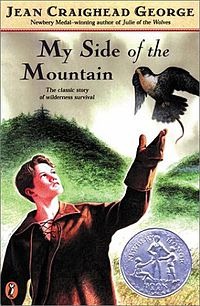
Last Saturday, I stumbled across My Side of the Mountain by Jean Craighead George, recommended to me by Jason Black a year or so ago when we were discussing his feedback on The Forgotten Road. My Side of the Mountain was written in 1959 as the Cold War grew colder, but before the world became such a dangerous place for kids. It’s a wonderful old story, written with an innocence that no longer exists in modern society.
Sam Gribley, a teenage boy from New York City leaves the crowds of the big town for a more independent life in the Catskill Mountains where his grandfather had once tried to start a farm. Sam builds a shelter in a tree, trains a falcon and tries to survive in a world completely foreign to him. Along the way he discovers that this foreign world may be more home to him than he ever would have guessed.
I wish I had found this story when I was a kid. I can guarantee my copy would have been dog-eared from constant re-reading. It’s a perfect book for the 8-11 year old boy who dreams of a life of adventure. I would have run off to the bush on our farm and tried to find the edible plants he talks about. I would have tried to make the tools he did. I would have tried to make shelter the way he did. Halfway through the book this time, as a forty year old adult, I wanted to try it all, even though I have pretty good, modern camping gear I rarely ever use.
My Side of the Mountain is a simple story. Throw out your expectations of the complexities of modern plots, and forget how impractical and frightening this story would be in today’s world. Just sit back and appreciate this boy’s story – written for boys of a different generation, but still a perfect story for a rainy or snowy Sunday afternoon. I know I’ll be giving it to my kids as soon I am am sure they know better than to run off to the woods on their own.
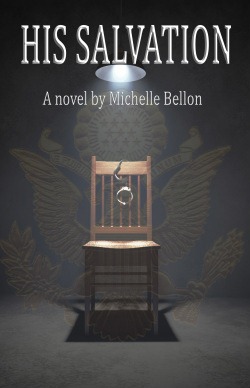 When I go to writing conferences or author events, I find it difficult to resist buying at least some of the books being sold there by the authors in attendance. I picked up Michelle Bellon’s His Salvation at the PNWA Conference in August 2011. I sat next to Michelle at dinner during one of the evening events, and once I make a personal connection with a writer, it’s even harder not to buy a book. I do like to support local authors, whether they be just starting out or well established. One of my hopes of this blog is that perhaps I will discover a fantastic new novel and help to launch the career of a new writer – to get their work and their name out to a wider market. One of my fears – especially with a writer I have met and may meet again in the future – is that there may be some issues with the manuscript that in all fairness to readers of my blog, I cannot overlook. Unfortunately, His Salvation falls in the latter category, and the current edition (dated July 2011) is very difficult to read.
His Salvation is a love story-thriller, set in the world of military psy-ops gone bad. A soldier, Seth McCullough, has been brain-washed into becoming a special-operations covert killer. His brainwashing begins to unravel, and he remembers a happier time during his teenage years, when he was desperately in love with Krista Chancellor. Krista, now a post-graduate student in psychology at a university in Austin, Texas, is the only person he trusts to help figure out what has happened to him, and to break the tight grip his controller has on his mind.
His Salvation was published by Old Line Publishing, which is a relatively new on-line publisher. Looking at the cover art, the formatting of the text and binding on the book, the finished product looks good. Old Line appears to offer numerous author services related to the formatting and the marketing of the book. Unfortunately, what they don’t seem to offer, is editing services. And His Salvation is badly in need of editing help.
I’ve spent a lot of time talking with, and working with my friend, Jason Black, a freelance editor. On his website (www.plottopunctuation.com/services), he describes three types of editing services he can provide as an editor: developmental editing, line editing and copy editing.
Developmental editing comes into play while trying to fix plot issues in a manuscript. Line editing will help to make the words flow better through choosing better words and removing words when they are not needed. Copy editing fixes mechanical issues like punctuation and grammar.
While there are numerous grammar and punctuation issues in His Salvation, and the plot tested my suspension of disbelief more than a few times, what the book really needed was a line edit. It would have caught point-of-view issues, which sometimes changed in the middle of a paragraph. It would have seen issues with word territory. I counted 8 occurrences of the word ‘literally’ in a four page span. Rarely, if ever, should a writer use the word ‘literally’. It would have cut down on the number of adverbs used (sometimes 2 or more per sentence). There were some great examples of misplaced modifiers (adjectives that added nothing or contradicted the image trying to be described). A good editor, like Jason, would have pointed to areas where the narrator was constantly telling the reader things, instead of showing the reader through the actions of the characters. About twenty five of the first thirty five pages were backstory, which, while informative, missed the opportunity to place the characters front and center in the story.
There were numerous other major issues with the book, especially when it came to dialogue, which was, for the most part, both lacking in believability and in volume. The words used by the characters just wouldn’t be said by these characters. They might be thought, but not said aloud. The dialogue felt like narration just wrapped in quotation marks. Dialogue was completely absent from the first thirty six pages, and on page thirty seven, when I got to the first spoken words, I had to put the book down. I almost didn’t pick it up again.
I know it seems like I am being callous and hard on the author. I wrestled with my decision to even review a book like this on my blog. I don’t want to hurt anyone’s feelings. I don’t want people to be mad at me for saying these things. But there are a couple of things at play here that are important for everyone to realize:
1) Self and independent publishing has gotten a bad name because of the lack of professional editing being done on self published works. This is a perfect example of why the reputation is what it is.
2) Authors who self publish in the hopes of attracting an agent or an editor for their next book, are doing themselves a massive disservice by not getting a professional editor, and listening to what they have to say. If there is one lesson that everyone should take away from this, it’s this: an editor is NOT optional. You can’t substitute a family member or a best friend for a professional editor, hope to have them catch your grammar issues, and let Microsoft Word catch your spelling issues. When I read a poorly edited book by an author, I don’t give them a second chance to impress me. An agent won’t either, and you sure as heck won’t attract a mainstream publisher that way.
As an author who has worked for over three years on a manuscript, I know what it is like to pour your heart and soul into a story. I proudly passed around my first draft to friends and family, and got (perhaps) a couple of edits per page back. I felt pretty good back then. Then I got hammered by agents I pitched. I’ve been through ten drafts since, and have pretty much abandoned passing it out to friends and family unless they truly understand the type of feedback I need. I’ve passed the manuscript to Jason for a developmental edit, which helped me to land my agent. But since then, at my agent’s insistence, I have done 3 more major edits, and still have at least 3 more to go. It hasn’t even come close to a publisher’s desk yet.
Going the independent or self publishing route doesn’t mean you don’t have an editor red-mark your work. It means you pay for that service yourself in advance. It doesn’t come out of your publisher’s side of the deal. Self-published authors need to realize this very quickly, or their first reader may be their last. In this day of internet search, it just takes one bad –but honest – review, to torpedo a book, or possibly even a career.
Take the time and spend the money to get your work professionally edited. If you can’t do that, for whatever reason, you probably shouldn’t self-publish. Nothing good comes from taking a shortcut like that.
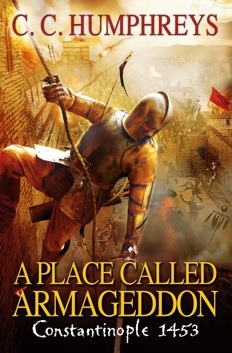 As soon as I saw the cover of CC Humphreys latest book, A Place Called Armageddon, I knew I was going to buy it. I love historical fiction books about famous battles, especially ones set in medieval periods. Just looking at my collection of Bernard Cornwell books about the period will confirm that pretty quickly.
As it happens, I first saw this book whilst I was selling it at a special table in the back of the main ballroom during Day 1 of the PNWA Conference last summer. I had met Chris a couple of times prior to the conference, and talked to him quite a few times while I was behind the desk and wandering about the conference, but somehow getting this copy signed eluded me. Now I really wish I had. This book is spectacular.
In 1453 AD, the Turks, led by Mehmet II arrive outside of the walls of one of the most famous cities in all of history: Constantinople. The city is just a shell of it’s once great self. Much of the population has left. Emperor Constantine, the last emperor of the Byzantine Empire, must pull together small bands of defenders from rival factions – the Greeks, the Genoans, and the Venetians – to save the city from the attacking Muslim legions who outnumber the men on the walls ten to one.
The story follows two brothers, Gregoras and Theon Lascaris as they are dragged forward towards a climactic battle to save the city. Gregoras and Theon have a history that barely allows them to call each other brother. One has been branded a traitor, and holds the other accountable. At the same time, we see Mehmet The Conqueror, one of his closest advisors, Hamza Bey, and a simple farmer, Achmed, as they prepare to attack. All of them are linked together through one woman, a fortune teller who sees greatness before them all, and death close on their heels.
A Place Called Armageddon is not a light read. It’s 459 very dense pages of Literary-Historical-Fiction. The battle, as Humphreys notes in at the end of the book, was huge and would have filled volumes in and of itself. Humphreys placed as many facts in the book as possible, and then wrapped memorable characters and fascinating relationships around the history. Just for history and the plot alone, this book is worth reading.
But if you read the book just for history and plot, you would be missing something – perhaps the best thing about the book. There are good books with hum-drum words and adequate stories. This book is written with prose. Every scene is crafted with an eye for pace, a feel for flow and an ear for rhythm, as if the stage actor in Chris was reading every word on a stage in one of London’s West End Theatres (where he once performed). The words are mesmerizing and beautiful and hand-crafted to be perfect in every syllable. I’ve never bought an audio book in my life, but I would easily buy this one if Chris does the reading.
A Place Called Armageddon is one of the great books of the year. The copy I have is from the UK, and I know it was released in Canada in mid-August 2011. I’m not sure of the US release date. Hopefully it gets the recognition it deserves and is read by a wide and enthusiastic audience around the world. If you like historical fiction and tales of great battles and great bravery, this should be on your must-read list.
So I just passed the two week mark on my recovery from surgery on my right foot. Officially I’m a third of the way through the recovery process. The stitches are out, and I can now ‘heel walk’ which means I can’t put pressure on the front of my foot, which also prevents me from driving any distance.
I’ve been out of the house three times in the past 14 days. Once to get a haircut. Once to go to the dentist. And once to go the the doctor to get the stitches out, followed by a trip in to my office. What can I say? I lead a wild life. Surprisingly, I have not yet gone stir-crazy. I have Twitter to make it feel like I have friends. My wife is also working from home, so I’m not completely alone all day long. And my kids keep me entertained in the early morning and evenings.
I had a very similar surgery on my left foot last spring, so I kind of knew what to expect this time around. This one actually went a lot better than the last time, partially helped by the fact that I didn’t push as hard to get back up and around in the first few days. I basically parked my kiester on the couch for the first 5 days. The indentation is still there.
Last time, while recovering, I barely did any writing at all for the entire six weeks. I felt extremely guilty about that by the time I was recovered, so this time, I vowed to get back to it as soon as my head was clear of pain killers. By the first part of last week, I was getting up early and spending anywhere from 30-55 minutes every morning writing. I’m currently editing my novel ‘Labeled’, so my goal was to edit one chapter a day if there were no major structural changes. I’m now into the chapters that need a complete rewrite, so that’s taking a bit longer, but it is coming along. I’ve set no time goals on this pass. It will take what it takes. If the words aren’t there, I go back a bit and try to figure out why. It’s usually a good indication that the line the plot was taking was off just a bit.
When not writing, I’ve been chewing through my NetFlix queues, which appeases my need to cross things off a list. I have been a bit ruthless to the queue though. If the movie was just so-so, I was able to stop watching pretty quickly. Such was the case with the mini-series ‘The Stand’ which I saw years ago, and always wanted to re-watch. The novel The Stand by Stephen King is one of the most influential books in my writing career. I got a few minutes into the third episode of the mini-series, and just couldn’t watch anymore. Click.
Other than that, I have been working my way through the backlog on my reading shelf, playing a lot of cards with my kids, and while it was on, I watched two rounds of the baseball playoffs (until my Detroit Tigers were ousted rather unceremoniously). My home office also got a rather thorough organizing, which was long overdue. I have played a couple hours of video games, but sitting in front of the computer in the evenings is a lot harder to do when you’ve been parked in front of it working from home all day long.
Now I have four weeks of relative inactivity left, and in that time, I have pretty much the same plan. Keep writing / editing. Read my way through the books on my shelf so that maybe I can pick up my Kindle before Christmas. Reduce down the NetFlix queue some more. Spend more time with my kids. Watch / listen to more Detroit Lions games. Write some short fiction.
Come late November, when I’m finally able to be mobile again, it’ll be time to get back into shape, to do the next edit on ‘Nowhere Wild’, to put up the Christmas lights, and to run all the errands I’ve been putting off. Until then, I’m trying to be ‘productive’, even when that means just sitting around and healing.
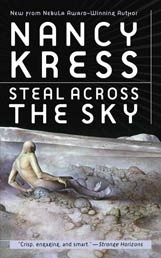 A few months ago at the annual Pacific Northwest Writers Association, I had the great please to meet with Nancy Kress and to moderate a session she gave discussing the differences between commercial and literary science fiction. In anticipation of that, I read and reviewed her Hugo nominated book, Beggars In Spain. While at the conference, I picked up one her more recent novels, Steal Across the Sky.
In Steal Across the Sky, an alien race has been found watching humanity from a hidden base on the moon, and when it is discovered, these ‘Atoners’ announce they need to atone for a crime committed against the world. Except for the cryptic communications the world receives, no one has ever laid eyes upon them. The Atoners won’t admit to what the crime is, and the only way they will, is to send small groups of untrained ‘witnesses’ out to other star systems to show them what they have done. These Witnesses must survive on these extra-terrestrial worlds long enough to bring home the details of what the aliens have done, and even then, no one may believe them.
It seems like it’s been quite a while since I’ve read hard core, non-YA, non-commercial, science fiction. The last one was probably Beggars in Spain. In fact, before sitting in on Kress’ presentation at the PNWA, I hadn’t really thought about there even being a difference between commercial and literary science fiction. Commercial sci-fi has a faster pace, with plenty of action and is usually plot driven. Literary sci-fi generally revolves more around an idea or a concept, or has a statement to make, and reads a little more slowly as the sentence structures are more dense, and the reader is forced to think a little more. In both Beggars and Steal Across the Sky, it is hard to miss the message Kress is trying to get across. In Beggars, Kress took issue with Libertarians. In Steal Across the Sky, religion and God is the target, more specifically, the Christian Evangelicals and the Christian God (at least in my opinion). In doing so, Kress makes the reader think about the consequences of knowing whether or not there is an afterlife, and whether or not that knowledge would somehow change the behaviors of people on Earth.
I enjoyed this book, but it is a more difficult read than I have recently grown accustomed. The book is divided into parts in such a way that it appears to be distinct novellas. It took a while, and a little faith, to realize that the parts would eventually come together. I had a bit of a hard time liking any of the characters, perhaps because they all seemed to be pretty weak, not the strong leads commercial sci-fi tends to drop onto the page so routinely.
For hardcore, literary science fiction aficionados, Steal Across the Sky should be required reading. For those more use to commercial or YA sci-fi, it’s a little more difficult to read. It’s not something to read when you want something light and fluffy or packed full of action (though there is some). If you fall somewhere in the middle, pick it up. At the very least, it will make you think, and that’s what good, literary sci-fi is supposed to do.
 Last month, I attended an event held by the Sumner, Washington Arts Commission for local authors. For four hours, we listened to authors talk about their books, their inspiration and the state of publishing. One of the writers on the panel was Kimberly Derting, author of The Body Finder, a Young Adult Paranormal-Romance-Mystery, and the first in a series by the same name.
Violet Ambrose is your normal sixteen year old high school student. At least outwardly, everything is normal. She’s got all the pressures of being a modern day teenager: parents, school, and the problems that come with having her best friend be the boy she now has a huge crush on.
But Violet also has a gift – she can sense the bodies of people who have not died of natural causes, and can sense the murderers who killed them. When girls in her Western Washington home town begin going missing, Violet realizes that she may be uniquely qualified to find the killer. But this gift comes at a price, and for Violet, the cost may be everything she has.
When I stumble across a book written by someone local, it’s sometimes quite surprising to find out that good writers live so close to home. I mean, I’ve somehow got the idea in my head that writers always live somewhere else – somewhere more dramatic like New York or Martha’s Vineyard or Malibu. As I’ve met more and more writers from the Pacific Northwest, my expectations are slowly changing. There are a lot of very good writers very close to home, and Kimberly Derting is definitely one of them. It’s also very cool to read a story set in an area where you know the street names.
The Body Finder is well written, and quite a page turner. I read it in just a couple of days, and though I am not the target audience (YA Girls in the 13-17 year old range), I do appreciate a good story when I read it. My wife really liked it too, so it definitely resonates with the (slightly) older female crowd who remembers what it was like to be a girl in high school. It does, at times, get caught up in the melodrama and cliché teenage angst of homecoming dances and petty relationship rivalries, something that perhaps I don’t appreciate quite as much as the target audience might. The writing style is consistent throughout the book, but it does feel a bit like a first novel, and I’m betting that the second in the series will be a little tighter. I know I learn a lot from every book that I write, and I’m guessing that there are a few things in The Body Finder that Derting would fix given the experience of now having written three other books.
Having said that, I would definitely recommend this book to anyone who frequently reads the YA Paranormal / Romance / Mystery category. I’m actually looking forward to picking up the next in the series when time permits, and reading more about the area in which I live.
Yes, I am just sitting around these days, doing pretty much nothing but working through my Netflix queue and my bookshelf. I had the second of two surgeries for the year last week, and as required by my doctors, I’ve been keeping my foot elevated, and staying off it as much as possible. I’m off the pain killers now, so that’s a good thing. Hope to be back to writing/editing tomorrow or Monday at the latest.
I learned last time I had surgery that pushing it too early was both bad for my body and my writing, so I’m doing everything I can to stay sane until I can sit for more than 15 minutes with my foot down without feeling like someone has tied an anvil to my arch.
So anyway, I’ll see you in a couple more days with a book review or two. Till then, Happy Thanksgiving to my Canadian friends and relatives, and Happy Columbus Day to my American compatriots.
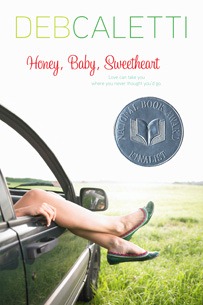
One of the books I bought at this year’s PNWA Conference, was Deb Caletti’s Honey, Baby, Sweetheart. I met Deb Caletti there, and had a wonderful talk with her and her husband. Honey, Baby, Sweetheart was a National Book Award Finalist.
I’ll be the first to admit that this is not a book in the genre I typically read. It is Young Adult, but it’s more about emotion than about action. Ruby McQueen is a sixteen year old girl living in the fictional town of Nine Mile Falls, Washington, just across Lake Washington from Seattle. Ruby is the responsible daughter of a woman who was dumped by her musician husband years before. Ruby tries to hold the family together by being the one who makes all the smart decisions, but as summer begins, she meets Travis Becker, a rich boy with a wild streak that pulls her out of her comfort zone. That isn’t always a good thing.
In an effort to distract Ruby from her problems, Ruby’s mother bring her to her book club, where meets an eclectic gang of older readers. One of those readers has a history that leads Ruby, and the book club, into a road trip that will change them all.
Like I said, this isn’t a book I would normally read (because I’m a guy who likes SciFi and lasers), but I did enjoy it. Caletti’s style is one of noticing things – the little things. Her description isn’t flowery. It’s detailed and appropriate for the story and for the characters. You’d expect a girl who is as introspective as Ruby is to notice these little details, and to spend a great amount of time considering them. What I find a little funny, is that with this type of story, those are all good things. In the genre I write, these little things are the ones I have to edit out, because they slow down the action in YA intended for the teenage boy crowd. It just goes to show you that even within the YA Genre, there are intricacies of writing that involve knowing your audience, and knowing what is needed to keep their attention.
This is one of those books that even though I am not in the target audience, I can appreciate the writing style because of what it accomplishes. Caletti is an artist with description and emotion. I’d highly recommend this book to those who regularly read the YA Romance genre, or for anyone who wants to see how to do these little things right. My wife really liked this book, and has already read more of Deb Caletti’s books. I think that’s a pretty good sign.
Officially, I’m not writing anything right now. As in, I have no new novel in the works, nor am I working page-by-page through an edit of an existing novel. A couple of weeks ago I finished a pass through one of my books and sent it out to the first of my reviewers. It’ll make it’s rounds through my circle of editors, then come back to me, and I will do at least two more polishing edits. That will probably start sometime in late October.
What I have really been working on is re-plotting part of the novel I wrote last spring called Labeled. When I was writing it, I knew there was something amiss in one of the core scenes – I took my main character out of the room during the pivotal moment in the book. That just can’t happen. Unfortunately, a large portion of the rest of the book was predicated on him not being in the room, so it’s not just a matter of sticking him back in the room and leaving the rest alone.
Two weeks ago I went through, chapter by chapter, and recorded all of the plot points in each chapter. Last week – after making a backup of the original file – I went through and plotted out changes to the novel. The point form outline for the next version is 12 pages long, which is, I believe, the most detail I’ve ever had in a plan for a book. Now, a lot of that content is notes from the original version. But still, with that kind of detail, I hope I have thought of all the changes I need to make. I’m going to let those changes percolate for a bit, and then review them with a few trusted advisors, before I start begin the rewrite.
But I can’t just sit around and not write, so instead I’m going to work on some more short fiction. Writing the new outline for Labeled reminded me that I have a sequel planned for it. But that sequel happens quite a time after the original. During that time, a lot of the minor characters will have things happen to them. This will be back story in the sequel, but will be great stories to tell in a much shorter form. This may even help me to improve the first book as I edit, since more details of the minor characters will come out. I’d like to take credit for this idea, but my writing partner Ben Newland put the thought into my head. I’ll blame him if it all goes wrong.
So anyway, things seem slow right now, but there’s a method to my madness. Hopefully that madness results in a big payoff by the end of the year.

I don’t read much middle grade fiction anymore. I read Gregor The Overlander by Susan Collins last year, and Lost in the Barrens by Farley Mowat, Middle grade fiction is a hard read for an adult. Young Adult Fiction these days is basically a book written for adults, but with teenage protagonists. I’m probably over-simplifying that a bit, but not a lot.
Middle grade fiction is a different beast altogether. The reading skills of the reader are generally lower. Their attentions spans (especially boys) are much shorter. The plot has to be more simple, and the characters fewer and easy to remember. I loved middle grade fictions when I was growing up, but once I graduated from that level of reading to more adult books, it was really hard to go back, because most middle grade books seemed so shallow when it came to emotions and plot.
Bread for the Pharaoh by Jerome Asher (aka Jason Black) is a middle grade novel set in on the Giza Plateau in Egypt during the reign of Pharaoh Kafre, sometime around 2550 BC. San is the son of Nasu, a baker who supplies bread for one of the Pharaoh’s Temples, and for the workers who are carving the great statue of the Sphinx. On a trip to the temple with his daily supply of bread, San meets Aja, the daughter of the High Priest. San and Aja strike up a friendship that is banned by her father because San and Aja are from different classes. Aja is a noble. San is just a peasant. But San and Aja continue to sneak around to enjoy each other’s company, and in doing so, stumble into a plot that not only endangers them, but their families as well.
In the interest of full disclosure, I should say that I know Jason Black pretty well. We’re actually in a writing critique group together, and I was a little nervous about reading this book because I do these reviews. What if I didn’t like it? It was written before I ever knew Jason, and long before we created our critique group, so I had no idea what the writing would be like.
Fortunately, the book is quite good. It does start a little bit slow for middle grade fiction, showing all the work San’s father Nasu must do to make the bread every day. San, the main character, doesn’t appear until page 3, which threw me for a bit, because the point of view had to shift from Nasu to San. But once past that point, the book picked up speed. San and Aja are constantly climbing on things to get away from pursuit or to sneak out to their forbidden meetings. They’re just kids, and that is clear, but the story puts them into the position of needing to act – of having no choice to turn it over to the authorities because the authorities either cannot be trusted or would not believe them. When I was a kid, and I came up with my fantasies of being a hero and saving the day, these were always key components. Kids want to believe that kids have the power to save the day when the adults are not there or won’t listen. Come to think of it, that’s the same theme JK Rowling used so well to put Harry Potter in danger so frequently.
Through the last half of the book, I had a hard time putting it down and would definitely recommend it to any family / friends with boys or girls in the 8-12 year old range. My 4 year old daughter actually sat next to me while I was reading it, and I read some of it to her, and she didn’t want me to stop. But my voice gave out, so she’ll have to read it to herself when she gets a little older.
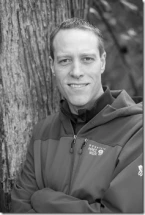

 Joe Beernink