
On the list of the top five books that have been on my Reading List the longest, High Fidelity by Nick Hornby was number one. The next one wasn’t even close. My wife, Lisa, gave this one to me to read after she was done with it, and I brought it on a trip we took to Palm Springs. This trip took place back in February of 2004. This was before we were even engaged, let alone married. I read about 60 pages of it, but didn’t finish it before the trip was done, and for whatever reason, it sat and sat on my shelf, unread for over 7 years before I finally picked it up again.
This is not to say that it is a bad book. It isn’t. It’s a pretty darn good book. But you have to be in the mood to read it, and if you’re a book-thinker (or a book-over thinker), like I am, you have to make sure you’re not at that point in your life where reading a book about a man having early-mid-life crisis is going to seriously screw up your perspective on the world. Back in the spring of 2004 I had been dating Lisa for just over a year. Things were going well, and I was debating popping the question. That was not the time to read this book.
You see, the main character is a man named Rob, who lives in London in the mid-90’s, and runs a small record shop. He’s a bit of a dead-ender. Not really going anywhere in his life, and always looking for a way to not get anywhere else. He’s had a few serious relationships in his life, but the most recent one, with his relatively long-term girlfriend has just ended when she left him for another guy. This leads him to question the end of every relationship he’s ever had, all the way from grade school to present day. He set out to try to track down these old flames, to see why they always left him. A small spoiler, it wasn’t always ‘them’.
The book is really well written, full of engaging minor characters like Barry and Dick, the two half-men-half-boy hangers-on that work at the record shop, and Liz, Laura’s best friend who acts as a go between for Rob and Laura. Rob goes off on long, frequent, soliloquys about how a person’s life can be measured by the music they own. The dialog is funny and snappy, and very well done.
I’d actually seen the movie version of High Fidelity starring John Cusak as Rob, Jack Black as Barry, and Joan Cusak as Liz, long before I read the book, so I remembered the basic plot. The movie (though Americanized) holds pretty close to the book, and it’s almost impossible for my to see those characters as anyone else but Cusak, Black and Cusak. The casting was spot-on perfect, and really did justice to the characters. I’ve added the book back to my NetFlix queue to watch again now that I’ve read the book.
It completely wasn’t fair of me to leave this book on the shelf for so long. But at least waiting this long ensured that I didn’t book-think my life too much and come out worse for it. It’s a good book, and well worth the read.

Tom Kowalski died today. I didn’t know the man. Not personally, anyway. But news of his death this morning stunned me and I had to fight back tears while sitting in front of my work computer.
Tom was the Detroit Lions beat writer for Booth Newspapers and MLive.com. During the football season, and during the never-ending football off-season, Tom covered the Lions like no one else. He was the elder statesman in the press room, having been in and out of the NFL locker rooms since 1982. He wrote about everything to do with the Lions, from front office moves and politics, to play-by-play analysis of pre-season games and individual practices. For the fans who follow the Lions, no one else even came close to the volume of information Kowalski delivered on a day to day basis, and even then, the fans wanted more.
Kowalski understood the power of the internet and social media, and bonded with Lions fans like me on live chats, Twitter and in the comments of every article he wrote for MLive. I live all the way across the country, and yet Tom kept my attention. During the long, horrible years where most Lions fans wanted to wear bags over our heads, or bail on the team entirely, Kowalski gave us insight and a little hope that someday, the fate of our team would improve. And if it didn’t look like it was going to get any better, he said that too, to temper our disappointment on game day. MLive is the first site I go to every day, and it’s because of Tom Kowalski’s writing. He was the 8th person I ever followed on Twitter.
Yesterday afternoon, I sent Tom a tweet regarding the previous night’s Lion’s game:
“Cunningham concerned about teams running screens to combat upfield push? Looked vulnerable”
He replied back a few minutes later with:
“{} It’s great way to slow down rush” (http://bit.ly/o0k433)
I was on the road at that point, and didn’t have time to follow it up until I got home. I sent back a reply at 6:57 PM (Pacific). His very last tweet was at 6:58 PM (Pacific), one minute later. In signing off for the night, in typical Kowalski humor, he said:
“OK fellas, here we go … Sleep well, I’ll most likely kill you in the morning …”
I have no idea if Tom ever read my tweet, and it doesn’t really matter, not in the grand scheme of things. But something about the timing of those tweets made a lump in my throat that would just not go away, and even now, as I write this, some 12 hours after I found out he was gone, there are tears in my eyes.
I will miss his writing and his tweets and his stories and his insight, and I know there is a hole in my heart today that is bleeding Honolulu Blue.
Tom Kowalski was 51.
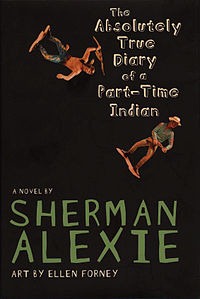 I should just cut this review short, and tell you to drop everything you are doing, and go out and buy The Absolutely True Diary of a Part-Time Indian by Sherman Alexie, right now. Seriously. Put down your coffee, go to you favorite bricks-and-mortar book retailer or on-line e-reader supplier, and get this book.
Quite simply, this is one of the best Young Adult books I have ever read.
I’m not the only one who thinks this book is good. It won a National Book Award, along with a couple of dozen other awards and acclimations.
The story is told from the point of view of Arnold Spirit, Jr., an American Indian growing up on the Spokane Indian Reservation in Eastern Washington. Junior, as he is called, doesn’t mince words. He’s had a hard life, and doesn’t have time to paint a rosy picture of life on the reservation. His father is an alcoholic. His best friend has anger issues. And Junior was born with a myriad of physical issues in and around his abnormally large head. Life is not easy for any boy on the reservation, and damn near impossible for a boy in Junior’s condition.
Junior, however, gets some sage advice from a very unexpected source. Get out. Leave the reservation. Do it while he still can. He’s smart, and he could do so much better, but only if he leaves his friend and his family behind and takes a long, daily trip to a very good school off the reservation. The trip splits Junior between two worlds: the racist world of the whites in the school, and the bitter world of the reservation which treats him as a traitor to his people.
It’s an amazing story. It pulls no punches, and is told with such brutal honesty in covering everything from alcoholism to masturbation to sex to drugs to racism, that it was briefly banned by the Richland, Washington School Board. Some parents expressed concern that such a book should not be read by their children.
What’s ironic about this type of attitude towards this book is that the one word that kept coming to mind as I read this book was ‘tolerance’. Tolerance of other races, of other people’s religious beliefs and circumstances, and their backgrounds. It made me question a lot of what I think, and especially what I fear. To have a book that took less than three hours to read have such a profound impact is remarkable.
This is one of those books that changes everything. Perhaps not in my life, but in my appreciation of what a good book can, and should, be. It’s one of those that I look at, and think “I could never write like that.” It can take the wind of a writer’s sails, reading something this good. I can only compare it to the feeling I had the day I saw Saving Private Ryan for the first time. I didn’t watch another movie for weeks after that one. What was the point? Saving Private Ryan had been profound and perfect.
Writing, after reading this book, will be hard. I’m a little afraid of going up against books like this when my books are published. How do you compete with this? My answer is that I don’t. People don’t stop reading because they’ve read a great book. People read more because they’ve read a great book, and perhaps I can ride Sherman’ Alexies’ coat-tails to just a little bit of fame and fortune. I can’t imitate his work, and I wouldn’t want to. But I sure can appreciate it.
Go out. Get this book. Read it. Let your teenagers read it. You’ll be glad you did.
Joe’s Note 2/16/2012: I know this is odd, but someone in Saint Paul, MN visits this post multiple times per day. I’m glad they like it, but would love to know why they come back so often. Anyone? Are people being redirected here from an external site? My curiousity is killing me.
I have always loved science fiction books that cover outer space firsts. First colony on Mars. First colony on another planet. First alien encounter. First alien war.
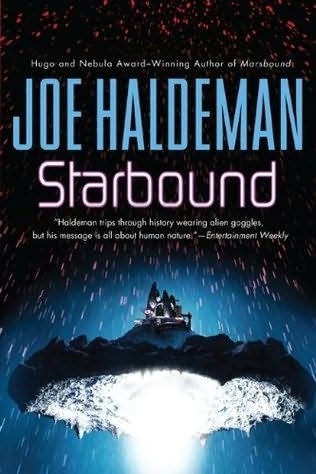
A while ago I read Marsbound by Joe Haldeman. It must have been at least a year and a bit ago, since I couldn’t find a review of it on my site, and my OCD no longer lets me read a book without reviewing it, or at least mentioning it. Marsbound is the first in this series, and describes a world on the brink of first colonization of Mars. The hard work has been done, and now the more casual colonists are arriving to begin their life there. Of course something goes horribly wrong, and that kicks off a whole series of events, including the near destruction of every living thing on Earth. Which brings us to the second book: Starbound.
The beings responsible for the near destruction of earth are still out there, and now humans must try to find a way to communicate with them, before the ‘Others’ find out their little plan didn’t quite work, and come back to finish the job. Of course, with a being that is so powerful it can sneeze and wipe out a planet, you can’t exactly threaten them, so the approach has to be a little more subtle.
There’s some good science fiction in this book, interesting and fresh concepts. Let’s face it, it’s hard to be truly original in these types of stories. I’m not the most widely read science fiction aficionado, but the world Haldeman creates definitely felt original.
The book was a quick read, and I liked it. I just didn’t like it as much as Marsbound. The story is told from three different first person points of view, and the reader is forced to figure out who is speaking based on who they are talking to in the room. i.e. you have to narrow it down by the process of eliminating who they are talking to. Sometimes this takes a page or to, and I found it distracting. Luckily, one of the viewpoints was a little bit more distinctive (being an alien). Quite a few times I had to go back a page or two to figure out who was talking. I’m not a big fan of making the reader do that much work.
Start with Marsbound. You’ll like that one. Read this one if you’re a big fan of Haldeman. Otherwise, I’d give this one a bit of a ‘Meh’ rating. It could have been better.
 I first met Nathan Everett at the 2009 PNWA Convention, at the same time I met Jason Black. Nathan and Jason were in the process of getting their publishing company, Long Tale Press off the ground, and I was a new author trying to figure out this whole writing business. I can remember a few conversations Nathan, Jason and I had by the windows outside the main ballroom at the Sea-Tac Hilton. I didn’t quite know what they were trying to do, nor did I get to know them very well.
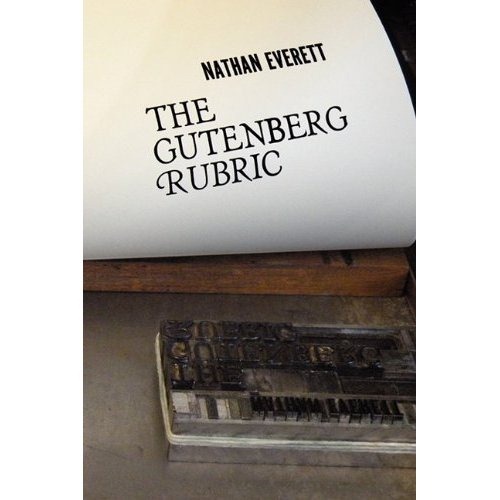
I probably met Nathan a few more times at PNWA events in the following months, but it wasn’t until Nathan got up in front of a crowd of people at the Barnes and Noble in Bellevue in June of 2010 that I heard anything about his book, The Gutenberg Rubric. The session that day was being given by Janna Cawrse Esarey and was focused on creating great pitches to give to agents at the next month’s conference.
Nathan got up, gave his pitch, and knocked our socks off. When he threw the words biblio-terrorist out to the crowd, he had everyone’s attention. He then went on to win second place in the 2010 PNWA Literary Contest in the Mystery / Thriller category.
The Gutenberg Rubric is a fast paced novel about a secret project created by Johannes Gutenberg, the man who revolutionized the book publishing world when he invented mechanical, movable type. This secret project, hidden for some 600 years, is part myth, part mystery and part magic. When professor Keith Drucker and his new love Madeline Zayne become unwitting pawns in a conspiracy to uncover the secret, they must stay one step ahead of those who are chasing them, and must test themselves to see if they are worthy of learning the secret Gutenberg never meant anyone to know.
If you liked Dan Brown’s The Da Vinci Code, you will like this one. Nathan is clearly a man who is very passionate about books and printing. I suspect that this book, due to it’s topic, was a labor of tremendous love for Nathan, and that the history presented in this book is likely to be text book quality. It’s provided as backstory when appropriate, and is quite fascinating. Not only was I thoroughly engaged while reading it, I know I learned something as well. The main characters are likable, the pace is fast, and the places exotic and very well described.
It’s really cool to see a book of this quality out there by someone I know. Nathan is currently getting ready to tour the US to promote this book, and I wish him all the best, and hope this one gets all the press it deserves. If you want to know more about the book, or to find out where he is going to be on his tour to meet him, check out his site at www.gutenbergrubric.com.
I’m right here. No, really. I am. I haven’t really gone anywhere. I’ve been here the whole time. I just couldn’t write. Why is that? Well…
I’ve been working on a pro-bono software development project for the PNWA, prototyping a system to eliminate those long lineups at the PNWA conference for Agent / Editor and Pitch doctor sign ups. Work on it has gone pretty well, and I’ll be documenting the project on my technical blog very soon. If you are a PNWA Member (or related to one) and a .NET developer, and want to contribute to the effort of building the conference management system, let me know. There’s lots still to do.
Working on that system did suck up all of my spare time over the last two weeks, and I am way behind on my blogging. Don’t worry, I’ve got a ton of book reviews to do, and they should be coming out soon.
Yes, I’ve had time to read, but not write. Why is that? Because I dislocated my left shoulder last Wednesday, and typing one handed on anything but software code is extremely hard. I started rehabbing it on Sunday, and I just got in from my daily workout. The shoulder is wrapped in ice now, and out of the sling, so I can actually get back to this writing thing. How did I dislocate it? You wouldn’t believe me if I told you. Unless you really knew me. Then you would totally believe it.
What’s that? Yes, I was supposed to have surgery last week on my foot. That’s now been put off until October. I’ll get just enough time to recover from my shoulder, and then I get to be laid up with my foot for another six weeks. My wife is very understanding tolerant.
As planned, I haven’t been working on any books this summer, but I have a lot of work to do, starting as soon as I get caught up on my blogging. And I have two writing deadlines coming up very quickly that I have to hit as well. That’s not procrastination. It’s prioritization. Come September, it’s back to the grind on the books. Another edit. More polishing. Back to my writers groups. Back at it, in a big way.
So anyway, if you have missed me, I apologize (and yippee! Someone besides my mom is reading this!) Barring another tragic accident, the content here should be fairly regular for the next few weeks. Stay tuned.
Normally, I won’t get too political on this blog. I do have opinions, but I can’t see how airing them here is going to positively impact my career as a writer. There are writers who are very active in their political commentary on blogs, and that works for them because they are already doing quite well. They are willing to put up with all the tom-foolery that happens when an honest political discussion goes bad. But even they get tired of the hijinks from time to time. Read John Scalzi’s take on how he wields his mallet of loving correction. Managing a blog with active discussions is a lot of work, and it gets a little discouraging, even for him.
This post, however, isn’t about politics. It’s about citizenship. Last week, for the first time in fifteen years, I voted. That sounds horrible, but it’s really not that bad. You see, until earlier this year, I was not a US Citizen; I was a permanent resident. It takes a lot of years and a lot of paperwork to obtain permanent residence, and then you have to wait a few more years before you can become a citizen. Before this, I was (and still am to some degree) Canadian. But I hadn’t voted in Canadian elections since the early 1990’s. The first few years was laziness and general apathy towards the Canadian political system. Then, once I became more interested in voting, I didn’t want to vote in an election for a country I no longer called home. It would be unfair of me to not have to live with the consequences of my vote.
For a long time, I waffled between becoming a US Citizen or remaining a permanent resident. I came from a country where I wasn’t persecuted or unfairly treated. I wasn’t fleeing environmental catastrophe or war. I’m proud of Canada and it’s history. I came for work, and I stayed for my career, and then I got married. I’m also not that big on patriotism for patriotism’s sake. Wrapping yourself in a flag of any nation is an easy way to let mob mentality take over your common sense. As Bruce Springsteen once said, “Blind faith in anything will get you killed.”
While I wasn’t voting, I also understood that because I was not active in the governing process, I had no right to comment on the politics of where I was living, nor would it be very gracious of me as a guest. Sure there were things that incensed me, and things that made me want to cry. I vented from time to time within my own close set of family, friends and co-workers, but I rarely tried to influence people’s votes. It wasn’t my place. I paid my taxes and grumbled, but I wasn’t active in the process of making sure they were spent where and how I wanted them to be spent.
But over the last few years, it has gotten more and more difficult to stand on the outside of the process and to not have my voice heard. My children will have to live with the decisions being made by our leaders today, and to stand idly by and to not at least vote, went from being comfortable to unconscionable. It was that thought, as much as any other, that convinced me to file for citizenship early this year. I was sworn in a couple of months ago.
Last week I voted.
It wasn’t a very major election: 1 city council position, 1 fire commissioner position, and a renewal of a tax to fund EMS service in our area. I read through the voter pamphlet, and read through the instructions on the ballot, filled in my answers and sent in the completed ballot. It all took about 45 minutes of my time, if not less.
Is voting all a citizen has to do? No. There are rallies to attend. Letters that should be written to stay active in the process, even outside of the never-ending election cycle. Citizenship is a privilege and a responsibility. It’s work, and it’s not always easy.
Voting is the first step in citizenship, and it’s one I am now proud to be able to do.

A little disclaimer before I get started here: I met Nancy Kress for the first time last weekend at the PNWA Conference, and moderated a session she gave called ‘Writing Successful Science Fiction and Fantasy’. I read this book as part of my prep for the conference. Nancy is a wonderful person to talk to, and gave a fantastic seminar. But I don’t think this fact changes my review at all.
Kress originally wrote Beggars in Spain as a novella in 1991. They say it was pretty good in novella form. It won the Hugo and the Nebula awards that year. Not bad at all. In 1993 she released an extended version as a 3 book series. The first (this book) was also nominated for the Hugo and the Nebula for novels (but did not win).
I had heard of Beggars in Spain long before I knew I was going to moderate a session with Nancy. In fact, I’d had Beggars in Spain on my Amazon Wish List for quite a while. I think I saw it recommended on a tech blog I used to read. You know when the nerds like a book, it’s probably pretty good science fiction.
In the not so distant future, prospective parents are able to tailor their children’s genetic traits through invitro-fertilization so they can be more beautiful or more athletic or more healthy. But one man decides his children will be better off if they never have to sleep. The advantages of never being tired, and never having to sleep, are endless. The children learn faster, they can train faster and they soon out-distance their peers. But differences like this are noticed, and like many differences, they are feared. The Sleepless, as they are called, are discriminated against because they are more than human. And that creates all sorts of political, economic and sociological issues, for both the Sleepless and the Sleepers.
The story is quite good, though I found I really didn’t like many of the characters. There were few that were written to be likeable on either side of the conflict, which was a little disconcerting at times, but perhaps a little more realistic than the typical hero versus monster storyline. I often felt sorry for the characters, but there were few I would have liked to hang out with.
There is definitely parallel between the factions in the story and modern day events in the USA. I pointed this out to Nancy when I was talking with her, and I had to laugh because who I thought she had predicted, wasn’t who she was taking a shot at. I don’t want to spoil it for everyone, so I won’t go any further, but if you want know, feel free to ask, after you’ve read the book.
I’ve often wanted to write and to put a solid theme behind the story as Kress does in Beggars. I haven’t yet been able to pull it off. That kind of writing takes things to a new level for me. I may unintentionally do it from time to time, but my intentional efforts seem far too contrived. It’s definitely a goal of mine, though.
Overall, Beggars in Spain is an excellent book, and I will definitely be reading more of Kress’ work.
I first attended the PNWA Conference in 2009. When I walked into the foyer of the conference center, I was as nervous as a cat in a room full of rocking chairs. It was a wondrous place, filled with authors and agents (who made me even more nervous). Every mechanism for improving my craft was new to me. I sat in the sessions and soaked up every concept, and didn’t even wait for the conference to end before I began to put the lessons into practice. By the end of the second day, I was sitting in an empty conference room editing my manuscript.
Last year, I calmed my nerves a bit, did a little bit of volunteering, and caught all the sessions I could. I focused more on the business of writing, and on networking with my fellow writers.
This year, I spent the entire conference volunteering. My official title was Event Liaison for the Pitch Doctor, which were fancy words that meant that in the weeks leading up to the conference, I made sure I had the volunteers who would work the Pitch Doctor desk signed up and organized. During the conference, I just had to make sure they had what they needed to ensure the sessions went smoothly. It was probably the easiest gig there was for the conference.
I also moderated two sessions (which both went wonderfully, I think). I helped a bit with the Speed Pitching, worked the registration desk, and tried to be where ever an extra hand was needed. The hours were long, and by Sunday morning, I could feel aches in every muscle fiber in my body. It was worth every ache.
I had a fantastic time. Volunteering at a conference isn’t for everyone, but it is a tremendous opportunity that I highly recommend to those who have been to the conference a couple of times, and want to find a way to get even more out of it. There are a few organized benefits for the event liaisons, and those are great. But there are also benefits that just happen because you are going above and beyond just attending the conference.
- You get to help solve problems. If you can help someone, and they go back to what they were doing while smiling, it is truly rewarding.
- You get to talk to everyone. Attendees, editors, speakers, agents, other volunteers. There is no greater single way to network at a writer’s conference than to be an active volunteer. As an attendee, you can do this too, but as a volunteer, it’s a lot easier to step out of your shell.
- The relationships you build while volunteering are much stronger than the ones you build while attending. I met a lot of people that first year when I was attending, but when I became a volunteer, I found my first real writing group, and coming out of this conference I’ve pulled in two very talented writers into the group. We all know were are serious about improving our skills because we see the level of commitment each of us has to our writing. We all know that writing is not just a passion, it’s a business, and we all want to succeed.
I’d be remiss if I didn’t mention just how much fun it was to be behind the scenes this year. Kelli Liddane and Anne Belen and Andrew Stoute keep everything going, and I was privileged to spend so much time with them last weekend. Rare was the minute where we weren’t laughing about something back behind that long desk. The other event liaisons and I were just cogs on the gears. These three kept the whole conference going and they never stopped moving, even when I no longer could.
I also spent a great deal of time talking to my agent, Sally Harding, about my book, and about my progression as a writer. Those of us who work with Sally knows she demands perfection, and she knows when we have more we can put into our work. I’ve got some more editing to do over the next few months, but I’m good with that. I want the book to be great, not good, and she won’t accept anything less.
I also bought a stack of books at the event book store, including:
- Steal Across the Sky – Nancy Kress (Autographed)
- His Salvation – Michelle Bellon (Autographed)
- Motor Bikes and Murder – A.C. Christensen (Autographed)
- Honey, Baby, Sweetheart – Deb Caletti (Autographed)
- The Guttenberg Rubric – Nathan Everett (Autographed)
- Guerilla Marketing for Writers – Levinson, Frisman, Larsen and Hancock
- Bread for the Pharaoh – Jerome Asher
- A Place Called Armageddon – CC Humphries (Should have been autographed, but I never had it with me when I was talking to Chris)
They’ve all been added to my reading list. I now have enough books to get me through to Christmas, I think.
It’s hard to say there was a single highlight to the weekend, but I know I will never forget the ‘wrap party’ in the Hospitality Suite for the agents and editors, finalists and staff on Saturday night. I talked baseball on the balcony with agent Minju Chang (a huge San Francisco Giants Fan), talked about writing and food with Sally, and then had a very wonderful chat with Deb Caletti’s husband, John, about life, writing, fame and fortune. Talking with Deb and John was like talking with old, new friends, and I really hope to get to meet them again in the future.
Sure there were things that could have gone better. I think I had the worst bed in the world in my hotel room, and barely slept, even when I was exhausted. The line ups for changing Agent and Editor appointments were horrendously long (something we’re going to try to fix next year). The buffet lines were a little slow as well. But I rarely saw anyone truly upset, and when that did happen, we all tried to find a way to fix the issue to make sure everyone got as much as they needed /wanted to from the conference.
If you were there, and have any suggestions or comments, please fill out the conference surveys sent out yesterday. They are vitally important for providing feedback to the board. If you want to be added to a list of volunteers for next year, let them know that too.
I’m hoping you enjoyed the conference, and I’m already looking forward to next year!
Just back from the PNWA Conference, and I’m exhausted. Hopefully I’ll have time to do a write-up this week. But for now, I’ll post a link to Karlene Petitt’s blog, where she has post a snapshot from early Friday morning, and does a nice little write-up. Enjoy!
I’ll keep my eye out for other links and list some of those as I find them as well.


 Joe Beernink