I finished the import of the blog entries from my old blog today, and completed categorizing them. All of them are in the category “Cranium Outpost Import” (which you can see on the right-hand sidebar of this site), though they may be included in many other categories as well. By and large, most of them are about my family and cover the time where my wife and I were preparing for the birth of our twins, and through the first few years of their lives.
You’ll notice a pretty distinct difference between those blog entries, and the ones I create now. Back then, I was blogging mainly for my friends and family, and the entries are usually quite personal. They are also very likely to cover many different topics in a single entry, so it is hard to classify them just as “Book Reviews” or “Family”. There’s a little of everything in each entry. As blogging has changed from a communication tool for my family, to a more professional component of my writing platform, I learned that each blog entry should be a single topic. I highly recommend to new bloggers that you refrain from massive mind-dump entries, and use smaller, more targeted (and more frequent) entries. Of course, during those first few months with twins, you take time when you get it and write until the kids wake up. Learning how to schedule a post for publication is an essential skill for those of us who write in spurts.
As I said previously, I originally wasn’t going to include these entries in this site. The writing and the message aren’t in sync with what I am doing now. On CraniumOutpost, when I did stray from family updates, my opinion pieces were more rants than op-eds. The writing wasn’t very good or consistent, and as I read back through some of them this weekend, I had difficu1lty remembering exactly where I was emotionally when I wrote them. Still, they make for interesting reading in terms of showing my development as a blogger, a writer, and a father, and I wanted everything under one roof.
So feel free to tour back through the archives, all the way back to that first entry entitled “A New Beginning” where I first launched my blogging career on November 13, 2006. Some of the blogs are irrelevant now, but some are still worth reading. Let me know if you find anything broken, or anything that you want to know more about.
Last week, I got an email from a reader of my blog, asking if I would be interested in ghostwriting his memoirs. I had to read the message twice. Actually, I probably read it a dozen times before I responded. And I sat with it there in my inbox for most of the day before I typed up a reply.
Life has a funny way of throwing you a curve-ball when you least expect it, but what was really odd about this one was that I was in the middle of reading John Scalzi’s book on writing in which he stresses the importance for writers to have multiple income streams. I am not now, nor likely in the near future, in the position to be a full-time writer. Writing is a hobby into which I am very, very invested. I call it my second job – a job that pays quite poorly. Pretty-much nothing right now. In the mid 80’s I did get a $14 check for a letter I wrote to Model Railroader magazine. The check was pink. But since then, not a dime.
I’ve written a ton of fiction in the last few years, but writing a memoir is not at all like writing fiction or even writing blog entries. There’s a certain standard of honesty in a a nonfiction book that fiction writers get to completely ignore and bloggers just aren’t held to. Nonfiction requires research and quotes and liability and becoming an expert on something. When this opportunity came into my inbox, and I thought about writing a memoir, I pictured someone poring over it, examining every adjective, and questioning whether the subject really did feel morose on April 13, 1973. Or did they just feel a little sad? Perhaps they felt morose on April 14th, 1973, which may sound irrelevant, but if, on the night of April 13th, they went out and hung up all the neighborhood cats from the clothesline in the back of Aunt Gertrude’s yard, maybe that date matters. Nonfiction scares the crap out of me because I’m so used to spending the entire writing day lying to the reader (except here, of course), and in nonfiction, someone would invariably call my bluff.
But say I decided that I wanted to write nonfiction and could get past the not-being-able-to-lie thing. This opportunity would surely diversify my income stream – or it would if I were making income from fiction. I suppose there is chance I could start making money from fiction very soon, (“So you’re saying there’s a chance!”), but I’m not counting on having Lauren Holly handing me a book advance next week. Writing is writing when you need to make money. Again, income diversification.
But technically, I already have income diversification. I have a day job. It’s not writing, but it does pay the bills. But it’s work. As Scalzi also points out, writing is work too. Yes. True. And, if he ever reads the next line, he will undoubtedly roll his eyes and say ‘moron’, but… given an even trade on dollars and donuts, I’d like to think my life would be better if my donuts came from writing. Because it’s what I’ve always wanted to do. And that’s why this offer was so tempting, even if it was outside of my comfort zone.
If writing was what I always wanted to do, the how did I end up not doing exactly what I want to do for a living? Well, that’s a bit of a story. Let’s see if I can summarize and not bore the crap out of you, or terminate any chance I ever have of landing a future job in IT. Which, by the way, I’m pretty damn good at. The IT part. Not the boring the crap out of you. I hope.
I’ve always been good with computers. I started using them when I was eight, when I had my first surgery on my feet (a whole other blog entry). I was in a wheelchair for six weeks, and around that time, my school got its first Commodore PET computer. With a little help from Paul Jensen, who was the son of my favorite teacher of all time, Ruth Ann Jensen, (who was my Grade 7 teacher, and my high school creative writing teacher), I started to learn how to program. One thing led to another, and my dad bought us a Commodore 64 for Christmas in 1982. I’ve used a computer pretty much every day of my life since then. I transcribed computer programs from Compute! Gazette, saved them on cassette tapes and later on the 1541 disk drive, and made that little shade-of-tan box do amazing things. I wrote short stories on the Quick Brown Fox word processor that I plugged into the back of the CPU. I printed those stories on my MPS-801 dot matrix printer, which was a lot easier to read than my horrible penmanship. My teachers didn’t like the fact that QBF had spell check, nor did they like the raised ‘g’ from the dot matrix printer. Mrs. Jensen docked me a grade on one paper because of that raised ‘g’.
By the time high school rolled around, I was pretty good with computers. But I also knew I wasn’t the best at computers. I liked using them, and I liked that they enabled me to do other things quickly and easily. I saw their power. I saw how easy it was to put together computer programs that did things that made other things easy or saved time. But I was never a bit-head. I was horrible at electronics, and I could never remember all the part numbers that ‘real’ computer people took so seriously. To this day, I couldn’t tell you the difference between a serial port and a parallel port, except that the plugs look different. And even with modern technology, I still don’t care about the difference between an Intel chip or an ATOM processor or care about advanced features on the latest cell phones. I look at computers and technology as tools to make my job easier. When I’m writing software for a client, I look to technology to solve a client’s problem so they can work more efficiently so we can all make the money we need to make to support our families, so we can go home earlier and do the things we really want to do. Thus, computer science was a side-thought when choosing which university I would go to, and what career I thought I would pursue when I graduated.
In Ontario, when I was in high school, college applications were accepted by a central office which limited each student to apply to three schools, so that students didn’t carpet-bomb every school in the province with applications. One of the schools I applied to was Ryerson Polytechnique in Toronto, for journalism. Another was the University of Toronto for aerospace engineering. And the third was the University of Waterloo for chemical engineering. But shortly after I submitted my applications, I discovered a new program at York University for Honours Physics – Space and Communication Science. According to those pesky Ontario rules, I could only have three applications active at a time. So I dropped the journalism application right before the deadline. I was accepted at York and Waterloo, and I don’t remember about U of T (I don’t think I made it, but I could be wrong). Due to a paperwork snafu, I also got an acceptance from Ryerson for journalism. By that point however, I was fully hooked on the idea of going to study Space Science.
But why did I drop the journalism application and not the one for chemical engineering? I really had no ambition to be a chemical engineer, and journalism was much closer to my dream of writing for a living. Well, a couple of points. 1) I had done an internship at Esso Petroleum in Sarnia during high school and I had some great letters of recommendation from those engineers and scientists that virtually assured me of a place at Waterloo and probably a job when I got out, and 2) I had to get in somewhere. U of T’s entrance requirements were ridiculously high, and I knew that was aiming for the stars. York’s program was new and fascinating . I saw it as the stepping stone to NASA. I met their entrance criteria but I was not a straight A student, so I was concerned I would get shut out and not have any school to go to in the fall. I think I was the final (or second-to-last) student accepted into York’s program. It was very close. ChemEng at Waterloo was my backup plan, one which, in retrospect, would have made me miserable because I hated chemistry in college.
But there were other considerations on the journalism side. I’ve always been a very practical person. I harbored doubts about my ability to make a living as a journalist in the long run. As I recall, the ‘80s were a rough time for journalists; a couple of them were killed or kidnapped in Beirut (or in some war-torn country). Plus, I was not the healthiest kid around, and the idea of being sick or injured overseas wasn’t appealing. Journalists didn’t make a lot of money back then – nor do they now, I suppose. I wasn’t very good at learning foreign languages. My French was horrible, which was a distinct disadvantage to a journalist in Canada, and Canadian politics bored the crap out of me. So journalism seemed to make the most sense to cut from the list of my possible career and educational choices.
In the fall of 1990, I arrived at York University in Toronto, where I would stay until the spring of 1994. I somehow wiggled my way through and graduated despite having serious doubts within myself as to whether or not I understood anything that was said after, “Hi. Welcome to York.” I then got a job with EDS in Oshawa, Ontario, working on the General Motors account programming in C. Not the perfect job, but it was a job, and about that, I was happy. I viewed it as a quick stop until I found something to really do with that Physics degree beside cover up a hole in my wall. That was September 6, 1994.
I stopped looking for something else to do with that Physics degree after September 1995 when I interviewed at the University of Illinois at Champaign-Urbana for a post-grad position in their climate study lab and confused how a laser worked with a photo-multiplier. I think the guy doing the interview felt extremely sorry for me, and told me that if I seriously wanted to do physics as I career, I should probably retake my third and fourth year core physics courses. I half-heartedly tried again in 1997 to see about jobs at the University of Colorado in Boulder, but was told the same thing.
Computers it was then. Luckily, I took a lot of Comp-Sci classes at York and was pretty good at them.
So now you know why I am not a world renowned physicist, and why I’m not a journalist. I have no ambition about going back into physics. That ship has sailed, and I missed it by an AU or two.
But the journalism thing – the writing thing. That desire never really left my bones. I still wouldn’t want to travel to war-torn-anywhere, but I have toyed with the idea of doing some freelance writing for the local newspaper to get my feet wet. I’ve thought about writing for magazines, both fiction and non-fiction. But until last week, I had never thought about doing any kind of non-fiction book. That little email sent my mind spinning and a whole series of questions ran through my brain. Questions like “How serious am I about writing as an alternative to what I am doing now? What would it take for me to truly retire from IT and write full time? What level of minimum income must I have to ensure I can provide for my family? If not now, when?”
None of those questions are easy, and I didn’t get to any final answers. In the end, after conversations with both my wife and my agent, I decided that this is not the right time to take on a project of this magnitude. I have four fiction books in various stages of editing, and I’m really hoping that 2012 is the year that one (or two) of them move into the next stage. I’ve got a new novel in development. I’ve got my regular job, and this blog, and all the marketing that will go with getting a book published. I’ve got a family with two wonderful kids who are starting to be able to do fun things like go camping and go to the beach. I couldn’t lose that experience. So I said no.
But I did do a web search to see if any of the local colleges offer continuing education for journalism. Not as a full time gig. Perhaps taking a class will help me to develop a new skill that, down the road, when I can balance fiction with non-fiction, helps to diversify my income, and allows my career choices to come full circle.
I will concede that I will never be a physicist again. I still can’t tell you how a laser works, and at this point, I don’t think I really care. But I can still write, and perhaps someday soon, I’ll finally get to realize my dreams of doing it full-time.
Today, I imported all of my blog entries from my old blogging site craniumoutpost.blogspot.com. I started that blog back in 2006, and then moved around a bit as I tried new technologies back in 2009/2010. Originally, I wasn’t going to go through the trouble to do the consolidation, but I realized that a) my OCD wasn’t going to let me off that easy, b) I want one place people can go to find out about me, and c) I have no intentions of ever updating that old site going forward, so I might as well get this done.
I’m going to cycle through all the old entries and categorize them as “Cranium Outpost Import” and correct whatever issues I can with them (formatting mainly). Some are completely irrelevant at this point, but that’s to be expected, since some are going on six years old. It’s interesting to look back through them and see the changes in my blogging style and in what was going on in my life at that time.
If you find any broken links on the old entries where the categories have been set, let me know. I’ll try to fix them.
And, no, I have no intention of bringing my old technical blogs over from devscape.blogspot.com. Those just aren’t relevant to the conversation.
I wandered around the neighborhood this afternoon in the rain, and took some more pictures of yesterday’s ice storm. We also drove though the older part of town, and trees two feet in diameter were cracked in half there. I don’t know that the pictures can even to this storm justice. It’ll be years before the city looks the same.
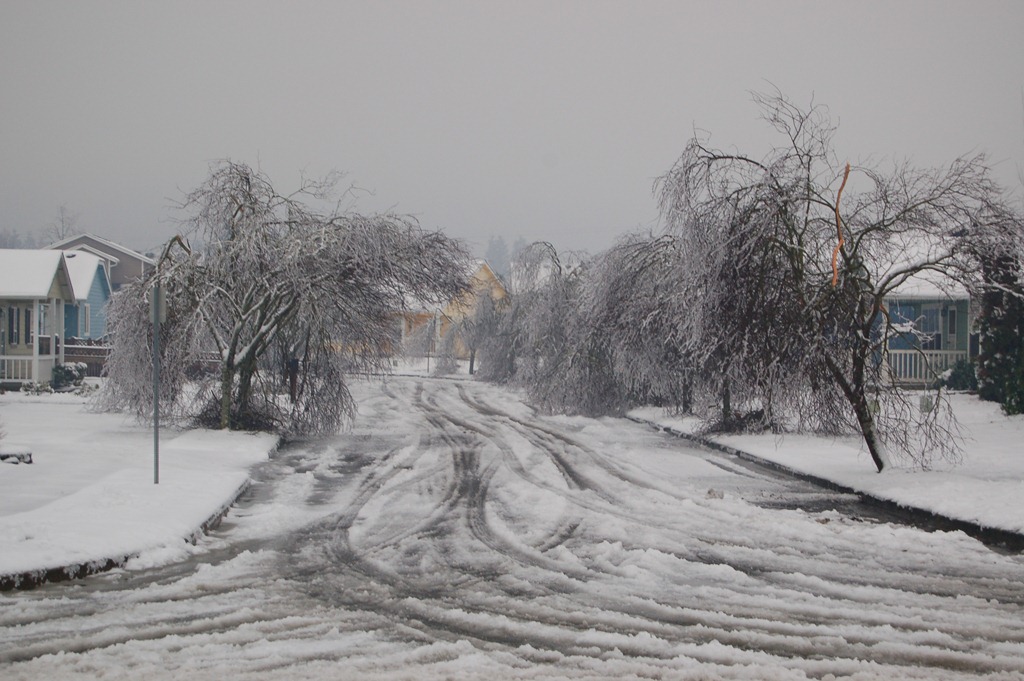

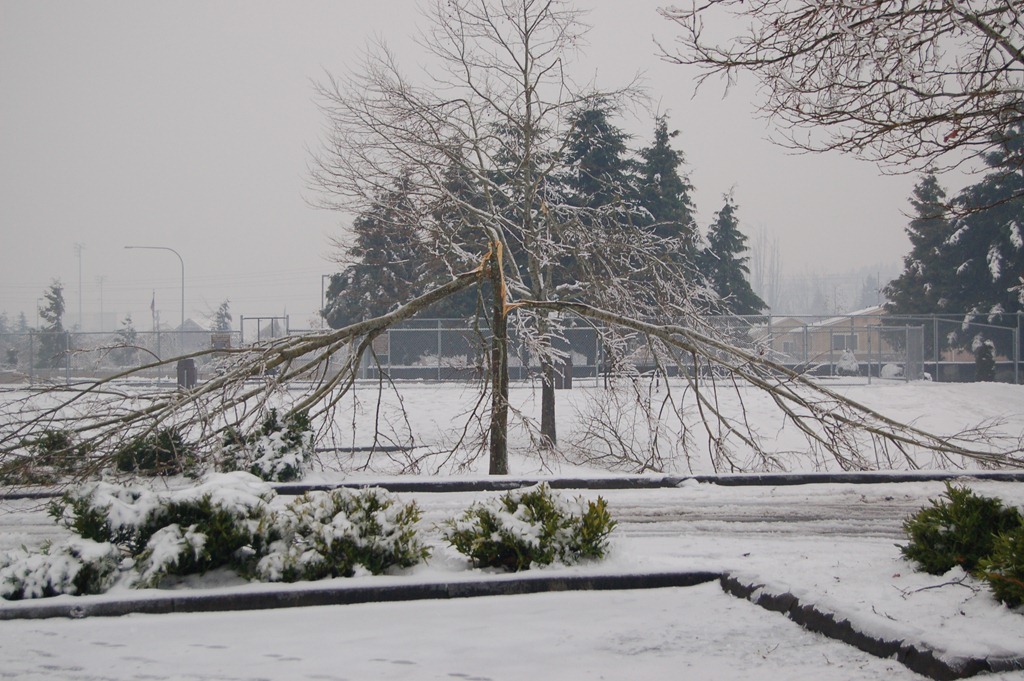
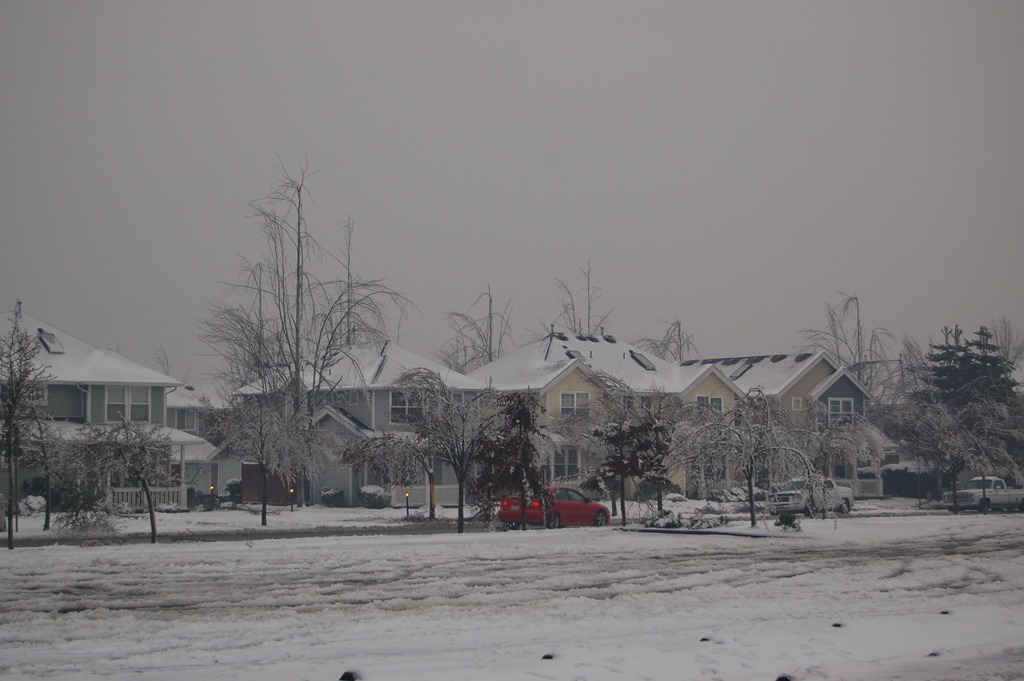
And a couple of artsy shots. Realize that it’s been raining (not freezing rain) for about 12 hours now and well above freezing, and we still have 3/8” of ice on everything.
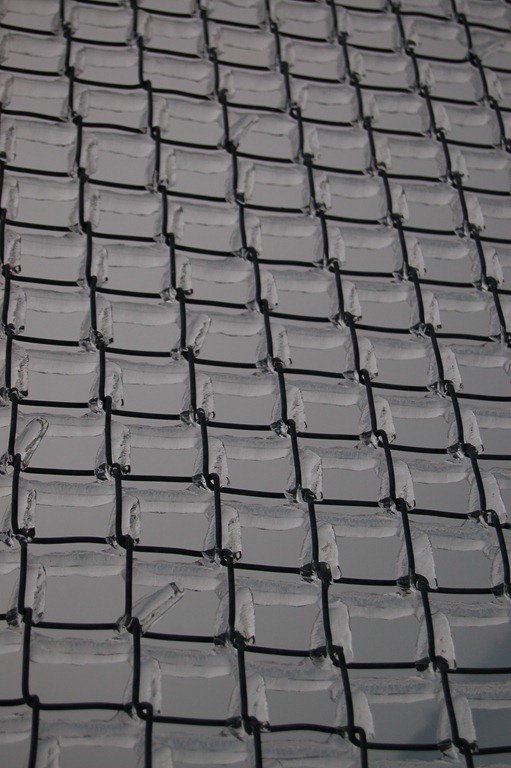

The ice wins.

Yesterday, the weather turned a little bit nasty around the Pacific Northwest. Snomageddon 2012, Part Deux. Five inches of wet snow, followed by a few hours of cold rain / sleet, then by a few hours of freezing rain and dropping temperatures. Our power went out in the middle of dinner last night, and came back on at 1:30 AM. We camped out in front of the gas fireplace to keep warm as temps dropped into the 20’s.
The damage this morning isn’t too bad yet, though one of my neighbors lost an entire row of trees along the back of their property (or will have to cut them down.)

Compare that with how these same trees looked a earlier this month.

This is what the street looks like this morning. Everything is covered in 1/4”+ of ice.

And our poor Japanese maple at the corner of our house. Yesterday, this tree was 12’ tall.

Here’s my son earning his keep yesterday.

And my daughter about to get into a bit of trouble with Mommy.

Today, I am working from home. The office is closed.
 For the most part, writers are solitary creatures. Unless you’re collaborating with a group of other writers, you’re probably spending long hours, either looking for inspiration, or trying to take the inspiration you have and get it down on paper, or into that laptop you lug around, and you’re doing it by yourself. You could do that just about anywhere, like in a library or in your bedroom, but writers, almost without exclusion, flock to coffee shops to write. It’s the ‘writer’ thing to do, and, as John Scalzi points out in his book You’re Not Fooling Anyone When You Take Your Laptop to a Coffee Shop: Scalzi on Writing, it’s pretty cliché. Writers go to coffee shops not because it’s a tranquil place to work (we all know it’s not), but because it a) has the kaffe which most of us writer types drink and b) because it’s a social – a sexy – thing to do, even though we likely sit there with headphones on and scowl at anyone who talks too loud or invades our space. Writers are an odd bunch. And Scalzi, in this book, is pretty good about pointing that out, while at the same time doling out advice on writing that goes well beyond the craft of the task.
In fact, You’re Not Fooling… is far more a book about the business of writing than it is about the craft. Want to learn about how to arc your plots or remove melodrama? Find a different book. But you want to know how to make money writing – what it’s really going to take? By all means, read this.
The book is a collection of blog entries written by Scalzi between 2001 and 2006 on his blog whatever.scalzi.com and was published in 2007. There are some intros to the chapters and to the blog entries to put the content into perspective, but for the most part, what he wrote in 2001 or 2002 (etc.) is there, as best I can tell. The blog entries all have something to do with writing, whether it be how he got his start, or how the publishing world works, or they discuss some kind of controversy that was brewing in the publishing world at the time. For the most part, the entries hold up well. There are a few things that are a little dated (i.e. ebooks prior to 2006 were nearly non-existent.), but even those entries are still worth reading because they talk about just how unimportant the medium is for writers. Those who get all upset because of the number of printed books they aren’t selling and don’t look at the e-market as an equivalent and viable market, are doomed to fail. Scalzi was all over that fact ten years ago, and it’s a major reason why he’s the success he is today.
If you’re a writer and you’re writing for the romance of writing (and enjoy being that misunderstood, under-appreciated, literary genius that isn’t published because, man, those idiots in the publishing house just don’t get just how much of a genius you truly are), Scalzi would like to slap you with a carp. This book isn’t for you, unless you’re in the mood to get the ass-whooping you’ve been needing. Writing, as Scalzi reminds us, is a business, and successful writers treat it as such in every way. You produce product. You refine your product. You market said product. You produce more product. If your product is good, you sell the product. Hopefully you make money doing it, and even better, hopefully, you enjoy the process as a whole, at least more than you could enjoy any other type of job you could get.
This is the second book of Scalzi’s blog entries that I have read and reviewed here, with Your Hate Mail Will Be Graded being the first. I enjoyed this one just a tad more because, as a writer, hearing the details of someone else’s writing career is inspiring. Scalzi’s blogging style is tremendously readable. His acerbic wit and immense vocabulary makes me a tad bit jealous of his skills. He makes me want to be a better writer. And frankly, reading books like Your Not Fooling… does make me a better writer, because, damn it, writing these days is so much more than just the art of the word. It’s the business of the word, and a matter of creating a platform and a strategy for your career that allows you to be the most successful writer you can be. It doesn’t mean just writing novels. If you want to be a full time writer, then diversify your income base around multiple streams: freelance, fiction, non-fiction, etc. It means building a platform where the readers and the jobs chase you, so that you’re not spending so much time chasing them. It’s a business and it must be treated so.
In a way, Your Not Fooling… is a complete rip off, because, well, Scalzi originally wrote all of these entries for free, and posted them on his blog to draw in more readers, who bought his other books because of liking these entries. And now, a couple years later, that free material becomes another revenue stream. “Suckers!” he says as he gleefully counts his loot. Damn he’s good.
But I’m ripping him off now, too. I’m taking that advice… the advice I paid a pittance for, and I’m using it to break into the business too. I’m stealing his ideas. I’m learning from his mistakes. If you’re smart, and you’re a writer, you’ll do the same.
Some people wonder where writers come up with their ideas. Well, I don’t actually know that for a fact – there probably is someone out there reading a book and wondering “where the heck did that idea come from?”, but for the purposes of this entry, let’s assume it to be true.
I previously blogged about how fear inspires some of my ideas. But sometimes I rely on a more traditional source… dreams.
Yes, it’s cliché and it sounds silly, and there are a lot of plots that sprout in my brain during REM sleep that might be straight out of the TV show Lost. But every once in a while, something else blossoms there. Sometimes it’s a single image, or a word, or a phrase, or a whole scene. It rarely has anything to do with the novel I’m currently working on, oddly enough. It’s usually something waaaay out there, related to some television I watched before I went to bed, or a magazine article or an image I saw on the web. Sometimes I have no idea where they come from. But they’re enough to wake me up, and flick some little switch in my brain that screams “This is important. DO something!”
When I get those idea-lahar sirens going off, what I should do is turn on the light, write them down and go back to sleep. But turning on the light in the middle of the night to write something down every couple of nights wouldn’t be good for my marriage. The lazy me – which is around more than I want to admit – ignores the sirens and hopes I can remember the idea in the morning. This is almost never the case. I usually remember that I was supposed to remember something, but what it was that I was supposed to remember is just a vague premise. I drop my head in shame and tell myself “Next time, get your ass out of bed. That could have been a best seller you just threw away.”
But on those nights where the idea is so good (or so powerful) that I can’t shake it, I run downstairs, and type it into my ‘What if’ file. I also mark it as ‘from a dream’ and add the date. The date doesn’t usually matter, but the ‘from a dream’ part does… a lot. Often, in the light of the day, things I typed in during that sleepy haze rarely make sense. And in some cases, I shake my head and wonder what exactly was my brain really working on when I dreamed that, and why did I ruin a night’s sleep for that incoherent mess. But sometimes, there is something there. The novel I am currently planning came from a dream, and so far, it’s working out very nicely.
The trick is to separate the wheat from the chaff… the great, game changing ideas which occur infrequently, from the crazy, nonsensical, stress or heartburn driven drivel that I wake up with on most days. The key is to record them all, and then come back to them once your awake brain has the power to blow away the chaff and to seize upon that kernel of real value.
In order to get to that point, you either need a spouse who isn’t going to wake up in a panic when the light comes on in the middle of the night, or you need to have the personal-resolution to get your ass into another room and write the damn thing down. You won’t remember it in the morning if you don’t. The sooner you accept that, the better your writing career will be… you know, if you depend on dreams as your only source of good ideas.
But if you’re like me, and your hand-writing sucks on a good day, be prepared to hit the keyboard at god-awful hours. Have your ‘What if’ file as a shortcut on your desktop. Have a lamp on your desk that doesn’t wake you completely up. Make sure, when you go to bed, that there aren’t kid’s Legos on the floor near the computer for you to step on in the middle of the night. Legos snapped into the bottom of your foot are not conducive to coherent thought. Make it as easy as possible to get the idea written down to whatever level of detail you have, and then to crawl back into your warm and cozy bed, and get back to what you were supposed to be doing when you were so rudely (but hopefully profitably) awoken.
For god’s sake, don’t just roll over and let the idea disappear back into your subconscious. You’ll never get it back. Sure, it might be crap, but it might not be. Don’t make that decision in the middle of the night. Let your conscious mind have a crack at it the next time you’re looking at that ‘What if’ file, and see if it’s wheat or chaff. You may be glad you did.
Just posting to let everyone know that everything is all right. No need to worry about us. Despite the blizzard-like conditions, we have heat and food and water. Cannibalism is a good 12 to 14 hours away. We should be fine. I braved the snow to get these pictures to show just how bad the Pacific Northwest winters can be!
Don’t let this picture fool you. This sidewalk is a death trap! (which is perfect for when the cannibalism becomes necessary.)
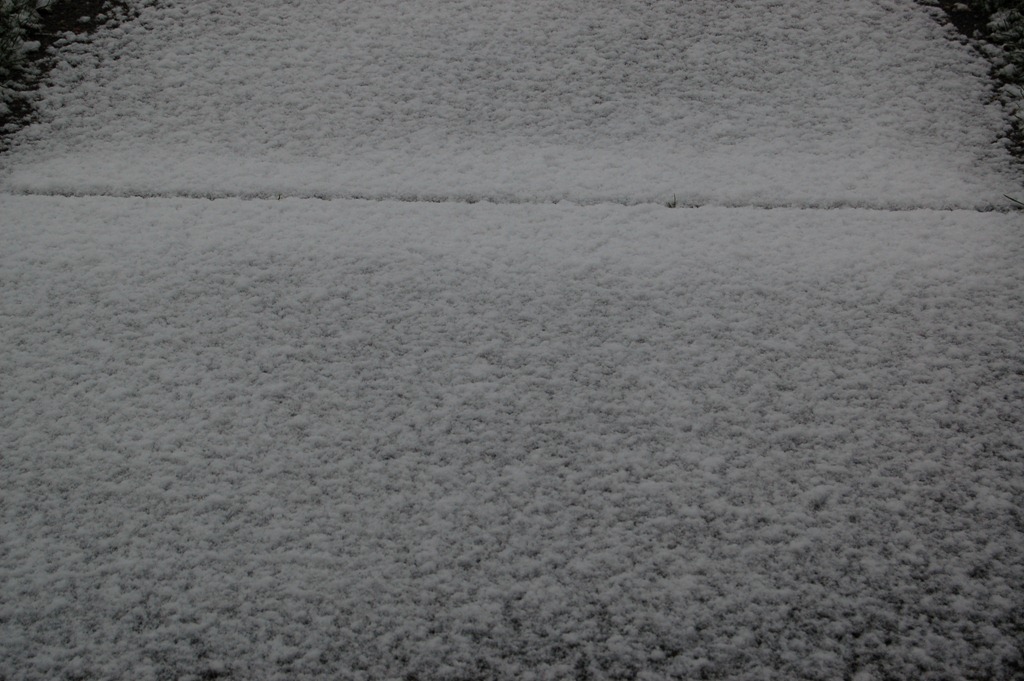
And these roads are treacherous!

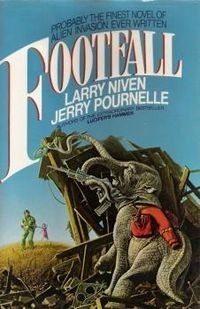 I picked FootFall by Larry Niven and Jerry Pournelle up at a used book store a couple of years ago. I’ve previously read a number of Niven / Pournelle books, including the science fiction classic Lucifer’s Hammer, and though I probably didn’t spend too much time examining the plot for Footfall, the idea looked interesting.
Footfall was published in 1985, when the cold war was still frigid and Tom Clancy was just beginning to churn out the techno-thrillers and high concept plots that had the whole world teetering on the edge of destruction. I bring up Clancy’s name because a) he blurbs the book on the front cover of the edition I have, and b) because the approach to the plot (a half dozen separate plot lines that inevitably come together at the end), reminded my of Clancy’s Red Storm Rising, which wasn’t actually published until 1986. Red Storm Rising is one of my favorite Clancy books. But I digress.
Footfall is science fiction, and really doesn’t have anything to do with Clancy. The enemies here are not Soviets or Columbians or terrorists. They’re aliens from the Alpha Centauri system, who have come to take over the Earth. They’re a tribal species who resemble miniature elephants, with two trunks with dexterous appendages at the end of said trunks that allow them to build and control things. As herd beasts, their idea of taking over the Earth implies that they should be able to get humans to submit and surrender, and once that surrender is complete, they expect the fight to be over. They theorize they should only have to prove their superiority once, over the strongest herd (the Americans) and then the whole world will capitulate and serve as members of the herd. Yes, if only that were so, the world would be a much safer place for us all.
As a concept, the story is not bad. The execution left me frustrated at times as the number of coincidences required to keep the story moving surpassed the level of plausible about a third of the way through when a man on a motorcycle crossing the US from California to Kansas stumbles across a woman and her daughter that he knows very well (also from California) just before they are attacked by the landing invaders. Now I suppose there aren’t a lot of people in Kansas (and even fewer after the aliens invade), but I had to squint just a bit to get past that one, and it just went downhill from there.
There were a few too many story lines going on, especially at the beginning, that seemed to have nothing to do with the outcome at the end. They almost seemed like leftover pieces of other books shunted in to make page count… which is odd since at 560 pages, it is a tad long to begin with.
There are two aspects of the end of the book that really sealed it for me as a ‘meh’ book. (These are slight spoilers, so skip this paragraph if you plan on reading this book). One is a complete continuity issue / deus ex machina where despite all of the US being under the thumb of the aliens, the heroes are able to bring 4 space shuttles together in one place without them noticing – a clearly offensive move to anyone who, you know, might be trying to prevent a counterattack on their space ship. The second is at the end of the book. The book ends the very second the conflict ends. There is no wrap up, no, “who lives / who dies”, no reunions. Yes, those can be tacky and overdone, and the book was already long enough, but it felt like this ending was a plot device, saying “look, we’re famous writers, and once you’re famous, you can do this kind of crap too.” I wasn’t satisfied with the ending, and I had to go back and read it twice to see if I missed something.
Overall, Footfall was a bit of a step below an okay book. It wasn’t as bad as many I have read, and perhaps I’ll give it kudos for a unique story. But the execution was lacking, and I think I continued to read it because it’s interesting to read a book that is 25 years old, and was written in such a different time here on Earth, and to remember back to when I saw that world on a daily basis. Interesting, but not great.


 Joe Beernink