
Today is the tenth anniversary of the day I first met my wife, Lisa.
Her sister, Katy, dragged her out to a country bar where Katy and I had met a few weeks before. Apparently Katy thought Lisa and I would be a good match. Lisa has gone on record about not expecting to meet someone at a ‘honky-tonk’, and had I not been wearing a shirt from the Hard-Rock Café – Rome I had picked up just two months before, we probably never would have spent the evening talking about Italy and travel. She didn’t want to date at that point (not just not date me—she didn’t want to date anyone). But I was patient and persistent, and a couple of months later, on Groundhog Day, we went out on our first non-date date. It was a few more weeks before our first official date-date.
We dated for about 15 months before getting engaged, and were wed a year to the day after we got engaged.
A lot has changed in the last 10 years. Lisa’s hair is longer. I no longer have the goatee, but I do still have the sweater and the boots. We have two wonderful children. We’ve had a rough couple of years with my health, but we’ve had far more ups than downs, and I can’t imagine the last ten years without her.
Happy Anniversary, Lisa!

 After the election, I said I’d be pretty quiet on the political front for a while, and I’ve managed to stay true to that for a good six weeks now. To be honest, there hasn’t been a lot going on, politically, that I have very strong feelings about, and I’ve been really busy writing / recovering. So I haven’t really blogged much of anything lately.
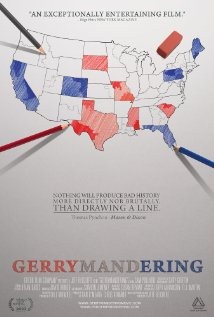
I’ve had the documentary Gerrymandering up on my NetFlix queue for a while, but I finally bumped it up to the top this week, because I knew I was getting close to talking politics again, and the issues I want to address are tightly tied to what I already knew about gerrymandering. I wanted to make sure I fully understood the issue before spouting off (or at least understood it as much as I could.)
Gerrymandering, for those of you outside the United States, is named after former Massachusetts Governor Eldridge Gerry, who, way back in 1812, rigged the geography of state districts to benefit his party. One of the districts apparently resembled a salamander. Hence, gerry-mander. Redistricting in the US happens after every census to ensure that congressional (or state senate) districts remain proportional. i.e. every district in a state should have roughly the same number of citizens (though not necessarily the same number of voters). But the redistricting process doesn’t say anything about how those districts should be laid out, and in many states, laying them out is left to the state senate/house—which means that the party in power at the time the redistricting is done can set the boundaries to benefit themselves, at the cost of their opponents. This has led to boundaries of some districts being moved by a block or two (or ten), just to exclude the house their opponents lives in, so they are no longer eligible to run in the election for that district.
The film, Gerrymandering, explains all of this very well, and I recommend everyone watch it. Gerrymandering may be the single most important political issue in America today. It is because of Gerrymandering that we have states like Michigan where the state districts have been set up to confine the large population centers to as few districts as possible. Most of the rest of the state is relatively balanced, but by segregating 12th, 13th, and 14th urban districts (which vote heavily democratic) from the rest of the state, the GOP has been able to control the State House. While this is totally legal, it isn’t necessarily fair.
This type of biased districting is happening in many key “battleground” states in the US (Florida, Ohio, Pennsylvania, Texas). With the increasing availability of massive warehouses of voting data, these redistricting efforts can be planned with amazing efficiency. It’s not an accident that Nate Silver was able to predict the results of the election so accurately this year. America may be a democracy, but data can, and does, crown kings all the time.
As we’ve seen in Michigan (and Wisconsin), control of the State House may now be more important than control of the US Congress. States are passing more and more laws that fill the gaps, or contradict federal laws. Whether is be so-called Right-To-Work laws or the implementation of Obamacare, there has been considerable effort at the state levels to push from slightly-blue or slighty-red to solidly-blue or solidly-red. This becomes a self-fulfilling prophesy, as the redder or bluer a state gets, the redder or bluer it will get in after the next redistricting. When a politician knows they don’t have to cater to both sides of the spectrum, they learn they have to cater more to the extremist side of their spectrum. This leads to candidates completely unwilling to compromise, and explains the completely dysfunctional nature of the US Congress at this point. If you think it’s bad now, just wait—it will get worse—unless something is done.
And that something? I think the best solution is for each state to have independent commissions comprised of geographers and political scientists. Politicians should have no sway over setting the boundaries of the districts they represent. They should represent all the people, not just the people who like them already. If we want to see the idea of America continue to succeed, then this has to be done. Anything else is just self-serving and doomed to failure.
When you look at the issues facing the US right now—the fiscal cliff, cabinet appointments, reducing spending, raising taxes—every one of these issues are divisive. And divisive issues mean there are more people in the extreme wings of the spectrum. Because of gerrymandering. every politician has to worry about those extremists, and can’t compromise. And if you think that tax policy causes issues between the right and the left, wait until the issue of gun-control hits the floor of the US Congress and the state houses around the country. All those voters the right picked up by gerrymandering their districts, they’ll come out in force, fearing their second amendment rights. Those politicians who try to compromise will be shot out of a cannon of their own making, and the division will only get deeper.
Three years ago, I did a major re-org of my home technology. I wrote two blog entries on my old tech blog (Evolution and Living The Evolved Digital Life) about how I cut the cable (or at least trimmed it), by downgrading my service from Comcast to the bare minimum. For the last three years, I’ve paid only for the lowest tier basic cable (local channels + Discovery Channel + Northwest Cable News). There have been a few shows/channels we’ve missed, but for the most part, we’ve been just fine. We watch a lot of stuff via NetFlix, both through Instant Watch and DVD rentals, and occasionally we’ll watch something on Hulu. We’ve gotten used to being a year behind on most of the popular shows (don’t tell me what happening in this year’s Breaking Bad or Mad Men or Sons Of Anarchy), but all-in-all, it really works for the style of life we lead.
When I was making those changes, we also set up our home PC with Windows Media Center as our DVR. For the last three years, that’s worked just great. Instead of paying $10 a month for a DVR rental to Tivo or Comcast, we’ve paid nothing. Well there was the initial set up cost of about $75, if I recall correctly, but beyond that, it’s been “free”.
One of the other things we did was to replace our old TVs with new, flat screen TVs. A lot of people have done that, and all the new TV’s have digital tuners in them. Since Comcast has been sending out both the regular, and an HD feed for the local channels, we’ve been able to take advantage of that as well. Nearly all of the stations in my area record and broadcast in HD, so for Comcast to send out the Low-Def signal, they actually have to downgrade it from the regular HD.
For the last couple of months, there’s been a warning coming up on our screen that as of 12/11/2012, Comcast would be sending out Digital Only broadcasts via the cable—the old analog signal would be removed. In order to continue to receive their transmissions, we would need to acquire (from them) a new Digital Transmission Adapter or DTA, also known as a Set-Top Box. We ordered the boxes, but we didn’t install them, hoping that since our TVs (and the tuner card in our computer / DVR) were already digital, that we wouldn’t need to install them.
Alas, December 11, 2012 arrived, and we began to receive a message on all former analog channels that we needed to contact Comcast to get our DTAs. But the HD channels we were getting before, continued to come through. We stopped receiving channels which had no HD equivalent (Discovery, NWCN, KCTS) altogether. I bit the bullet, and installed the DTA on our TV, only to discover the following:
- All signals were now low-definition, even if the native channel was HD.
- Our Windows Media Center PC would not be able to function as a DVR any longer if we installed the DTA, because the DTA had to change the channel, and with the equipment I had, I didn’t have a way to interface the DTA with Media Center for control.
This left us in a bit of a quandary when it came to the DVR. The DVR could receive HD signals, but not regular def, so we wouldn’t be able to record Discovery (Gold Rush) and KCTS (Masterpiece Mystery / Downton Abbey). Fortunately, I found a component from Hauppauge (http://hauppauge.com/site/webstore2/webstore_remote-mckit.asp) which should allow us to maintain the Media Center PC as our DVR. The downside is, the we will lose our HD recording.
The other problem we’ve run into, is that I spent the better part of a day trying to redo the configuration on our Logitech Harmony 900 remote to control the DTA to change the channel. It was actually easy to add it, but I suspect we had had a long standing misconfiguration in our remote, and adding the DTA really caused this issue to show itself. The TV kept switching sources unexpectedly after switch from DVD to TV. While I could figure out how to get the picture back, there was no way the kids ever would be able to. That would mean I’d have to come downstairs every day at 6:00 AM so they could watch cartoons, and we could sleep. I eventually got it fixed, but it took more time than I planned.
So, after all this is said and done, we will have likely lost our HD signal, which we were probably getting and shouldn’t have been, all this time. The new part for the PC cost about $40 with shipping, which is about 4 months of renting a DVR from Comcast, assuming it works. But the biggest cost was the time and hassle and energy I spent dealing with this. I had assumed that because I had new equipment with digital tuners, that everything would be okay. But clearly, Comcast is trying to force my hand to pay for the HD channels since I have gotten used to having them. HD is really nice when watching sports. Their strategy will probably work with most people not willing to give up what they already had.
But every time I have to go through a hassle like this, I don’t upgrade my service—I downgrade it by reducing my use of that provider. I currently use Comcast for my phone service, but I can now see a day coming very soon where I no longer will. That’s $40 a month they won’t be getting from me. And in all likelihood, within the next few years, I’ll get rid of my basic cable as well, and completely go to web and streaming services for everything. I thought the adjustment 3 years ago would have been hard, but it really wasn’t. Cutting the last part of the cable cord shouldn’t be that big of a deal either.
Could Comcast have avoided disgruntling this particular customer? Yes, in one step. For those people with digital tuners already in their devices, don’t require a DTA. Do I know that is possible? No. But it sure makes a lot more sense at first glance, than forcing a DTA onto everyone’s home entertainment center.
I can’t blame Comcast for trying to get me to pay more for what I once took for granted. I mean, that’s what big monopolies do. But that doesn’t mean I’m actually going to go along with that plan. And I’m sure not going to send them a Christmas card this year.
When I was four years old, I was supposed to get up on stage as part of a choir at the Christmas pageant at my elementary school. All I can remember is seeing the crowd and running off the stage, crying. For years, the thought of getting up on stage scared the crap out of me. I found ways out of being part of any further plays, concerts or speeches until high school. The only time I had to get up in front of anyone after that, was for an awards ceremony in 11th grade, and I shook like a leaf the whole time. I thought my heart was going to burst out of my chest, and run off the stage on its own.
But a few years ago, I started noticing I had fewer problems getting up to give speeches. I still wasn’t completely comfortable, but the thought didn’t paralyze me quite so badly. I gave one at my wedding reception for about a hundred people, and someone asked me afterwards if I had ever thought about going into politics. Apparently, they thought I did a good job.
One of my career goals for writing, is to be a keynote speaker at a large authors’ convention. To me, that would be a sign that I’ve made it as a writer. But I knew that for me to get up in front of a large, professional organization, I needed to start smaller, and to have the opportunity to practice that craft, just like I’ve practiced writing over these last few years, but in a low-risk environment.
I had tossed around the idea of joining Toastmasters a couple of times in the past years, but it wasn’t until my agent, Sally Harding, recommended that I get used to doing things like readings and talks prior to the release of my first novel, that I actually decided to to it. Then I had to wait until I was healthy enough to be able to go to the meetings, to start.
About a month ago, I attended my first weekly meeting for the local Toastmasters Club. Toastmasters is a great organization for overcoming that fear of speaking in public, and for learning how to prepare for those speeches. It’s been around for almost ninety years, and there are chapters in just about every part of the world.
Today, I gave my first speech (the Icebreaker Speech)—a six minute (and five second) talk about my Guillain-Barre Syndrome. I was a little nervous at the start, but I think it went pretty well. I’d practiced it about ten times in front of my webcam over the last two weeks. The topic was quite personal, so I had no worries about forgetting it. I worried about rushing it, or going over on time more than anything else. There were a few butterflies, and my palms were a tad sweaty at the start, but nowhere near the panic attacks I used to get as a kid. I’d actually got up a couple of times over the past few weeks for things called table topics, and the first time I did that, I was very nervous. This time, not so bad. So even over just a few weeks, things have gotten better. One thing I did notice, is how fast the time really flies by when you’re up there, and how hard it is to focus on anything but the speech. I mean, I know there are other people in the room, and I made pretty good eye contact with them, but they almost seemed like furniture… it was just me and the speech. I don’t know if that’s a good thing or a bad thing. We’ll see if that changes as I become more comfortable with my public speaking.
In late January, I’m scheduled to do the second of the ten speeches that are part of the Competent Communications Program of Toastmasters. I’d like to get through all ten speeches by the end of 2013. That’s not just an arbitrary date: I hope, and expect, to be doing a lot of public speaking starting in 2014.
If you’re interested in improving your public speaking skills, I highly recommend checking out Toastmasters. It doesn’t cost much (is free for guests), and it’s already been helping me.
It’s a short song, but it’s cute. I heard it on the radio this morning, and thought it’d be a good one to share. Enjoy!
Today, I completed the first draft on my latest novel, A Hundred Names For Rain. But it is not done. Being done means I am am ready for other people to start reading it. It’s not anywhere near that, yet.
I started this book as an experiment. I hadn’t written anything new in over a year, and for me, that’s a very long time. I’ve spent months recovering from Guillain-Barre Syndrome, and also completed half a dozen major edits on existing manuscripts since finishing my last new book, Labeled, in June 2011. I needed to make sure I still had it.
I also wanted to know what writing full-time would be like. I lost my job back in October, and because of my GBS, I just haven’t been able to go back to work full-time yet. So I could, for the first time in my life, just sit down, day after day, and write.
The other thing I wanted with this book, was to work on areas of writing I really hadn’t done before. This book is different in tone, characterization, and subject than anything I’ve ever written before. I wanted to challenge myself to see what my writing boundaries were, so I could set my expectations for the future. I’m sure my agent will be thrilled to hear that. (Don’t worry, Sally, it’ll be a long while before this one makes it to your desk.)
So how did I do?
First, because I’m a stats kind of guy, here are the relevant ones:
- Number of Days since I started manuscript: 37
- Number of Days where writing actually happened: 34
- Length of Manuscript: 70482 words, or 282 Pages, or 42 chapters + epilogue
- Average words per day: 1904
- Average words per day on days actually written: 2073
- Highest number of words written in a single day: 3845 (November 16)
- Lowest number of words on days actually written: 458 (November 4)
Below is a graph of words versus date. Since I was writing this alongside other people doing NaNoWriMo, I tracked their pace to mine, just to see how I was doing.

As for the results of my experiment:
1. Yes, I still have it. Writing new words comes easy for me, and I have no lack of new story ideas. I had actually thought this one up back in February, when I was still in critical care. I wrote a 5000 word outline as soon as I could type when I got out so I wouldn’t forget it. Even with nine months to percolate, it still seemed like a good idea, and stayed on my mind enough that I knew I would write it eventually. Now was as good a time as any.
2. Writing full time is a completely different experience from writing as a hobby on the train, for many reasons.
First, I wrote this whole book on my desktop PC, instead of on a laptop. My desktop PC has dual, large-screen monitors and is connected to the internet. My laptop has a single 13” monitor, and is rarely connected to the internet. After the first few days, I had to force myself to shut down my Twitter client so I wasn’t continuously distracted my the twitterisms of the people I follow.
The writing process was completely different as well. When writing on the train, I always read and edited everything I wrote the last time (usually about 600 words) and started from there. But with full-time writing, the story remained in my head all day long. I didn’t have to go back and re-read to see where I left off. So I just started writing as soon as I sat down. I expect this will bite me when I go to do the first edit, as the words have never actually been read after I typed them.
What was important in writing full-time, was to maintain a very daily routine. Shower, breakfast and surf the web while I ate, vision therapy / exercise, take kids to school, put the kettle on, open the document and close twitter, make tea. Write. If undisturbed, I’d write from 7:45 AM till 9:30 or 10:00 AM. On days where I fell off the schedule (or weekend days where the schedule just didn’t exist, the writing was much harder. I tried to handle all phone calls, emails and blog entries in the afternoon, if I had any energy left. This wasn’t always possible, and my wife can attest to how grumpy I became when my schedule got interrupted.
One advantage of writing at home full time, was that taking a mid-day bath (which I do anyway to help with my GBS symptoms) really helped to clear up where the story was going next. I obviously couldn’t do this while at work. Sometimes I would write in the afternoon, but usually I was worn out from my morning session, and writing late in the day would kill me. This is more of a function of still dealing with GBS than the effort required to write. I think I could probably write 2500-3500 words every day if I didn’t have the GBS to worry about, but anything beyond that, and my brain wouldn’t be able to keep up with the story.
The other thing I noticed is that by the end of the book, my typing had gotten much better and much faster. I’ve never been a touch typist, and years of programming haven’t helped, since programming usually involves using a lot more of the keyboard, and using the mouse a lot more. I don’t know what my typing speed is, but it is definitely faster now than it was a few months ago.
3. The book did not end up with the same tone as I initially planned, though the plot did follow fairly closely to what I had outlined. I had planned for a very dark, gothic tone. It ended up more like more like a Jonathon Tropper novel than an Anne Rice tome. I just couldn’t maintain the dark tone and not make it feel awkward. As a result, I will have some portions that need significant rework because the tone isn’t consistent.
So now that this book is done, what’s next?
In the next week or so, I’m going to give it a quick edit, cleaning it up to remove obvious errors and to see if I can identify passages where the tone just doesn’t match the rest of the book. When that’s done, I’ll pass it off to my first alpha-reader, my wife, who gets first read on everything I write. If she says it’s complete crap, it’ll probably never see the light of day.
After that, I will be returning to the world of Jake and Izzy in Nowhere Wild, and doing some edits. I’m not sure how long that will take me, but I do know that I will have my very first official publishing deadline to deal with. That effort will begin the week of December 17th and go as long as it takes.
Beyond that, it’s likely I will jump back to Labeled and do a review / edit of that before passing that off to my next set of readers.
I know I will write at least one new novel in 2013, likely a rewrite of Nowhere Home, the sequel to Nowhere Wild, and possibly one short, non-fiction book. We’ll see how everything comes together, and how much time I have. If my business takes off, or I return to work full time, my plans could dramatically change.
But one way or another, 2013 will be absolutely filled with words. I will likely never go another year without writing a novel. I just love it too much. Even when the words aren’t working, it’s still the best gig in the world.
In part 1 of this series, I covered games I played on a Commodore 64, Amiga and at the arcade. In part 2 I covered those games I have played on the PC. In part 3, I will cover the console games I have played.
Let me warn you, console games for me consist primarily of XBox Games. I’ve never had a Nintendo or a PlayStation. And actually, my game playing on the XBox has been fairly limited as I bought the XBox around the same time as I got married, and I just didn’t play it a lot. But since this series started because I dug out an old XBox Game off the shelf, I will cover the ones I played the most.
The only non-XBox game is listed at the end, and should bring back the memories for all you really-old fogies out there.
 Halo – This is the game that convinced me to buy an XBox. I used to go over to a friend’s house and play Halo every week, and I got tired of getting beat all the time. I needed to practice—so I bought my own console. Unfortunately, practice didn’t help. I still sucked at first person shooter games, and got beat, badly, every week.
 Project Gotham Racing – I played a lot of this game once I figured out that a) I sucked at first person shooters, and b) I needed something I could use as therapy for my thumbs. Yes, that’s a true statement. Playing video games was great for keeping my CMT-afflicted thumb muscles in shape. I liked the game itself though, as I could see improvements race-to-race and day to day, and I felt like I could eventually master it. I got close. Muscle memory is a wonderful thing.
 Pure – This is the game I pop in when I have 20 minutes to blow, and want to give my thumbs something to do. The movements are a little more complex than PGR, so it allows me to work on my coordination and muscle skill. I’m actually being serious here. Games can definitely be used as rehab tools for hands with muscle impairment issues.
 Madden Football – I’ve had 3 different versions of this over the years, and my last one is Madden 2010. I usually play it as the Detroit Lions, go in, demolish the league for a season or two on easiest setting, and pretend that the Lions have really won the Superbowl and have built a dynasty. One can always dream, right?
 Star Wars Battlefront – This is my alternate, pop it in for a few minutes, and play game. My son has recently started playing this, and I fear he will soon be able to beat me, so I may hide it on him.
 Lego Batman & Lego Star Wars – These are the games we picked up for my kids to play. I’ve played a lot of hours on these, and while they aren’t the greatest games in the world, they are kid safe, funny at times, and a good way for the kids to learn to use a controller (like they wouldn’t learn how to use one of those sooner or later).
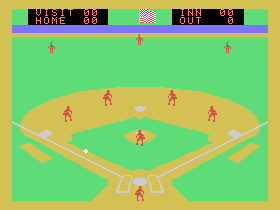 Colecovision Super Action Baseball – If you were a kid in the 80’s and had a chance to play Colecovision’s Super Action Baseball, you knew you were playing the best game ever made. With it’s funky controller and game sounds, you could play for hours against your friends, mixing in fastballs and curves and setting up you lineup. I can’t tell you how many winter days I spent over at my friend’s house playing this. Great times!
Anyway, that’s my recap of some of my favorite video games of all time. If I think of some more I’ll post them in another list in the future.
I watched less TV in November than I did in any month of 2012, except for January, before I started tracking these kind of stats. That’s a very good thing: a) It means I’m recovering from GBS, and b) it means I’m busy writing and reading more. I think I actually cut back a bit too much over the last couple of weeks, and overdid the writing and reading a bit. I need to find a happy medium.
You’ll notice a couple of kids’ movies in this list. Normally I don’t list anything that my kids watch, because I generally am not watching it with them. But below you’ll see two Disney movies. I highly recommend going back and watching Mary Poppins, even if you don’t have kids. As far as Lilo and Stitch goes, I had heard great things, but we just didn’t like it, and turned it off halfway through. I wouldn’t recommend it.
I got hooked on the AMC series Hell On Wheels this month too, but the last two episodes of Season 1 landed with a thud, and I don’t know that I can watch it any more. The same goes for Hawaii Five-O. Hawaii Five-O completely jumped the shark in Season 2, and I was embarrassed when my wife would see me watching it when she walked into the living room.
I had a hard time getting into Mad Men until the beginning of Season 2. Now I can’t stop.
Best movie of the month goes to Seeking a Friend for the End of the World with Steve Carell and Keira Knightly. Quirky, but I liked it.
So anyway, listed below are the movies and TV series I’ve been watching since Part VII of this series:
- [x] = Number of Episodes watched if TV show
- ( y ) = Rating out of 5.
- Items in bold = ones I highly recommend
DVD
- Connections 2: [1] (3)
- Eureka: Season 5: [1] (5)
- Hawaii Five-O: Season 2: [1] (1)
- Lilo and Stitch (2)
- Mary Poppins (5)
- Seeking a Friend for the End of the World (4)
- The West Wing: Season 2: [2] (5)
- The West Wing: Season 3: [3] (4)
- Wallander: Series 2: [2] (4)
Instant Watch
- Being Human: Series 2: [1] (3)
- Friday Night Lights: Ssn 1: [1] (3)
- Hell on Wheels: Ssn 1: [7] (3)
- Mad Men: Ssn 1: [1] (3)
- Mad Men: Ssn 2: [12] (4)
- The Planets: [2] (4)
- The Ultimate Wave: Tahiti: IMAX (3)
Ten months ago, I was diagnosed with Guillain-Barre Syndrome. Today, while I am still dealing with some lingering effects, I can say I am a lot closer to being 100% recovered than at any time since the diagnosis. Still, I’m not at 100%… probably 75%—which means I can do the basics around the house, but walking any distance is still not recommended, and doing physical things like yard maintenance or hanging Christmas lights, still a dream.
The numbness I’ve fought since that first day, has pretty much gone away, except on days where I really overdo it. Every once in a while, my checks will still go numb. If I notice that when it starts, and rest for a while, the symptoms usually reverse and clear up within minutes, or at worst, hours. I can actually see the problem in the mirror—I’ll get blotchy-red patches on my cheeks where they’re numb. It’s kind of freaky.
If I push beyond that, I’ll start to feel it in my fingertips. If I let it get that far, it’ll usually take a good night of sleep to recover. If I go beyond the tingling fingertips, it’ll start to affect my left leg. Once at that point, I’ll be down for a day or two. I don’t let it go any further than that.
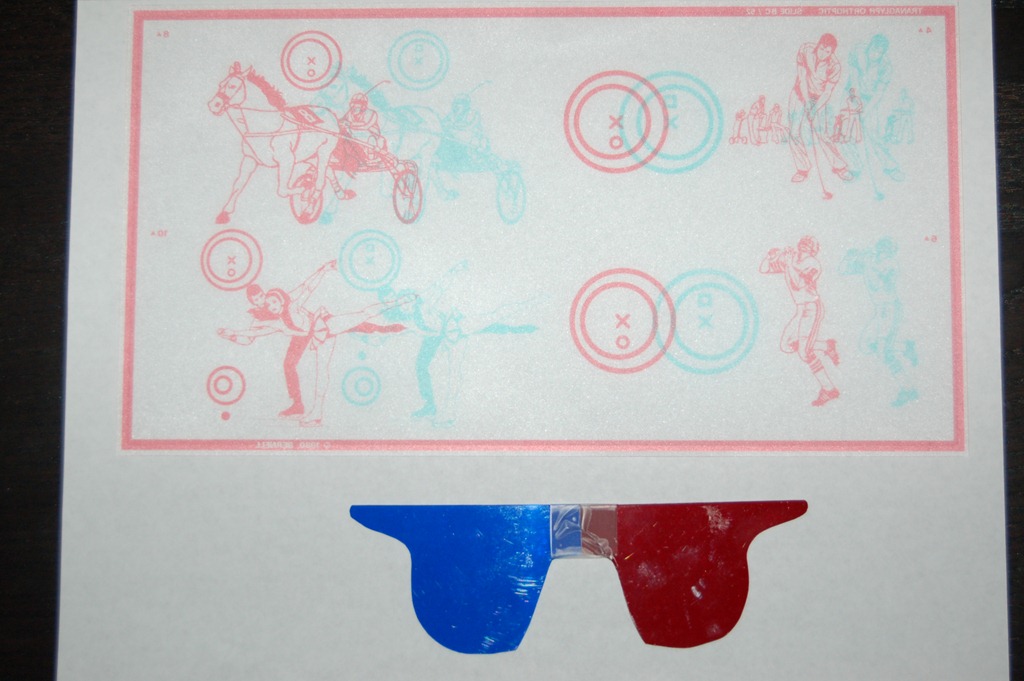
My eyes are still a work in progress. I continue to do vision therapy on a daily basis, trying to get my eye muscles to improve my object tracking, as well as my convergence and divergence. Those exercises involve tossing a ball from one hand to the other hand twenty times, first while moving my whole head, then only moving my eyes. After that, I stare at a special piece of plastic (below) with really awesome ‘3-D’ glasses on, and try to get the colors to align. Normal people can apparently get these images to align in less than a second. The two images on the right take me a minute or two to do, and I’m still working on the ones on the left. But that is progress—when I started, I couldn’t even get the ones on the right to move.
If I overdo it with my eyes, either by reading or working on the PC too much, it can take a couple of days to recover. They tire easily still, so I take frequent breaks, and space my work out through the day.
The other issue I ran into this month is that I began to notice how atrophied my muscles have become due to inactivity. I resumed strengthening my shoulder muscles by working out with light weights, but that set my neck into a tizzy (perhaps because of bad form or just a muscle imbalance) and that caused massive migraine headaches which are no fun at all. I’m going to try going to physical therapy in December to find ways to strengthen my neck to avoid that side-effect in the future.
I’ve also been dealing with broken big-toe, suffered in October. It just isn’t healing as fast as I want it to, and it often keeps me awake at night. Bad sleep means lower reserves the next day, which leads to more issues. I don’t think this recovery has much to do with the GBS, except that I probably broke the toe because I tripped while walking over uneven ground, and I know GBS has definitely affected my balance and muscle strength in my extremities.
So as of now, I’m still at home, writing and looking to build my freelance writing and software development client list. If I can get my toe to heal, stop the migraines, and get consistent, good sleep at night, I should be able to make more progress in my GBS recovery this month.
I don’t think about GBS every minute anymore. I’m able to hang out with friends from time to time, without worrying I’m going be unable to function for the next two days. I can take my kids to the pool, and not feel like I’m going to keel over. My energy budget has grown. I just still have to remember to spend it wisely.
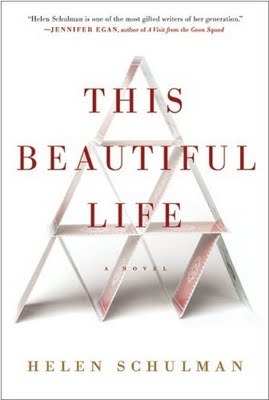 I rarely pick up books based on reviews I read in magazines. I usually rely on word of mouth, Twitter, a trip through a book store, or my wife pushing a book in front of me and saying “You should read this.” But a few weeks ago, as I was sitting in a doctor’s office (again), waiting (again), I opened a magazine, and flipped to its section of book reviews. At the top of its list, was Helen Schulman’s This Beautiful Life. The magazine said it was one of the 7 Books [which would] Rock [my] World. Well, everyone needs to have their world rocked once in a while, so I took a picture of the review (so I wouldn’t forget), and then picked the book up at the library the next time I was there.
This Beautiful Life is the story of a New York City family, living in the private-school bubble of elite society circa 2003. Liz, the mother, is now a stay-at-home mom, filling her day with the minutiae of daily life, caring for her 5 year old adopted daughter, Coco, and her 16 year old son, Jake. Richard, the father, is wrapped up in his work, heading up the negotiations to build a new university in Harlem. Jake is a good kid, trapped in that age where weekend nights are only good for wandering the streets, trying to figure out which party has the greenest grass.
Everything is going fine until Jake, who is under the influence at the time, rejects the advances of Daisy—a girl who is too far young for him—who will not take no for an answer. After the rejection, Daisy sends Jake a special video of herself that Jake, in a mistake that will haunt him for the rest of his life, forwards to one of his friends. While the video spreads, Jake’s life, and the lives of everyone in the family unravels.
I picked this book up because it sounded like a gritty YA story. After reading the short, and disturbing, first chapter, I had very high hopes for this book. The book is told from three perspectives: Liz (the mother’s), Jake’s, and Richard’s (the father). Each one was written with a slightly different narration style. Liz’s chapters rambled—clearly the author’s way of telling us that Liz was wrapped up in all the little things: gossip, hearsay, presenting the right image, and the insignificant aspects of life. Jake’s chapters, in the beginning at least, wandered a bit too as he tried to figure out what he wanted. Richard’s chapters were filled with business related concerns—how could he save his boy’s college chances? How could he keep the family living like they did now that their name was tarnished?
It took about 70 pages to get to the incident that caused the whole mess. By then, I’d become a bit frustrated with the book, mainly due to the long chapter in Liz’s perspective which overflowed with long sentences and multiple commas per line.. Had it not been a short book (220 pages in hardback), I might have given up on it. The pace picked up a bit after the incident, especially in the Jake chapters, which were far more readable than Liz’s blathering, and Richard’s cold, calculating worries.
I understand that a lot of people really like this book. The story isn’t bad. But had it been done as a YA book, told from Jake’s and Daisy’s perspectives, this could have been so much more interesting. I didn’t like Liz, and I didn’t like Richard. Frankly, they both annoyed the crap out of me. At one point, I wanted Liz to throw herself out the window of their building, just to end her whining. I felt sorry for Jake (for both making the mistake, and for having the parents he did). Daisy’s perspective, in this style, was glossed over with a couple of pages at the end that could have been left off, and no one would have noticed.
After reading this book, I’ve come to the conclusion that I like YA because of the pace, and books that intentionally defer pace in favor of prose, don’t appeal to me quite as much. Perhaps that makes me less of a true aficionado of literature, but I’ve already said that before.
I had really high hopes for this book. I guess it just wasn’t what I hoped it would be.


 Joe Beernink