 I don’t read non-fiction, not related to writing or software development, very often. I will read historical fiction, but in general, I read books in my leisure time to get away from the real world; to immerse myself in a world that may be believable, but I can always hold out hope that these things did not, or could not happen, because they are fiction. Sure, they may be inspired by real life, but the names have been changed and the world is somehow different and isolated. I don’t want to read about bad things happening to real people. It’s one of the reasons why I don’t watch the news as much as I used to. I have kids, and every time I hear about something bad happening to someone, I realize that was someone’s child. It could have been my child.
I stumbled across Slavomir Rawicz’s book The Long Walk in a bookstore in McMinnville, Oregon while on vacation. It looked like a book I would be interested in reading because it was, primarily, a story about survival against the elements of nature. It is a true story (as best I can tell, though there is some debate as to whether or not some aspects were fictionalized): interned at a labor camp in Siberia during the height of World War II, Rawicz and a small band of other escaped prisoners make a 4000 mile journey from Siberia to India, across the frozen lands of Siberia, the Mongolian Steppe, the Chinese Gobi desert, and the Himalayas of Nepal. It is a brutal story of incredible fortitude, difficult choices, and a harsh world. The men make mistakes – there is no doubt of that – mistakes, that with a better knowledge of geography they might have been able to avoid.
But before you can get to the story of survival against the elements, you have to get through the story of what Rawicz survived in the Russian prison system. Rawicz, a Polish army officer is accused of being a spy, and through months of brutal interrogation, refuses to sign his name to a confession of crimes he never committed. The description of this cruelty leaves little room for the timid to ignore these despicable acts. And because this is non-fiction, you cannot pretend hat these weren’t human beings perpetrating these atrocities. Somewhere along the way, the human race has failed, and produced these monsters, and you understand why, sometimes, war is necessary.
But most of all, you marvel at the strength of the human spirit, and I find myself wondering if I could have survived those months in captivity, and those months inside a freezing cattle cars on the way to Siberia, let alone the trek to freedom after the escape. My answer is unequivocally, No. I’m not that strong of a person, either physically or emotionally. I wouldn’t last a day under these conditions.
This is a a really good book. It flows well, and you can’t stop turning the pages. It’s definitely worth the read.
I slept in this morning. Why? Because I could. Yesterday I finished the first edit of my latest book, now titled Army of the Risen (AOtR). Again, Huzzah! I sent it right to FedexOffice for printing and picked it up late yesterday afternoon. Lisa is reading it as we speak I write this, and I am getting caught up on blog entries. Hence, the flurry of activity here.
How did I get the edit done so fast? Well, the writing was, I think, a hell of a lot better on the first draft of this one that it was on the first ten drafts of The Forgotten Road. In other words, I’ve learned a hell of lot in the past two years. I also had a plan for this book that really helped the plot stay on target. I did have to correct a number of continuity issues, and had to write in a few new paragraphs here and there, but I really didn’t need (yet) to delete any long passages. At least not the 100000 words I removed from TFR during it’s life span. I also had the benefit of a scheduled day off from work on Friday, and proved to myself that I can in fact, write all day given the opportunity to do it.
There is one small section of AotR I may revise later, as I think it gives away something that I could write an entire book about later if I so choose. We’ll see what the readers think.
So for the first time in about a year, I have a blank slate in front of me. I’ve got another story idea in my brain that I will start outlining tomorrow. It’s totally unrelated to these existing story lines, but it will take a while before I start writing. I do have a large stack of reading to get through in the next few weeks as well, including some reading for work, and I want to re-read The First Five Pages by Noah Lukeman to refresh some of the lessons learned over the past couple of years.
It’s kind of a weird feeling to have spare time. I actually picked up a new video game last night (Sins of a Solar Empire) to add some non-TV downtime to my life. I’m pretty sure it won’t take over my life, but with Christmas coming and a lot of days stuck in the house while the Pineapple Express deluges the Pacific Northwest, I needed something to avoid complete boredom. I don’t want to jump into a new book without enough planning time. It doesn’t pay off.
There’s been no word from the agent I sent TFR to last week. I was hoping at least for a receipt confirmation, but I’ll at least wait a couple more weeks before I check to see if they got it.
Okay, that’s about it for now. See you next week!
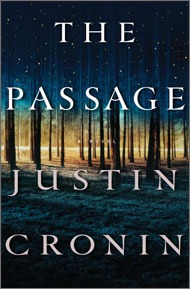 When you pick up the hardcover edition of The Passage by Justin Cronin, you know you are not going to be able to take this one everywhere you go. It’s huge. It’s heavy. It’s Stephen King-sized. And in a lot of ways, it’s very reminiscent of King’s The Stand. Though I have not read The Stand in twenty years, it still does occupy a haloed place on my bookshelf because it was one of those books that inspired me to become a writer.
The Passage is an epic tale, spanning almost a hundred years. It’s a great story, with a great premise, a lot of characters and a lot of sub plots that are woven together to tell Cronin’s pre- and post-apocalyptic tale. The US Army has created a race of beings, “virals”, to be the ultimate fighting soldier. But these soldiers cannot be controlled, and when they escape, only a select few in the world will survive the catastrophe.
I liked this book. But I could have liked it more. Perhaps the sheer size of it (767 pages) caused too much reader fatigue, and the fact that it took me a few weeks to read the whole thing because I have been otherwise occupied threw off the pace a bit. But part of it was Cronin’s prosaic style. Don’t get me wrong, he is a good writer. But some of the sentences made me wince, and cry out in frustration. They included a semi-colon, a parenthetical with another semi-colon, and then a colon. All in one sentence. Some sentences included half a dozen semi-colons, and a dozen commas. I’m sure every one of those sentences was perfect in its grammar and structure, but they were agonizing to read because my eyes had to continually skip back to reread sentences to figure out what the original concept was. That destroys the flow of the story, and causes me to start skimming. As a writer, I know that when the reader starts to skim, the editor should have done a little more editing.
The other issue is the sheer number of characters in the second third of the book make things a little difficult to track. Every one of them turns out to be essential to the intricate plot, but you almost need to make notes to follow them all. If you aren’t truly focused, you might miss something, and again have to go back to reread.
All indications are that Cronin is going to make a fortune off this book, the movie rights, and the sequels that are already planned and in production. I am looking forward to the sequel, though I do hope it is a bit shorter than the first book. I may even buy an e-reader just so I don’t have to lug it around if it isn’t.
If you enjoy big, epic, post-apocalyptic tales, you’ll like The Passage. If you want a light, quick read, this might not be the book for you. I liked it, but I didn’t like all of it. Be prepared to do some work, but it will make you think about it after you are done.
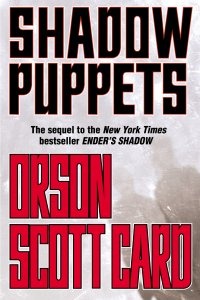 One of my all time favorite books is Ender’s Game by Orson Scott Card. He also wrote one of my least favorite books, Empire. Shadow Puppets falls somewhere in between, though slides more towards the Empire class than Ender’s Game.
Card followed up the Ender storyline with a whole series of books about the hero, Ender, and then another series about one of Ender’s Jeesh, Bean. This ‘Shadow’ series includes two books prior to Shadow Puppets called Ender’s Shadow and Shadows of the Hegemon. Ender’s Shadow was wonderful and Shadows of the Hegemon, as I recall, was pretty good.
But in Shadow Puppets, the story hits a lull, and I came away little frustrated, because, through the first 80% of the book, nothing happens. My wife says that it gets better in the next book, Shadow of the Giant, but Shadow Puppets was pretty boring, and makes me nervous about picking up anything else in the series.
I’m sure this book sets up future conflicts in the series. But it suffers the problems of putting people who are so brilliant (as these kids are), in a story that lasts so long that it requires them to do dumb things in order for the plot to have conflict. In constructing an arc where everyone is always making spectacular maneuvers, the simple things they fail to see, their personal blind spots, their character traits that allow them to fail, are almost ridiculous. It’s the opposite of Deux ex Machina, where something incredible and out of the blue has to happen to save them. Something ridiculous has to happen to put them into jeopardy.
Because of my reading OCD, I will undoubtedly read the next book in the series. But had this book been my introduction to the series, even I would have had a tough time finishing it. By all means, read Ender’s Game and Ender’s Shadow. Just be ready for a bit of a slog when you get past those two.
This morning I finished another draft of The Forgotten Road. I say another with a very tired voice, because since November of 2009, this is my 10th full edit. I don’t know exactly how many I did before that, but it was at least 4. I started this book in August 2008, before the stock market collapsed, before H1N1, before I had even heard of the PNWA. A lot has happened in the world and a lot has happened to my writing since I started. I’d almost go so far as to say that I am a completely different writer now than I was back then. And the story is completely different than I originally envisioned. Part of me is disappointed by that. It’s not the story I wanted to write, but the story I wanted to write was boring. It didn’t have legs. It had to be changed. But that doesn’t mean I’ve completely come to terms with that yet.
I sent TFR out to an agent this morning. I’ve got high hopes for this agent as we have spoken multiple time in the past, and she had some very encouraging things to say about my writing the last time we spoke. We’ll see what happens, and I ‘m sure I’ll be quite anxious as I await a reply (I’ve already checked my email inbox twice this morning and I only sent it half an hour ago).
I really hope I don’t have to do another major edit without having a deal in place for this one. To take it any farther without advice from a professional editor or agent would return minimal results. If I get no feedback from any agents over the next few months, then I’ll consider the book done and retire it to my ‘what else have you got pile’. As in, if I sell another book, and the publisher wants to know what else I got, I’ll slide them this one. If I haven’t got a deal by the next PNWA conference, I’m going to set it up online for downloads and ask for donations. That approach has worked for other authors like John Scalzi. We’ll see.
So what’s next? Today? Some reading. I’m in the middle of two books right now, The Passage by Justin Cronin and The Long Walk by Slavomir Rawicz. Two books? Yes. You’d understand why when you see the size of The Passage. You can’t bring that on the train unless it’s an EBook.
Tomorrow, I’ll start the first edit on The Unexplored Territory. Count on another 10 days before that is done. Then I’ll send that to the printers and pass it around my critique group. Then I’ll start story development on the next book that is percolating in my brain. A writer’s mind never completely sleeps.
I’ve also got some other blog entries to get caught up on, so I might do that today. And there’s this whole Christmas thing to get done. And I have this job thing… you know the one that pays the bills. That needs some more time as well.
But expect to see a new listing on the web site soon, with the opening chapters of The Unexplored Territory. I think this one is damn good.
This morning at 7:15 AM, I completed the first draft of my most recent novel, currently titled The Unexplored Territory. Huzzah! This will not be the final title. I just can’t come up with a better one.
In a couple of weeks, I will do a first edit as I have previously noted, but I need a break from the story right now. In the last 12 days, I averaged almost 2000 words a day, with a high over 3300 words. Not bad considering I also work a very full time job and and two little ones running around being the joy of my life and all. I was really cranking on it, and it took a bit of a toll on my sanity. I love the story, and hope that will last through the next few months as I edit and polish it. But driving that hard on a story means I gave up reading for fun, watched only a couple of movies, and if I woke up in the middle of the night and thought about it, there was no way my mind would shut off.
Tomorrow, or maybe tonight if I get ambitious, I am going to dive back into The Forgotten Road. I hope to have that edit done by the end of next week.
Last weekend I hung out for a while with another author named Mark Teppo while our children (who are friends) had a play date. We talked a lot about writing and the impact of writing on our lives, and on our pocketbook. Mark said that it was probably too late for him to warn me off of writing as a career choice because I’d already been bitten by the bug. I came to realize about a year and a half ago that I would probably not make any money doing it. But it was interesting that I thought about that statement quite a bit this week as this story was coming to an end.
Even if I don’t make a dime from these novels that I have written, I don’t know that I could stop writing. If I rode the train to work every day, and did nothing but sleep or read, the commute would kill me. But even more than that, I know I couldn’t go back to watching TV for 4 hours a day, or playing video games until all hours of the night. The act of writing, the creating the story, even if it is for my own enjoyment and if no one else ever reads it, has really become an end unto itself. When I started the final, climactic scene of The Unexplored Territory, I knew what had to happen, but I didn’t know exactly how it would happen, or how the characters would respond. The final outcome absolutely floored me. The adrenaline rush had my heart pounding, and I worked up a sweat while writing it. I hope the readers have the same feeling when they read it. Regardless, I really enjoyed these last two weeks, because the writing experience was so thrilling.
To celebrate the completion of the novel, I bought a new recliner for my office so I can write when my wife is watching Dancing With the Stars. I also did most of my Christmas shopping, hung the outdoor Christmas lights, fixed the back gate, pruned the trees and bushes, added some hooks to the garage. All stuff I have put off the last few weeks to write.
And while I was doing that, I think part of me was already starting to think about ‘What Ifs’ for my next book. What if….
I’m sitting here listening to a football game on the ‘radio’ which is actually online, but the fact that I’m doing that precludes me from writing, even though the kids are down for their afternoon nap. But I’m not feeling too bad about not writing right now, because I passed the 70,000 word mark last night, and have about 7-8 chapters left to write – somewhere between 10000 and 16000 words, depending on how verbose I get. At this rate I should be done at some point during the Thanksgiving weekend. YAY!
I’m already thinking about the edit on this one, before I even come up with a title for it. It’s currently called The Unexplored Territory which screams “Hello Generic Book!”. I’ve also considered The Army of the Purple Stain which sounds like it’s about the male gender’s worst nightmare, a bunch of armed, severely PMS’ing women. Those are two examples of why I probably won’t mind if whatever publisher I find helps to come up with a better title.
I know my editing passes won’t need to be as dramatic as they were on The Forgotten Road. I’ve learned a lot since I wrote the first draft of TFR, and I really don’t see having to re-architect this one. I do see having to do a pass for continuity and place names (which I am also horrible at). I know I’ve got places where one of the characters travels for 1 day, but is gone for 3, and doesn’t sleep the whole time. Don’t think that passes the credibility check. I also have dramatic weather shifts from nasty, wet coastal winter, to tropical beach like conditions in the space of 24 hours. Not a huge bearing on the story either way, but geez… you’d think I’d figure that out a little better.
So hopefully, one more week and I’ll be done this first draft. It’ll be nice to be done, and I can go back to doing some reading sometime in December. I miss not having much spare time.
As per usual, when things get a bit busy, the first thing that gets dropped is this blog. The good news is that the source of my bus-i-ness, is, for the most part, my writing. My current work in progress is approaching the 55,000 word mark, and for the last ten days or so, I’ve been writing quite steadily, having missed just two days, a Saturday on vacation in Oregon, and yesterday where I spent the entire day on the couch recovering from a 24 hour flu bug. I had plans to get up early this morning and write, but my body needed more sleep, so I slept right through the alarm on my body clock, and waited until the kids awoke us at the oh–so-late hour of 7:15 AM.
I’m really happy with this new book, and have set a goal of finishing the first draft by the end of November, but that will involve a couple of long days to make up for a few short days. Luckily Thanksgiving is a 4 day holiday for me, and I should be able to make good use of it.
I have one more person left in my writer’s group to review The Forgotten Road, but as soon as I am done my first draft on my WIP, I will sit down and do another edit on TFR, and then send it out to the agents. Still hoping to have that done before Christmas. Then an edit on my current WIP, and send that out to my readers. By January 1, I’ll have my desk clear of works in progress.
And then what? Well, not sure exactly. Each of these two books I am working on is planned to be the first book in series. But I’ve also learned not to jump into the second book until the first book is wrapped up. Too much stuff changes. If I get immediate feedback from an agent that they like TFR, then I will go and do a major edit on Nowhere Home (the sequel to TFR). If I don’t get feedback, right away, I may write some short stories, or start planning on another series I’ve had in my brain.
I’m definitely not out of ideas at this point. I just need to figure out which is the best one, and go with that.
As far as reading goes, I haven’t been reading much. I’m working on Orson Scott Card’s Shadow Puppets, but it hasn’t really grabbed me, but that could just be that I am not in the mood to read that right now. Anyway, the stack of books on my to read pile was refreshed by a stop at a book store in Oregon on vacation, and I am looking forward to some of those books. But writing comes first, second and third right now in my spare time.
Okay, off to run my Saturday errands, then back to writing this afternoon during the kids naps, and then tonight again after they go to bed.
When I was in college, I lived in a very small apartment (440 square feet) in Toronto on the 17th floor of a 26 story building in a very bad part of town. I lived on campus for my first two and a half years, but I partied too much, drank too much, didn’t get along with my roommates, my grades tanked and I needed a change. In this little apartment with its dramatic view of other high rise, low rent apartment buildings called ‘University City’, I wrote most of my very first novel, To Cage the Eagle. This novel will probably never be published, as it is very centered on the world of 1993, and it would need a lot of work to bring it up to date. But in that crappy little apartment, the words flowed and I figured out that I loved to write. The long walk to campus through the bad neighborhood and cold Canadian winters encouraged me to stay in on the weekend nights and write until all hours of the morning, and the isolation gave me time to study and to bring my grades back up so I could graduate on time. Still don’t know how I did it, but I am sure that little apartment and the focus I was able to achieve there had a lot to do with it.
After leaving that apartment, I bounced around to a number of places: a basement apartment in Oshawa, ON, a brief house share with a friend of a friend (the worst roommate, ever) in Whitby, ON, a house share with a teacher and a police officer (I wish I had been able to stay there longer) in Whitby, ON, an apartment near Denver, CO, my first house near Denver, CO, an apartment in Kent, WA, a condo in Kent, WA, and finally, the house I am living in now. In none of these places did I write anywhere as prolifically or as well as I did that first apartment. Perhaps it was because I was working a lot of hours trying to build my career, or perhaps I forgot how important writing was to me, or perhaps the feng shui of each place was just wrong for me to write.
What I’ve always wanted, was a comfortable place to write and to read that discouraged distractions and felt as good as that first place.
I think I now have that. Over the last two weeks, I’ve turned my overstuffed office with all it’s mismatched furniture into a writing retreat. I painted the walls a soothing green. It didn’t turn out to be the exact shade I was looking for, but it’s close enough. I bought all new furniture from Ikea… cheaper than the custom furniture I first considered, but took a lot longer to put together than I had planned.
I sorted through my books, and boxed up two full boxes of ones I would never read again and wouldn’t want my kids to read, and will be taking them to Half Price Books next weekend. I even sorted through my old textbooks and put those in the ‘Get Rid of Box’. I’m currently ripping all my CD’s over to digital storage so I can box them up and put them in the closet. I invested in a credenza to store all the crap that used to clutter my desk. I bought a nice looking file box to store my old copies of my manuscripts and research that once filled binders stacked on my shelves.
I wish I had taken a ‘Before’ picture, but here is the ‘After’ version. I still need to get a comfy guest chair and a little ottoman that we can roll out from under the desk when two of us need to look at the computer. I also plan on putting up a couple of nice pictures, getting a second monitor and a real monitor stand, but I ran out of budget for this month. Maybe next month.
And yes, buying all this stuff seems a little… materialistic, especially since I have yet to make a dime from writing, unless you count the $14 I made from the sale of an article to Model Railroader Magazine back in 1986 or 1987. But this is also my home office. My wife will use it one day a week for working from home, and I have goals of doing that someday myself.
My primary writing space will still be the train back and forth to work. But at least now my wife can watch TV at night and I can write without bothering each other, and we can both work from home (on opposite days), without wrecking our backs.
I’m almost caught up on my book reviews and remodeling. My next entry will return to writing updates, and of course, I will again disappear for long periods as I actually write. But now at least you know where I am.


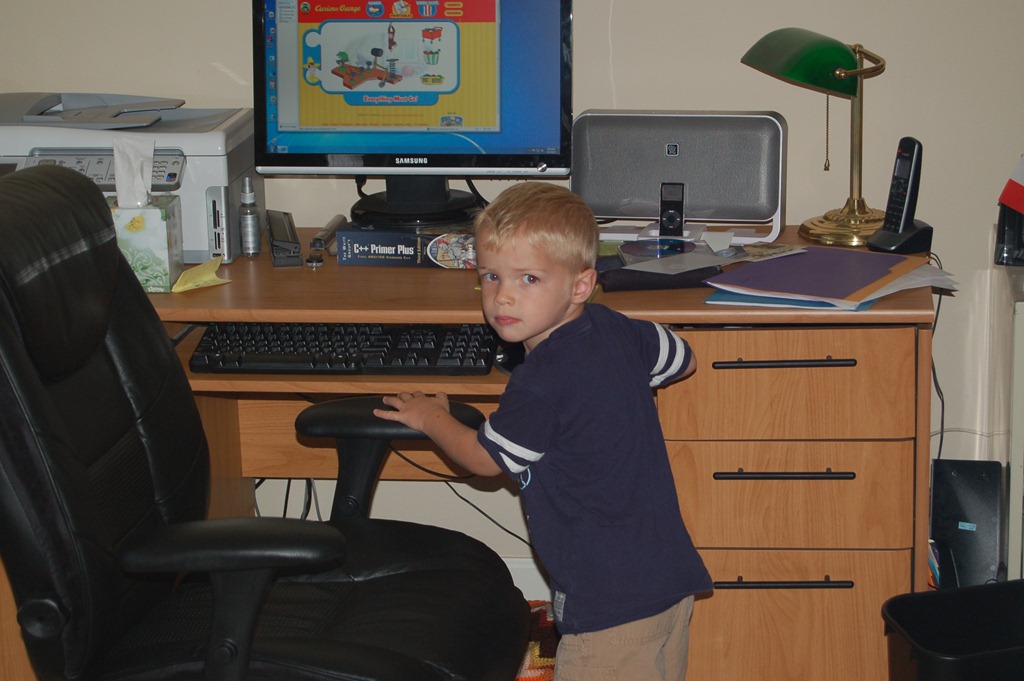
I did find an old picture of my son at my old desk, and I think it’s pretty obvious that the new office is more conducive than the old one.
I held off as long as I could in reading Suzanne Collin’s final book in the Hunger Games series, Mockingjay, not because  I didn’t want to read it, but because I didn’t want the story to end, and I didn’t want to read it while distracted. I wanted to immerse myself in the story, and with as busy as I have been lately (which I will explain in my next blog entry), I knew that I would both be too tried, and wouldn’t have the time to really get into the story and enjoy it.
But I couldn’t wait forever, and despite my desire to read it all in a weekend, I pulled it from my shelf last week and read it in every free moment – on the train, in the car waiting for the train, or waiting for a meeting to start.
I don’t envy Collins. By the time Mockingjay was being written, I suspect she had already realized the monster she had created with the Hunger Games and Catching Fire, and trying to write a conclusion to this series that did the storyline justice must have been absolutely brutal. The scope of the story of Mockingjay is so much larger, especially in the first half, than the other two books because it has to be. There is so much more at stake, and an average writer would have fallen prey to the cliché. The hero, especially in a story told from the first person, would have had to be instrumental in every scene in order to make the audience present. But Collins is no ordinary author, and her considerable skill at telling the story allows the reader to skip long periods of time without feeling like they have missed something critical. This is very difficult to do, especially when the scope of the story is so grand.
Again, I don’t want to give away any spoilers, but the ending really surprised me. It is not a typical ‘and they all lived happily ever after’ ending. These characters have been changed – ruined even – by what they went through in the three books, and those who survive cannot possibly return to a life of leisure and happiness. I had a very visceral reaction to the end of Mockingjay. Gulp. I swallowed and shook my head. Not because I was disappointed or sad. It just took my breath away, and was so surprisingly brutal, that I my chest ached and I struggled to cope with the end of the story.
I will read this series again, because I am sure that I missed so much on the first reading. It has a assumed a place of reverence on my bookshelf, and I suspect it will heavily influence my writing through the rest of my life.
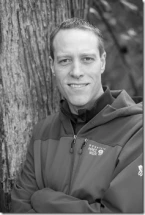

 Joe Beernink