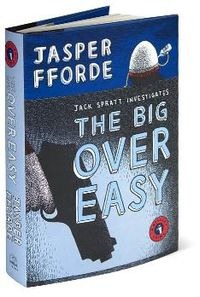
 No one will ever accuse Jasper Fforde of being unoriginal. His Thursday Next Chronicles were some of the most unique story concepts I have ever read: Thursday Next is a literary detective, thrown into the plots of books to investigate crimes against literature. She chases mastermind criminals bent on destroying the classic works of fiction from book to book, dropping allusions to books I may or may not have ever heard about, and making minor characters in other books into major criminals. The premise is so well done, that I found myself wanting to go back and read some of those other stories to see what really happened.
The Big Over Easy is a slight deviation from the Thursday Next Chronicles. In this book, we follow Detective Jack Spratt, and his new assistant, Mary Mary, as they investigate a particularly baffling case of an egg that has fallen off a wall. It could be an accident (the egg was drunk at the time). It could be suicide (this egg was depressed, they say). Or it could be murder. This egg, Humperdinck Jehoshaphat van Dumpty, aka Humpty Dumpty, or Hump to the numerous women who vied for his affections, had a lot of problems. It’s up to the motley crew of detectives from the Nursery Crimes Division of Reading’s police force to solve the case.
Jack Spratt has a reputation to rebuild after failing to get a conviction against three little swine from maiming a wolf with a misunderstood reputation. Mary Mary wants nothing more than to move up and out of the NCD to work with more highly regarded detectives, and she’ll do what it takes to make sure that happens. Working on Nursery Crimes is not glamorous work. Jack thinks it should be. Mary just wants to move on. This crime will make or break the NCD, and with it, both their reputations.
Along the way, we meet alien detectives who speak only binary, encounter Georgio Porgio, the villainous mobster, and a host of other characters who are nothing like the ones you remember from the stories of your childhood. Your parents and your teachers only told you part of the story. These Nursery Rhyme characters are a lot more complicated than you ever knew.
The Big Over Easy is filled with wonderful backhanded mentions of the classic rhymes from our childhood. I’m sure that on the first read I missed half of them. Since I have two young children, and we used to read some of these stories to them before bed, I am a little more familiar with them than I was five years ago. But when I read them, I never would have thought to turn them into something like this book. Fforde has done a wonderful job of turning them into a mystery that is genuinely intriguing, laugh out loud funny, and hard to put down.
Jasper Fforde is truly one of the unique story tellers of our time, and should be required reading for every author who thinks all the stories have been done. The Big Over Easy is, if you can keep an open mind, a great place to start reading his collection. I highly recommend it.
Yes, I am writing. Not as much as I was a few weeks ago, but I’m working on something a little different. There’s no daily word count or estimate for completion. It’ll be done when it’s done.
And yes, I am slacking on book reviews as well, but there are two reasons for that. One, I have been spending most of my time re-reading the Harry Potter Series, and I don’t really want to review a book I’ve already read. I’m reading it for pure enjoyment, and to get ready for the final installment of the movies which come out July 14. Last night I finished The Order of the Phoenix (I read 600 pages of it yesterday) and today I’ll watch the movie. I’m not quite sure when I’m going to pick up The Half Blood Prince. This isn’t a race, after all. I’d just like to be done the whole series by mid August so I can see the movie in the theatres. These books are completely amazing, and if you haven’t read them, you really should. But if you haven’t read them and are more than fifteen years old, there’s probably nothing I’m going to say to convince you to. Your loss.
The second reason there have been no reviews is that the next review I post will probably be a double feature, and I’m only a few pages into the second book, which I am reading on my IPhone. We’ll see how that one goes.
It is a little weird not to have a major work in progress hanging over my head, but the last one really took a toll on me. Not just the daily grind of writing, but the fact that I was never really quite satisfied with the manuscript. My wife has read it, and she agrees that it needs a lot of work. The plot and the characters are there, but it’s like a jigsaw puzzle not put together quite right. In a few months, I’ll dive back into it, and see if I can fix it. It’s a little depressing that I missed the mark by so much on this first draft, but since my internal editor already knew it before it was done, it wasn’t a shock to me when my wife broke the news. If I had thought it was the greatest thing since sliced bread, and then got the bad news, it would have destroyed me. But instead, it just allowed me to move on to my next project while my subconscious gains a little distance, and hopefully will figure out exactly where the story went wrong.
My wife and I recently celebrated out sixth anniversary, and though we didn’t plan anything special for that day, we did get away last weekend. We dropped the kids off at Lisa’s parents’ house on Friday afternoon, and headed up the road a few miles from their place to Wenatchee, Washington.
I’d been to Wenatchee once before, though I don’t quite remember when. I think we were only there for an hour or two, and we certainly didn’t see much on that trip. So this was a chance to really get out and see the town, and enjoy a little kid free time.
Last fall, my wife and I took a trip to McMinnville, Oregon and stayed at a beautiful bed and breakfast called A Tuscan Estate. This time, we stayed this time at the wonderful Ivy Wild Inn Bed and Breakfast in just west of downtown Wenatchee. These two get-away weekends have convinced me that B&B’s are the way to go for all future kid free weekends.
Upon arrival, we were warmly greeted at the door by the owner and chef, Richard Kitos, and shown to our very comfortable room. The Ivy Wild is a 6000 square foot mansion, with a beautiful back yard and old fashioned charm. Breakfast both mornings was fantastic, the rooms were quiet, and the other guests there quite friendly.
Richard was getting ready to cater an event Friday night, but he took the time to make a great dinner recommendation at Garlini’s which is just a few blocks away, and completely walkable from the inn. I highly recommend the salad and the pizza there, but leave room for the chocolate dessert. I don’t remember what they called it, but it was fantastic.
Saturday, we spent the day touring Wenatchee, driving from one side of the town to the other, basically checking the town out. Some of the areas are a little tired as the apple industry that made Wenatchee famous has run down over the past few years. But there is fresh money coming in from wineries and from West-siders coming over for 300 days of sun a year, and there are some very impressive homes. There is also the beginnings of a tech-center – a result of cheap power from the dams on the Columbia River. Hopefully tech really takes off there over the next few years. I think it would be a great town to live and work in, especially with a young family.
We also took a drive up to Cashmere, Washington, an idyllic little town nestled in the Wenatchee River valley between Wenatchee and Leavenworth. We stopped there for lunch at The Best Bite, where I had what I called, ‘The best sandwich I’ve ever had’: The BLACT. Bacon, Lettuce, Avacado, Melted Cheddar and Tomatoes, with what I think was an herb mayo. Wow. Perfect!
We overate at dinner back in Wenatchee on Saturday night (and I should have stopped after the second glass as well), but a nice quiet night back at the Inn was just what we both needed. By morning (with another great breakfast), we were both missing the kids and ready to head back. But we definitely enjoyed our trip, and I would highly recommend the Ivy Wild Inn if you are looking for a place to get away from it all for the weekend.
I finished my first read-through edit of my ‘Labeled’ last night. It’s not as bad as I thought it was. It still needs a lot of polish and probably a rewrite of a couple of areas, but I think it works. I made a few minor changes to fix consistency issues, and whatever grammar and spelling errors I saw. I sent it to my wife’s Kindle last night, and she stayed up late reading it, so either she was engrossed by it, or she just didn’t want to face me while I was still awake.
Today, and for the rest of the summer I will be turning my attention back to The Forgotten Road, which will probably also get a new name. I don’t know what that name will be yet. But it will not have the word Shadow, War, Night or Dragon in it.
It’s completely weird to have to turn your mind from one book to another overnight. I was laying awake in bed this morning, still thinking about my characters for Labeled, and I had to tap myself on my shoulder (figuratively) and remind myself that today is not a day for that. I have a 7 AM call with my agent’s office to discuss the changes for TFR. I had to force those old characters back into my head (as soon as I can remember their names). Then I’m going to take the weekend off of writing to let my subconscious do some of the heavy lifting, and start the edit next week.
To force myself not to write this weekend, I’ve got Harry Potter and the Order of the Phoenix sitting beside the couch. And yes, it is completely weird that I have to force myself not to write. Weird and exhausting and wonderful.
Have a good weekend!
The tag line says it. The first draft of my latest novel ‘Labeled’ is now complete. I thought it was going to take a little longer than this, but it came together really quickly at the end, and I decided short and sweet was the way to go.
I’ve got to do a major edit on it before I turn it over to Lisa to read, but I’m going to take a day or two off before I do that.
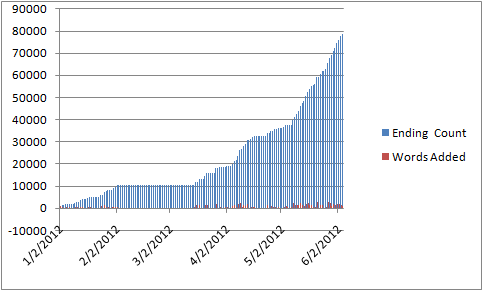
Here’s a few stats on the novel:
| Total Number of words | 78512 | |
| Date Started | January 2, 2011 | |
| Date Completed | June 4, 2011 | |
| Total Number of Calendar Days from Start to Finish | 155 | |
| Average #of words all days | 510 | |
| Total number of days of writing | 76 | |
| Average #of words on actual writing days | 1033 | |
| Total Number of “Excused Writing Days” | 67 | Days working on other stories, traveling, sick, working from home on a deadline, surgery, broken laptop, reviewing plot plan, etc |
| Total Number of “Unexcused Writing Days” | 12 | Days with no good excuse for not writing |
| Largest Word Daily Word Count | 2912 |
In the graphs below, the long stretch of zeros from February 3, 2011 to March 14, 2011 has to do with a major edit of my previous novel, Army of the Risen. I wasn’t being lazy. That interruption, plus a relatively unproductive stretch in late March due to surgery. Those days make up the majority of my excused writing days.

It’ll be a few months before I send this out to anyone, but I think it has legs, and once I clean it up, it’s going to be one people will genuinely like.
Time to get out and enjoy the weekend.
I’m getting very close the end of my current work in progress. I spent most of the last two days’ writing sessions working on the climactic scene, which is quite possibly one of the longest chapters I’ve ever written. The book is up to 76167 words, which is 14030 more than it was on my last update nine days ago. There is a zero word day in there on a day I didn’t actually start up my computer, so on the days I did write, I averaged over 1750 words. Not bad.
As I am writing, I am already making notes for things I will change or fix in my next edit. As I said in another entry, at one point I took my main character out of the room during a major scene, and I think that really hurt the middle of the book. In the climax of the book, I somehow left my main character’s archenemy out of the scene, though the hero does have to battle the henchmen. I think I’ll probably rework this to give it a little more oomph, though as I have been writing it, I’ve really enjoyed the action of this chapter. We’ll see how it seems in the read through.
I think, after the completion of my current chapter, I’ll have 3-4 more small chapters left to write, which amounts to about 5000-6000 words. I should be wrapping up on Sunday or Monday of next week. This first draft is a little longer than I thought it would be, but a lot will change in the next edit.
I’m still really looking forward to being done this one, but I really do like the last couple of chapters that I have written, and I know this story is a good one. I just have to correct the mistakes I’ve made in the middle of the book, and see if I can’t keep the action going throughout the story.
 Before Susan Collins’ career caught fire with the Hunger Games, she wrote a series of books about a boy named Gregor who falls through a grate in the laundry room of his New York City apartment building, and into the Underland, a place where a few humans have chosen to live amongst giant cockroaches, bats, rats and spiders. Gregor’s fall doesn’t hurt him, but it does leave him and his sister, “Boots” stranded in a strange and mystical land, full of danger and mystery. He becomes known as Gregor the Overlander, and this is the first book in the series.
This book is targeted more towards the nine to eleven year old crowd, than towards the YA matter I normally read, and as such, it’s a bit of an adjustment. The vocabulary is, of course, simpler, the dialog very plain, and the conflict far less gory than most of the books I read. It’s a quick read as well, at somewhere between 60000-65000 words.
It’s a good tale for the crowd it is targeted to, and I would have no qualms about giving it to my kids when they reach that age, as long as it doesn’t give them nightmares. I’m not a big fan of creepy-crawly things, and am a life-long arachnophobe. Scenes with giant spiders, especially when well written, scare the bejesus out of me. But these spiders weren’t over-the-top scary, so I think most kids will be able to handle them.
If you’re an adult though, and you ‘re looking to pick this book up because you liked the Hunger Games and like YA and want to read more of Susan Collin’s writing, be forewarned, that this is nothing like the Hunger Games. It’s a completely different genre, and you are likely to be disappointed. But if you like children’s books, or just want to pick up something you think your pre-teen kids will like, give this a try. It’s a good re-introduction to a genre you probably haven’t read in a long, long time.
As I wrap up the first draft of my fifth novel, I’ve come up with a list of lessons I’ve learned from writing them. Some of these are mistakes that have cost me a lot of time. Some are things that have really helped me to become a better writer as I’ve moved from book to book and scene to scene. I don’t mind making mistakes. They teach you a lot. But I hate making the same mistake twice. I also appreciate that it’s hard to learn from other people’s mistakes. Ignore / dispute these as you see fit. If you have some of your own, I’d love to hear them.
These are in no particular order.
- If you are writing in the first person, never take your main character out of the room, unless you are writing a mystery. Your main character is the reason the story exists. If he / she isn’t in the room when the big events happen, then why are they your main character? No one wants to read about someone learning about an incident second-hand. You lose the emotion and the urgency. Put your character in the room. Put them in the danger. If they shouldn’t be there, or couldn’t possibly be there, you may be writing about the wrong character.
- Take the time to outline your book. Maybe it’s a one hundred word pitch that you would use to sell the book to an agent. Maybe it’s a one page synopsis. Maybe it’s an act by act or chapter by chapter breakdown. Maybe it’s a full 9000 word treatment that describes every plot point. Maybe it’s all of those. On my last two books, I’ve done the first three, and while I’ve still made other mistakes, I’ve at least had a plan that I could refer back to when I got stuck, and I wasn’t wandering aimlessly for days.
- Know your genre, and what the appropriate length is for a first book in that genre. If you are writing young adult, and your story is over 80000 words, you’re probably in trouble. JK Rowling was able to exceed that number only with the fourth book of Harry Potter, written after the success of the first three. Booksellers just aren’t willing to give that much shelf space to a new writer. Sure E-Pub may change that, but consider the reader too. How likely are you to pick up a 600 page book by a writer you have never heard of? Word count alone is just a guide. If you have so much dialog that 60000 words has eaten up 350 pages, you’ve got a different problem.
- Character and place names are critical to get right. They set the tone and convey history with just a name. Bob Smith is an ordinary man. Roland Deschain is a man you don’t want to mess with. If you want a real lesson in naming, reread Harry Potter. I’m horrible at coming up with names. It’s something I really wish I was better at, and something I will spend a lot more time on before I start my next book.
- Try to keep the length of your chapters consistent. Readers want to have a basic idea of how long your next chapter might be so they can decide whether or not to start that next chapter before they go to bed (Credit Jason Black for that tidbit).
- Read about writing. It’s a craft and it’s not something many people just know how to do. It takes practice and study. Start with Noah Lukeman’s The First Five Pages.
- Write every day. It’s amazing how much momentum you can build up by doing that. Conversely, taking a day or two or three off can completely kill your momentum. Writing is not something you can just do when you feel like it. It’s too easy to not feel like it all the time.
- Don’t just write every day. Get a routine that you stick to. Write in the same place, at the same time of day. Only when you’ve been doing that successfully for a while should you be willing to break the habit and try other places. You need the muscle memory of sitting down in that one chair, or in my case on that train, to kick in. Your brain will learn to turn on as soon as you sit down, and you’ll be writing without even trying.
- Join a writer’s group that has the same goals you have. Having your relatives and friends read your manuscript is great for your ego, but not for your career. A writer’s group will get you used to hearing bad news, and a good one will give you constructive criticism. But make sure you all have the same or at least similar goals. If there are people in the group who just want to write poetry, and you want to write novels, chances are good someone will be disappointed.
- Format your manuscript correctly from day one. It’s a lot easier to send it out to a group or to an agent when you know that it’s ready to ship as soon as the typos are gone. The submission world still revolves around the following standards:
- 12 point Times New Roman font for the body
- 1 inch margins all the way around
- Double spaced
- Author Name/MSS Title in the top left corner of each page (inside the 1” margin)
- Page number in the top header (inside the 1” margin)
- Track your writing stats from day 1. It’s great motivation and the numbers can be very interesting. I include the date, number of words written, running word total to date, where I wrote, any major interruptions, and what I was working on. Other people I know track the time they spent writing as well.
- Your first book is likely to be autobiographical, or at least the main character will have a lot of your traits, and will suffer from that. You’ll say it’s not, but it will be. Very few people will write a first book that is publishable because they are too close to it. That’s fine. Get it out of your system, learn from it, and move on. It may be a great book, and maybe it should be published. But I’d bet number two will be better, and you’ll realize that as soon as you finish the first draft of the second one.
- Never put your main character out in the middle of nowhere by him/herself for the entire book. There’s not a lot of dialogue in a wilderness novel without a bunch of flashbacks. And you’ll get as tired of writing it as the reader will reading it.
- Never write the second book in a series until after the final draft of the first one is done – as in the first one has pretty much gone to print. You’re wasting your time, and the editing process on book one might be so brutal that book two has no remaining connection to book one.
- Saying book one of a series has to be slow because all the action/emotion happens in book two means that the action will never happen. There is no book two without a sold book one, and a slow book one means no book one. Don’t hold back on that first one. (Credit to my Agent, Sally Harding for that sage piece of advice.)
- Read. When you’re not writing, and not holding down that day job, you should be reading everything you can get your hands on. Read with a critical eye. What was edited well? What techniques did the writer use to get you invested in the story? If the story was bad, or the writing terrible, what did the author do wrong? Take a book with you everywhere you go.
- Turn off the TV, or at least watch good TV. This does not mean infomercials or Reality TV. History Channel. Fine. Discovery Channel, OK (once in a blue moon). Judge Judy. No.
- Stop playing video games. I lost the better part of a year and a half to World of Warcraft before my kids were born. I enjoyed it at the time, but looking back now, what a waste. I could have written 3 novels in the time I played that game.
- Don’t quit your day job.
- Don’t give up when you get a bad review.
- Save early, save often.
- Make frequent backups. At least daily. Use a service like Mozy or KeepVault. If you have multiple PC’s, use LiveMesh.
- Backup your master copy before you start a major set of edits, and give it a useful name. i.e. TheAdventure_v_1.1.docx so if you accidentally delete a scene or a chapter, you can roll back to the last full version.
- Shelve the book for 2-3 months between edits to give your brain time to distance itself from the story. Write something else during that time. If you’re thinking that your next draft is going to completely change the entire book, it’s time to put it down and write a different book.
- Work on one thing at a time, and work it through to the end. While I have had some success by working on edits of other books for a few weeks while in the middle of writing one, the style and the story changes once you have been away from it for a while. That’s not always a bad thing. I learn a lot from editing books that I immediately apply to the next one I write. But there’s a danger you might lose your enthusiasm for the story, and the reader will notice the change in style.
Okay, this has been a long post, but I put it together over a number of days. I’m sure there are still things I’ve missed and I’m sure I’ll learn more from my next book.
For me, finishing my fifth book is something of a milestone. For me, it tells me that I am physically and mentally able to write, and that I have battled through procrastination and “writer’s block”, and given even a couple of words for a starting point, I can associate 80000 more words to it and turn it into a story.
But the learning process never ends, and I hope my next novel is the one where I really put it all together, and write that breakout book.
Progress on my work in progress came in big chunks since my last post. At the start of my writing day on May 15th, I had 48577 words. Today I ended the day at 62137 words. That’s 13560 words in 9 days or an average of 1506 words per day. My low was 428 words and my high was 2921. The 2921 words I wrote last Saturday while sitting in a perfect writing chair at The Bookery, a book store / coffee shop in Ephrata, Washington. I was visiting my in-laws, and while Grandma and Papa were watching the kids, I snuck off for some serious writing time. Three hours of solid time at the keyboard, and the numbers to prove it.
I’ve completed the setup for the third act, and will begin writing towards the climax tomorrow (or later tonight if I don’t get get trapped on the couch watching Sons of Anarchy again.)
My gut tells me I have somewhere around 6 chapters left, at 2000 words each, which should bring me in around 75000 words, give or take a few. That’s about right. Looks like the end of next week, if not earlier, figuring that this is a long weekend and I don’t have any major plans besides some outings with the kids. That’s the good news.
The bad news is that I’ve pretty much convinced myself that I am going to have to completely rewrite the second act of the book. Probably 20000-25000 words. I’m not excited about that, but I know it’s the right thing to do. But I’m also not going to do it right away. I’m going to do a quick read through edit after the first draft is done, then let my readers read it. Then it will sit on my shelf for a few months while I do edits on The Forgotten Road and Army Of The Risen.
It’s important to let a book sit a while after the first draft is done to let it breathe. The time away creates the distance you need to look objectively at it. It’s crude, but I always say that time away gives you the ability to “Kill your babies.” – those sections you just love, but don’t contribute to the work as a whole. You can’t see those sections when you are too close to it. It also prevents you from deleting the sections you should keep that give the book the feel and the flow you originally intended.
Right now I’m ready to be done with this book. I’ve been working on it off and on since January 2, 2011 and five months is entirely too long for a first draft to take. Some people may work on a book for ten years, but that’s not me. I see the story unfold in front of me as I’m writing, and taking too long to write it makes it seem like the story is slower than it is. I would prefer no more than 90 days from Chapter One to The End. That’s under a thousand words a day, and totally achievable. Keeping the flow going over five or six months is just too difficult, and it really starts to affect me personally to have it hanging over me like the Sword of Damocles day after day.
And besides, I came up with a really cool new story idea over the weekend, and I really want to dive into that one!
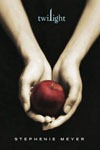 That is not a typo or a joke. I actually read Twilight. And I read 450 of 498 pages in a single day. Before you lose all respect for me, let me explain a few things.
First, I write Young Adult Fiction. For a long time, I didn’t know that I did, but I do, and that means, as I writer, I have to read from the genre that I write. Why? Because it’s been over twenty years since I’ve been a teenager, and my memory of what teens like and what they think is based on liking 80’s hair band music, reading J.R.R. Tolkien and Stephen King books, and watching the Karate Kid and Top Gun.
Yes, I am old. Yet I write YA Fiction because I like characters who are inventive and optimistic and courageous and emotional. I find stories filled with older characters to be a little depressing and cynical.
Okay, so why Twilight? Simple. Because it’s popular. If Twilight is what is (or was) hot, I need to read it. Call it hazardous duty if you want, but as a writer, you need to realize that your target readers decide what is good, and if you can’t get in touch with them and see what they see, you’re going to miss the mark. When I was at the PNWA Conference last summer, Amber Kizer did a wonderful session on writing for YA, and insisted that all YA Authors read Twilight. Not because it’s good, but because our target readers think it is, so there must be something there.
Okay, enough justification. You either believe I read this book as research at this point or you believe I’m a closet fan of glittery vampires and need me some Bella and Edward and Jacob to fill some deep need in my life. I’m not going to spend any time on describing the plot. Okay, well a little. A deeply neurotic girl moves to Forks, WA, falls in love with a glittery vampire, and is chased across the country by another vampire. There. That’s the plot.
The common complaint that I’ve heard about the Twilight ‘Saga’ is that Bella never grows up. She’s always whiny and self centered and over the top from beginning to end. There is the opportunity for her to grow throughout the book, but she never really does, at least not in her tone. I suppose she thinks she is self-sacrificing in the end, but she does it in a whiny way, and that bothers a lot of folks.
The vampires are very pretty, and that bothers a lot of folks too. Vampires are supposed to be moody and dark and dangerous. But not glittery.
Okay, so the characters needs a little bit of work to move this book from where it currently resides in the young adult paranormal romance category to high literature.
There are some pretty big head shakers in the plot too. Things that are just a little bit over the top. The baseball game was it for me. Some people will say it’s the glittery vampires. I’m actually okay with that. I appreciate a fresh take on a very well-worn metaphor.
Yes, metaphors abound in the subtext, and they’re not well disguised. You don’t have to think very hard. Girl moves to small town and is the outsider. Doesn’t respect the kids who are already there, and sees herself as better. Falls in with a dangerous crowd. But one or two in the crowd are just misunderstood teenagers. They’re dangerous to others, but not to her.
It’s all about the angst that every high school kid faces. Everyone thinks they’re the outsider, even the beautiful ones. They’re not popular enough or smart enough, or they’re abused at home or have a past mistake they cannot take back. Bella is all of those teenagers reading these books who fantasize about being more grown up than they are, and making decisions that take them away from their own personal hell. That’s why teenagers read these books. It’s escapism, and it speaks right to them. They don’t have to look hard to figure it out. That’s the appeal. That’s what authors need to remember when they are writing for the YA audience. Teenagers want to believe that given the opportunity to take control, they could make it on their own. They want to see other teenagers do the same.
So is it a good book? Let me put it this way. I read 450 pages of it in a single day. But I probably won’t read book two. I didn’t get violently ill or cry out “OMG it’s horrible”, or break out laughing at the absurdities. It’s not the worst book I’ve read. It’s not even the worst book I’ve read this year. So hey, I’ll go as far to say, it’s not all bad. In the battle for best Saga of the last fifteen years, Harry Potter wins hands down, but Twilight hit a mark, so it shouldn’t be totally discounted.
The good news (for everyone) is that I won’t be writing paranormal romance any time soon, nor will I have vampires or werewolves in my stories. Wait… scratch the werewolf part. I actually have a short story I wrote in high school with a werewolf. Maybe I should dust that off and see if it’s got any legs…


 Joe Beernink