
I will remember 2011 as my year of pain. Physical pain that is. Two foot surgeries. One dislocated shoulder. A trip and fall that cause wounds that took 5 months to heal. Overall, a year that I hope to not have to repeat, physically at least. It’s a damn good thing Groundhog Day isn’t a true story. I’d be the Ned Ryerson of 2011. Bing!
One of the impacts of being incapacitated so much is that I’ve gotten way out of shape. I put on a significant amount of weight this year, and have only been heavier once in my life. It’s not a comfortable feeling, and I was not happy when I looked at myself in the mirror. It also affected my energy levels, and that’s not a good thing when you have two little kids that you want to play with. They learn by example, and when they see you sitting around, they tend to sit around too. Running around with my kids outside for 15 minutes put me back on the couch for a half day, unable to do much more than waddle to the kitchen and back for an ice pack.
Back in the late 1990’s, I did a lot of long distance bicycling, but by the end of November of this year, the thought of even walking a mile was exhausting.
So, at Thanksgiving I took advantage of a Black Friday sale and bought a new toy. Well, it’s not a toy exactly. More like a slave-driving-taskmaster that will whip my butt back into shape.
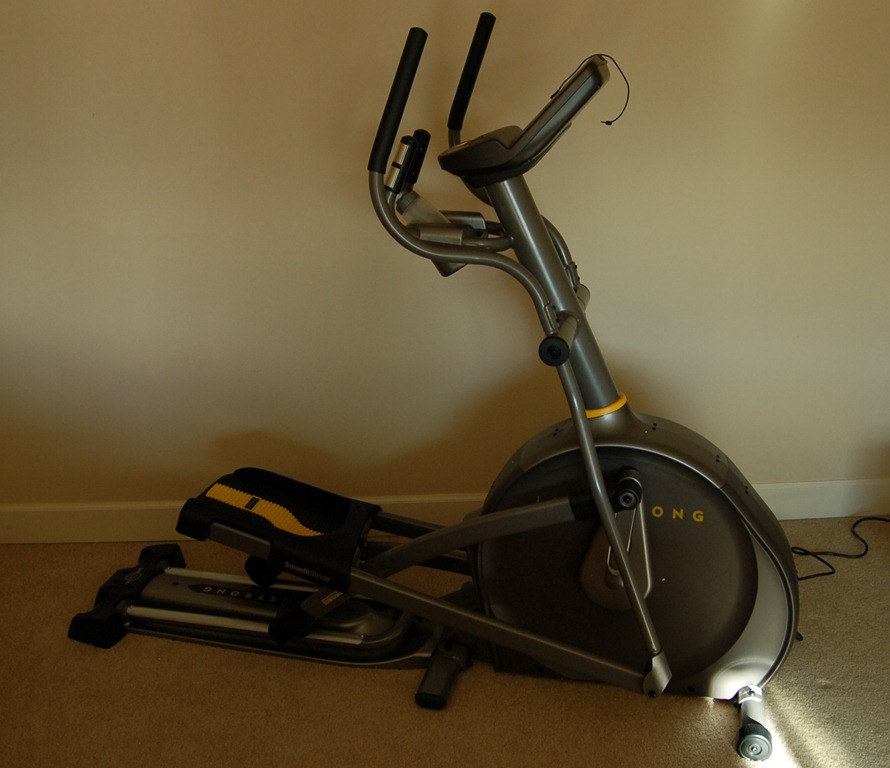
It’s a LiveStrong 10E Elliptical Machine. I had actually tried out a bunch of Elliptical machines over the last few months, and kept waiting for this one to go on-sale. It seemed to be the best balance between price, size, and features, and fit my stride pretty well. It also has a pretty small footprint compared to other elliptical machines, which is key if you aren’t going to put it in your garage.
It was delivered a week ago, and I’ve done 4 workouts on it since. I love it. At first I couldn’t do 15 minutes on it, but now I’m up to a full 30 minutes, and am starting to increase the workout level. The machine is smooth, quiet, and stable. We’ve got it set up in our bedroom, and I can either turn on the TV or put music or a podcast on my IPhone and dock it to the built in speakers. The 30 minutes fly by.
After just 4 workouts (plus my usual weight lifting on alternate days), I feel so much more energetic. When I know I have an evening workout planned, I’m already looking forward to it when I wake up – much the same way I used to look forward to my long distance rides fourteen years ago. I don’t think it will take long for me to drop the extra weight I put on this year and get back into shape.
The only problem I’ve had with the system is with the “download / upload your workout” capabilities advertised with the system. Supposedly, I should be able to go to LiveStrong.com and upload my workout history via a memory stick and chart my progress over time. I haven’t found the page on the site that allows me to do this yet, and I’ve pretty much given up on that. It’s just not documented very well if the capability is there, and I’m not going to keep hunting for it.
If you’re looking for an elliptical machine, or if you’re out of shape and you’re serious about getting back into shape, I think this is a good place to start, and I’m looking forward to a much better 2012 because of it.
Today is absolutely gorgeous in the Pacific Northwest. Here’s proof. This is the view from my bedroom window. That dark object beyond the trees? The sleeping Mount Rainier. Shhh. Don’t wake it.

What’s remarkable is that this is December. In the PNW. And we have sunshine. On a Saturday.
Crazy. I know!
Yes, the blog has been quiet lately. It goes through these lulls when I get busy. I did read a book last week, but it’s a book that I am reviewing as part of my writer’s group, and it’s by an author you might have heard about. It’s good. Hopefully we’ll see it in print in the near future, and then you’ll hear a lot more about it here.
Other than that, I’ve been heads-down editing since the middle of September, first on my book Labeled, and then on my book, Nowhere Wild. Both edits are now complete. The first 25 pages of Labeled is in front of my writer’s group and I plan on submitting that for the PNWA Literary Contest next year. Entries are due by 2/17/2012. I’ll spend a bit of time over the next couple of weeks cleaning up the synopsis. and getting everything ready to send out.
Nowhere Wild is also in the hands of my writing group. I’m a little nervous about getting feedback this time because my writing group is pretty spectacular when it comes to writing credits. Plus, I’m getting close to the end of my rope on just how many full edits I can do on a single book. I know I can do ‘as many as it takes’, but I’m really hoping I can get to the point of “It’s pretty damn good. But you have an extra comma on page 236”.
With both of those stories wrapped up, I’m taking a short break over the holidays to do some reading… and some blogging. I’ve got 3 other books that could use a good edit, but my brain is telling me to take a short hiatus. Only one of those three is stand-alone (Army of the Risen) . One is a book that will probably never see the light of day (To Cage the Eagle), but that doesn’t mean my OCD won’t let me try to make it better, and the other is the sequel to Nowhere Wild (Nowhere Home). I’ve learned my lesson about working on the sequel before the first book is finalized. It’s going to need to be completely re-planned and rewritten since the plot of the Nowhere Wild changed so much, and I don’t want to do that more than once.
It may sound like I’m down on writing right now. I’m really not. I want to do more of it. I’d love to be able to turn out books like Zane Grey or Stephen King. But I don’t have that kind of time in my life right now, and I need to pace myself. My goal is to become a better writer so I don’t have to do so freaking-many editing passes through each book before it is ready to send off to my agent. So I guess I am just down on editing, not writing. I wish the two weren’t so… connected.
I can’t wait to start on a new story, and I’ve been resisting looking at my “What if” file to see which idea seems to have the best legs. But I want to make sure at least one of these stories I’ve already got done is “out the door” so I can dedicate a long stretch of time to a single work without worrying one of the old ones is waiting for another turn with the red marker.
So that’s the plan for the next two or three weeks. If I can just keep that “What if” file closed, everything will be just… oooh… wait… What if there was this guy, see…
EDIT 3/14/2012 – The Puyallup Writers Co-op is no longer meeting, as far as I know, and I am no longer involved with organizing it. Please contact the Puyallup library directly if you have any further questions.
Since March of this year, my friend Ben Newland and I have been organizing a monthly get-together for writers in the Puyallup, Washington area. For those of you not familiar with the South-Puget Sound Area, the City of Puyallup is about 4 miles east of Tacoma and 35 miles south of Seattle. Ben came up with the name “Puyallup Writers Co-op” and the name has stuck.
We meet once a month at the Puyallup Public Library. The meetings are usually on the first Monday of the month, though occasionally we bump it back a week to accommodate holidays like Labor Day, and in next month’s case, the New Year’s closure of the library.
We’ve had pretty good turnout each month, though it hasn’t yet been consistent. We’re hoping for 15 people per month. Once we reach that interest level, we plan to begin having guest speakers and other events.
For now, our focus has been improving our craft through critiques and writing exercises pulled from Noah Lukeman’s wonderful book The First Five Pages.
The meetings are open to everyone from teenager on up. More information can be had at our new Facebook page. Click the like button, and you’ll be notified of any announcements or changes in the agenda.
Hope to see you there.

I had no idea what Neil Gaiman’s American Gods was about when I picked it up at the local library a couple of weeks ago. I didn’t even bother reading the cover before I brought it home. I had added it to my ‘must read list’ earlier this year when it came in at #10 on NPR’s list of top 100 Science Fiction/Fantasy Books of all time. When I saw the book on the shelf at the library, it practically leapt into my hands.
Not knowing the topic of a book, or the style of the author, can lead to an interesting experience in those first few minutes of reading. I was just coming off reading C.C. Humphrey’s wonderful (but disturbing) book Vlad, The Last Confession, and I was ready for something light – something I could read in a couple of days. American Gods, at 588 pages, is not light in weight, nor in words. This is literary fantasy, so you know you’re going to have to work to get it – to get all of it. But the book has a good, strong hook, and pulled me in before I realized I wasn’t reading something fluffy.
Shadow has recently been released from prison early due to the death of his wife. On his way back to his home town for the funeral, he meets a man who knows him all-too well, and seems to always be one step ahead of him on his journey. At first aggravated by this, then irresistibly pulled in by this man, Shadow soon finds himself dropped into the middle of the battle to end all battles, where gods themselves tremble in fear.
As the book started, I tried to figure out what I had read that was similar to this. I can think of two stories that come close: Richard Kadrey’s Sandman Slim, and Stephen King’s The Gunslinger. Kadrey’s book is more… ruthless… and King’s epic series, is , well, more epic, given the fact that it’s seven books, not one. If you liked either of those works, you should like American Gods.
As I said, this book is literary fantasy, which means that it is not always an easy read. The pace is lot slower in this type of work than say, in a John Scalzi book. There are long paragraphs of description and irregular prose… words and sentence structure there more for the artistic effect than for the story. That’s not a bad thing. It’s definitely not what I write, and I noticed it a lot more because I am editing one of my stories right now. I have to be hyper-conscious of not doing some of the things that Gaiman can do because of the type of book this is. In one memorable section, I saw back-to-back sentences with 130+ words. They are there for effect, and I understand the effect he was looking for, but in the style of story I write, those practices would be far more jarring to the reader and would likely be trimmed at an early edit.
If you are a hard-core fantasy or sci-fi reader, this book should be on your list. It’s a good book, with interesting characters, and it held my attention. It’s definitely not what I would call an easy read, but it is worthwhile, and a good book to curl up with on a cold, winter evening.

No too long ago, I raved about C.C. Humphrey’s book, A Place Called Armageddon. At the risk of becoming repetitive, here we go again – another C.C. Humphries book set in the dark times of the mid-1400’s, another book worthy of the term ‘Historical Literature’, and another book that deserves critical acclaim for its prose. An oh… the single most disturbing scene I have ever read in my life – two paragraphs that still give me the chills a week later.
This is the story of Vlad the Impaler, not the Count Dracula Bram Stoker made famous through his tales of vampirical practices. Vlad the Impaler – Vlad Dracula, Prince of Transylvania, Son of Vlad Dracul. Son of the Dragon. He was known by a dozen different names, and the fact that he was known by all these names at the time he lived indicates just how well-known, and how well-feared he truly was.
The story starts with the capture of the three people who knew him best: his best friend, his mistress, and the priest he confessed to. The first twenty pages are a bit convoluted, as each of the three is brought before a papal commission, bound to find the true story of the man. The true story begins with Vlad’s childhood, as a hostage in the hands of the Sultan Murad and the father of Mehmet, the boy who would become Vlad’s life-long enemy. From there, we follow Vlad as he grows and becomes a man, and from man to legend. Along the way, we trace the battles he fights and the atrocities he commits.
As we follow him, we see the world through his eyes, and his reasons for doing what he did. We’re forced to pity him, to root for him, to like him, then to pity him once more. Humphrey’s does an excellent job of playing with our emotions and taking practices that would be abominable today, and making them necessary for the common good of that time.
This is not an easy book to read, and parts are not enjoyable – nor should they be. This is not commercial fiction – you have to really read and let the words flow over you. Every paragraph is hammered in the forge of Humphrey’s craft. But it is a book worth reading because of that craft, and because it is interesting in its topic and fascinating in its detail… and disturbing in its images.
If you like historical fiction, I highly recommend this book. If you’re looking for sparkly vampires… go somewhere else, kid. This is deep, and it’s dark and it will be hard to forget.
In case you are wondering, the two paragraphs I spoke of earlier… two paragraphs that will haunt me forever… the end of page 101 and the start of page 102. I dare anyone to read those two paragraphs and not clench every muscle in their body. Very few books have ever caused that sort of visceral reaction in me, and the only other one I can think of off the top of my head was Stephen King’s The Shining, albeit for completely different reasons.
Read. Enjoy. But be forewarned.
I’ve reached that point in my recovery from surgery where things are starting to get back to normal… at least in the respect that I’m now expected to get my own cup of tea and the kids are no longer giving me the benefit of the doubt when I say “Daddy’s recovering. He needs quiet time.”
I’m also at that point where I can drive in to work a couple of days a week (though stop-and-go driving is actually still painful). So life is returning to normal, and I’m getting less done.
What? Getting less done?
Maybe it just seems that way.
It’s all about the mornings for me… and well, the afternoons too, but the mornings are killing my productivity. I’m a morning person. Always have been. Always will be. There were a few weekends in college where I slept past 10 AM, but, in all fairness, those followed the nights where I didn’t get to bed until after 4:00 AM. What? I was studying. Ahem.
My normal wakeup time when I’m taking the train into work is between 5 and 5:25 AM, depending on which train I want to catch. On those days, I write on the train on the way in and on the way home. I’ve gotten a lot of writing done that way over the last 3 years.
But working from home has made me somewhat more lazy. Friday morning, I didn’t get up until 5:45AM. Crazy, I know. I wrote for about 45 minutes before breakfast (interrupted 3 times to help my son turn on the TV to watch Ironman – Armored Adventures, his current favorite show on NetFlix.) Then it was off to work – a five foot commute from the comfy chair in my office where I write, to my desk chair where I do my day job. I sat there for about 8 or 9 hours with a brief stop for lunch. I’m incredibly productive (for my employers) when working from home. I bang out more code and fix more bugs in a day of working from home than a week in the office. My only distraction at home is watching the garbage truck and its amazing robotic arm pick up the neighbor’s recycling bin and throw it up into the air.
On days where I ride the train, I get that afternoon writing session on the way home. On work from home days, I cannot stand to be in my office for even another minute. So I usually either move to the couch and watch something on my NetFlix queue, or, if I’m feeling good, go out to the garage and get a workout in. Option A usually wins out.
On days where I drive in, I get even less done. There’s no morning session, or afternoon session. There’s just my 35 mile commute each way, which kills my ambition for the rest of the day. I hate driving in, and have said a thousand times that if I had to do it every day, I would quit.
It’s not that I haven’t been getting anything done. I have been editing ‘Labeled’ quite productively over the past few weeks when I do get time and energy to sit down. As of this morning, I have just 4 chapters left to edit, but two of those will be complete rewrites. But because of the unusual schedule, the fact that I am ‘just editing’ and not doing it consistently, I don’t feel as productive as I have in the past. For me, as a writer, nothing feels as productive as tracking the word count on a new story. Editing just doesn’t seem to be as fulfilling. The editing cycle never seems to end.
But it’s not like there isn’t a new novel burning a hole in my mind right now that I just have to write. There are, however, the beginnings of something stirring. It’s going to get put in my ‘what-ifs’ file today, and perhaps get expanded over the next couple of months. I’ve got too much editing I still need to get done this year to start on something new, but come the New Year, I want to have a plan in place for the next story.
So, yes, life is getting back to normal. And maybe the new normal for me as a writer with 5 books ‘done’ is always being in an editing cycle. But I can’t wait to get back to working on a new story. Life just isn’t the same when I’m not.
 I purchased Motorbikes & Murder at the PNWA Conference in the summer of 2011, after meeting the author, A.C. Christensen.
The plot centers around a female ex-Marine named Mackenzie Merrywood who is riding her motorcycle around the Olympic Peninsula in Washington State, bound for California. She meets up with a group of female bikers and though she is seeking the isolation and solitude of riding the open road by herself, joins up with this ‘gang’ after a run in with a trucker. Mackenzie stays with this group as they ride along the Pacific Coast and follow the Columbia River, heading towards Sturgis, South Dakota for the big rally. Along the way, the group runs into more than a few problems, including a serial killer with a penchant for cutting the hair off his female victims.
This is a self-published book, and, unfortunately, it really shows. As I said in a previous book review of a self-published book, just because you self-publish doesn’t mean you can take shortcuts in the process. Just because you can hit that publish button and make your work available to the public, does not mean you should.
I’m pretty understanding of books that have subtle plot problems, or books where I’m just not the target audience. Those types of books I can read, and say “It wasn’t for me, but I would recommend it to people who like X”, or perhaps draw a small lesson for my own writing out of it, while at the same time praising the writer for the their style or their prose.
But I have a really hard time being gentle with books that I paid for that weren’t even proofread. I’m not talking about developmental editing (plot) here, or even line editing (editing to make the prose more efficient). I’m talking about spelling mistakes, capitalization errors and basic grammar errors. I’m talking about knowing the difference between “their, there and they’re” and “its and it’s” and “too and to” and “conscious and conscience”, and doing the little formatting things like properly denoting thoughts with italics. There’s a grammar error in the first line of Chapter One. There are three proper name errors in the first paragraph of Chapter Two. There are spelling errors in the titles of some of the chapters.
These are all things that should have been caught with a simple re-read by the author. Yes, it is hard to catch some of these things, but hard is no excuse. There’s no excuse for an author not to know some of these basic rules of the English language. Buy Strunk & White’s Elements of Style and read it. Really. Actually read it. Don’t just have it on your shelf, collecting dust. Open it to a random page every day and read the page until the contents are all second-nature.
Copy edit issues aside, how was the rest of the book? Well, since there was no copy-edit done, it’s pretty safe to say that there wasn’t a lot of time spent on the line-edit. The dialogue did have something I’ve never seen done before. It lacked contractions. “I am” instead of “I’m”. “You will” instead of “You’ll”. Yes, the meaning of the line is the same, but we’re talking about motorcycle-riding bad-asses here, not 18th Century English school teachers. Authors, speak your dialog aloud. If you are tripping over it, it’s time to edit.
Also, when the characters were swearing, the text censored the words “sh**” instead of “shit” and “f**k” instead of “fuck”. Really? We’re talking about serial killers and rapists who get their dicks cut off, and you’re worried about the letters “it” and “uc”? No. Don’t do that. If you want to have your characters swear, let them swear. If you want to keep it clean, don’t let them swear. Say they cussed, or raged, or something. Don’t censor. It makes the writing look timid and makes the author look frightened of words.
A small point on character naming, but one authors shouldn’t forget. Name the characters with appropriate names that give the reader an impression of the character. There were a few characters I just didn’t get a good feel for because the names were generic. And be aware of over-using certain sounds or letters. I counted at least four characters with names that started with M, and three of those also had last names that started with M. There are 26 letters in the alphabet. Make use of them all.
As for the plot itself, if you are going to write a murder mystery involving the police and FBI (don’t call it the F.B.I. bureau for god’s sake), keep the actions of the agents and officers involved real. Learn their language and follow protocol. Make friends with a retired cop and have them give you feedback. Read Just The Facts, Ma’am by Greg Fallis. An FBI agent will not search a suspect’s motorcycle without cause or a warrant and pocket evidence for use later. The agent will not let crimes slide just because they are on vacation.
Spoiler Alert: The end of the book involves a chase that goes from Sturgis, SD to Sedona, AZ, through Denver, CO and Gallup, NM, where the hero chases the villain through the night on her motorcycle after having been awake for something like eighteen hours before starting the chase. Mackenzie rides from Sturgis to Gallup without an extended stop. That’s over 970 miles of highway and mountain road. 16 hours of riding. My father-in-law figured that one out. I used to live in the Denver area, and I once drove from Moab, UT to Denver (a much shorter trip) after a three day mountain biking trip on the White Rim Trail. I was driving a car, and had 3 hours sleep before I started, and I still needed to stop in Vail for 2 hours of sleep just so I could see the road clearly. It’s been a long time since I’ve ridden a motorcycle, but 16 hours (at best) sounds utterly implausible. What’s worse is that the trip wasn’t necessary in the first place. A much shorter trip could have had the same effect, removed the implausibility and ratcheted up the tension.
I was a little frustrated with this book yesterday as I was reading, and I posted a few thoughts on Twitter when I took breaks. I wondered how literary agents could read stuff like this, day-in and day-out. The answer was, they don’t. They stop reading after a page or two or twenty at the most, and throw it away if it is not working. If I had a job in the publishing business, I would have to get used to doing this. It didn’t take me long to read this book (it’s only 244 pages) so, perhaps 4-5 hours of reading. I’ve been trapped in my house for the last few weeks, so 5 hours doesn’t seem like as much time wasted as it would if I had lots of other things to do. But I swear this is the last time. I’ve now pretty much sworn off self-published books unless I really know the author and trust that they did the basics to make the book readable.
Self-publishing, as someone said at the PNWA conference, has taken the slush pile and moved it from the agents’ desk and put it in the public’s lap. Half-hearted efforts like this really don’t do anything to change that impression. This book received a number of 5 star reviews on Amazon.com. I can’t believe those reviews are honest and not planted. This isn’t the first time I’ve seen this happen, and as a consumer who buys books based on recommendations and an author who hopes to someday have some recommendations, this behavior is really bothersome and should not be encouraged.
If you want to self-publish a book for your family and friends to read… some kind of family history or personal story, with no intention of commercial sales, self-pub is a great way to go. But if you really want to write for public consumption, please refrain from hitting that publish button until you’ve had a professional editor review your work, and you’ve fixed everything they’ve told you about, even if the thought of doing another edit depresses the crap out of you. A corollary to that rule: If you’ve never gotten depressed from editing feedback on your manuscript, you’re aren’t getting it reviewed by the right people.
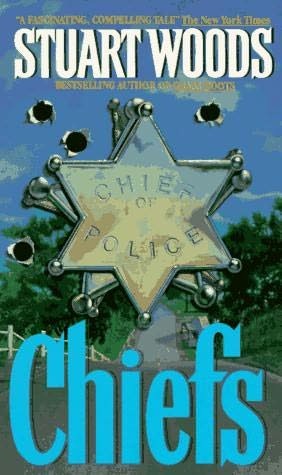 I usually don’t review books I read that I have read before, so this isn’t so much of a review as a gushing recommendation. If you haven’t read Stuart Woods’ book Chiefs, you really, really should.
The story is a complex, multi-generational tale of 3 police chiefs in the town of Delano, Georgia from 1920 through 1962. In 1920, Delano is a new planned town, in the heart of the old south, where the cotton industry has been decimated by the boll-weevil and slavery is not so long past. In this small town, race is always a puddle of gasoline waiting for a lit match. Each of the Chiefs, from fair-minded Will Henry Lee, to Klan backed Sonny Butts, to Tucker Watts – a man with a secret of his own – has their own challenges, including a murder committed on Will Henry’s watch that pulls them all in and threatens to destroy the town.
I first read this book back in the early 1980s, when I was 12 or 13. I also watched the mini-series as it aired back in 1983. I saw the book on the shelves at the local grocery store a few months ago, and couldn’t help but to pick it up. The climax of this book is one I have never been able to get out of my head.
Re-reading this thick tome (574 pages) was a very enjoyable experience. I liken the writing style to John Grisham… except that this book was written 8 years before Grisham wrote A Time To Kill. The characters are memorable and well-constructed. The story flows through three parts, and just keeps moving. If there is one thing I judge more harshly all these years later, is that the climax isn’t quite as good as I remembered it and is over far too quickly, but perhaps my memory had set the bar impossibly high.
I’ve had the Chiefs min-series on my Netflix queue for months, but as far as I know, it doesn’t yet exist on DVD. Hopefully someone in Hollywood rectifies this soon, and allows a whole new generation to get pulled into this amazing story.
There’s been a lot of chatter on the radio and on the interwebs recently about Generation X. Generation X, as defined by wikipedia is
“is the generation born after the Western post–World War II baby boom ended.[1] While there is no universally agreed upon time frame,[2] the term generally includes people born in the 1960s through the early ’80s, usually no later than 1981 or 1982”
Seeing as I was born smack dab in the center of that particular period, I am a Gen-Xer through and through. Like the rest of my cohorts born in 1971, I turned 40 this year. Oh-my-god, ring the bell, the Gen-Xers are now middle-aged. The media has turned its eyes upon us and find out that – to their great shock – we’re happier than we should be. They expected the latch-key kids from broken homes who lived through the recessions of the late seventies, early Eighties and the Nineties to be depressed and following the previous generation’s path to self-destruction. What they found, apparently, was that Gen-Xers got married later, but stay together more. They dote on their kids, but at the same time, work more hours per week than Gen-Y or the Millenials (the two generations that followed Gen-X). No arguments here. I’m still smack dab in the middle of that demographic (for the most part).
But these studies miss one critical thing. A generation is more defined by the events which occurred during it’s formative years than these studies give credit. Tom Brokaw’s Greatest Generation was defined by brave soldiers from World-War II and D-Day. The Baby-Boomers were defined by the anxiety of the Cold War and the Cuban Missile Crisis. I postulate that Generation-X’s formative moment occurred on January 28, 1986 – the day the Space Shuttle Challenger blew up, and to this day, that event affects our definition of what happiness is.
I can remember exactly where I was that day. I was 15, at home in my parent’s kitchen. We lived on a small family farm in rural Southern Ontario, Canada and I raised chickens to sell eggs for spending money. Don’t laugh – those chickens paid for a lot of my first year of college. The doorbell rang and one of our regular customers came in to buy eggs, and told us to turn on the TV: the Space Shuttle had blown up. I watched that television the rest of the day, seeing those 73 seconds play over and over. I didn’t know how much it would affect my life at that time, but I knew it would.
I was a space nut. I wanted to be an astronaut. I went to college three years later and majored in Space and Communication Science. On the morning of January 28, 1986, the chances that I would actually become an astronaut were slim (for many reasons), but I could see the future sitting on that launching pad. We were just getting used to these launches becoming routine. Our expectations had been set. The incredible had become normal, and we were going to build upon that. The shuttle didn’t just have seven courageous people on board – it had the dreams of all the generations to follow. Seventy-three seconds later, those hopes were the eighth casualty of a faulty O-ring.
It took 32 months before another Space Shuttle flew. In the grand scheme of things, two and a half years doesn’t seem like a big deal. But for a generation teetering on the edge of the computer revolution, thirty-two months was enough time for the big dreams to turn into small ones. Dreams went from building spaceships to building microchips. Focus turned from looking outward to big goals that had a long term vision for generations to come, to looking inward, and doing little things to make money today.
I don’t want to diminish the accomplishments of the last 25 years. The microchip and the personal computer have revolutionized the world. Businesses saved billions by making their enterprises more efficient through reduced overhead and waste, better reporting and reduced product fulfillment time. Capital was made more fluid and mobile. The gains in productivity in the US in the 1990s were driven by the computer revolution through the reduction of costs as manpower was replaced by megahertz.
But those incremental improvements came at an additional cost that is perhaps not so measurable. Businesses now expect their projects to have a return on investment measured in weeks or months, not years or god-forbid, decades. The attention span of executives is miniscule. In an age of 24 hour investment channels and day trading, it has to be. Executives who don’t pay attention to the daily stock price don’t last long enough to see grand visions come to fruition.
What does this have to do with Generation-X? How does the seminal moment in our history change what happiness is to us?
We were the generation that saw that shuttle blow up at an age when we were still making decisions on what we wanted to do with our lives. Our first exposure to taking massive risks was catastrophic failure. Our memories are filled with what is possible, but also with the consequences of taking risks. We see incremental change as somewhat more palatable. We do the small things that we hope lead to big changes. We took jobs that weren’t what we wanted to do, but made us money and offered some stability. Our most brilliant students didn’t go into science, they went to Wall Street. We found fulfillment in the distractions offered by technology, and in technology for technology’s sake instead of as a stepping stone to a bigger goal. We don’t ask for the big ticket items. We play it safe. We’re less likely to make waves, and we’ve been okay with that. We’ve been satisfied. But I wouldn’t say we’re happy.
Recently I’ve started to sense that this feeling of satisfaction is diminishing. You can see it with the Occupy protests. At first I thought this was a movement driven by Hipsters and anarchists. But as I’ve listened more – not just to them, but to my own nagging thoughts and the thoughts of those around me who are my age – I’ve grown to appreciate that the complacency of my generation is fading. We’re still protective of what we have – we have the responsibilities of having kids to feed and college to save up for. But we’re not happy with the corruption in both politics and commerce. We’re trying to find the balance in working for the corporations that sign our paychecks and supporting the valiant fight against the corruption inherent in the system.
Gen-X wants their dreams back. We want to look beyond the next quarterly profit statement, beyond the next election and beyond the label for the next generation. We jumped so quickly on the Barack Obama bandwagon back in 2008 because Obama had a long-term vision for America and the world that wasn’t based on fear. We sat on the launch pad with him at the beginning of 2009, our hopes ready to lift off and to chart a new course for a lost generation. And then John Boehner and the corporate-bought Republican Congress and their obstructionist approach became the faulty O-ring in the American system and destroyed not only President Obama’s ability to govern, but the average American’s faith in the system.
This is not how democracy is supposed to work. American democracy is no longer working because it no longer exists as it was originally envisioned. It stopped working because a generation became too complacent, too risk adverse and allowed a select few to command too much power.
My generation learned the wrong lesson from the Challenger disaster. We gave up real dreams in exchange for having new cell phones every year, and gave up our freedoms to make marketing networks like Facebook more valuable than companies that make rocket engines, and called that progress. We should have honored the sacrifice of those brave astronauts by forcing our leadership to pursue goals worth having. We should have been active in ensuring our voices were heard over the disproportionate cries of the lobbyists. We need to support the Occupy movement, even if we have responsibilities that prevent us from being active participants.
But reforming American democracy to eliminate disproportionate representation is not an end goal. There has to be something more. We need leaders with vision and guts: the vision to see where America could be in 100 years and the guts to present that vision to the country. We need citizens willing to dream big again.
Hopefully, the end game to the occupy movement will be a world that can move forward, unburdened by corruption and cynicism; that a new generation of brave leaders will emerge from the crowds, and build something that all generations will be proud of. And if it is done right, we can return to the dreams from before those horrible 73 seconds, and begin to expect the incredible to be routine once again.


 Joe Beernink