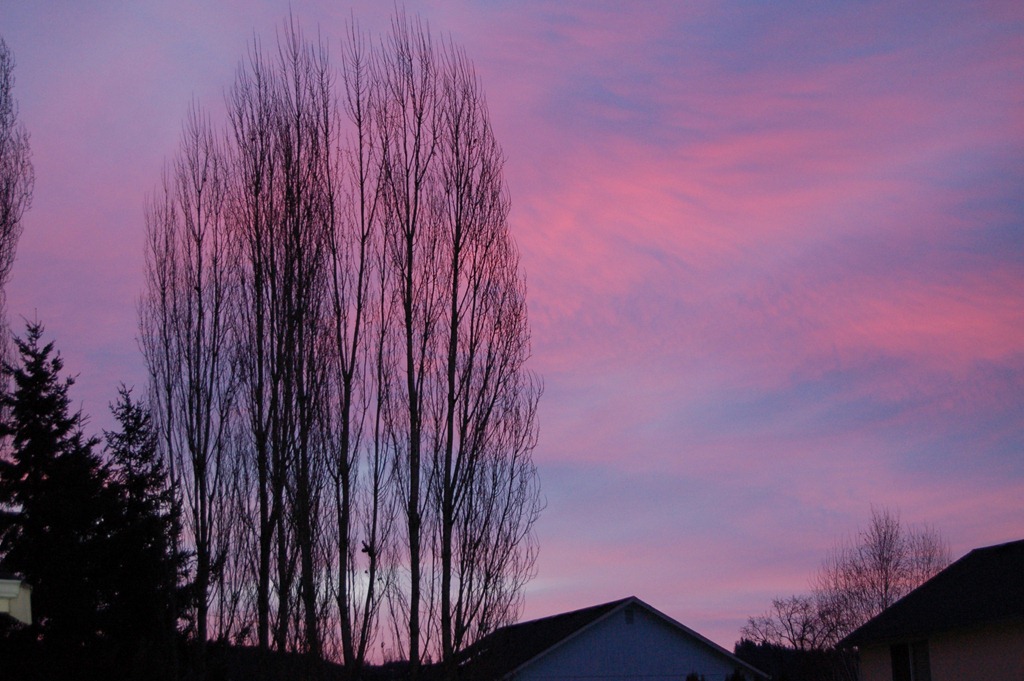
I had plans to write a long blog entry this evening, but we went out for dinner and I ate enough heavy food that I will now be satisfied if I can make it to the couch and watch a movie tonight. So here’s a picture of the sunset instead.
It’d look a lot better if I could get rid of all the houses in the way, but I’m not that good with photoshop, or dynamite, yet.

Getting back to five day work weeks makes life a bit of a blur all of a sudden. I was worried, as I always do, that having not written anything in a while would mean that the writing bug had flown off – I would face the blank screen of my laptop and my brain would tell me “You idiot. The ideas are gone now.”
But that didn’t happen. I sat down the other day, pulled the laptop out of my bag when my butt hit the seat on the train, and I wrote a title and a one paragraph plot summary for my next book, a YA Sci-Fi adventure. I can’t tell you the title yet, because, frankly, it gives away the story. But from that title, and that one paragraph, I wrote a two page plot overview. Then I broke out all the characters, started my character log, and started building the world the characters live in… the classes of people, the size of the planet they live on, the ships they fly around in, the politics, the economy, their rites and rituals. Everything that I could think of that influenced the ‘why people will act the way they do’ in the story.
This morning, I created a list of chapters 1 through 43 in the same document, and, starting with the first one, I began detailing out the plot. Why 43? I’ve found 43 to be my magic number for an 80000 word book. About 1860 words per chapter. If I can’t fit the plot into 43 chapters, I’m trying to do too much. If I can’t reach 43, there isn’t enough ‘there’ there. It’s not a perfect system, but I keep trying to improve it until I get it right. Today I got through the first three chapters. And the words are just flying. I didn’t want to get off the train this morning. I can feel the story. It’s right there, in front of me, crystalizing by the minute. My experience is starting to pay off too, as I see ways to weave character development arcs and sub-plots in, and ways to tie Chapter 1 to Chapter 43. I love writing. Right now, I don’t care if this book ever sells. I just want to write it.
I’ve fallen a bit behind on some of my other blog entries as I binge write. But they’re coming. I just need to cut back on something else. My first choice would be work… but until writing starts paying the bills, that’s not going to happen. So I’m glad my Netflix Instant Watch queue is rather barren right now. It makes it a little easier to keep the TV off at night, and keeps my ass in this chair, being productive. And also points out that I need a new office chair. My ass is killing me after just an hour. Must be all the working out I’ve been doing. The padding is gone.
A few days ago, my 4 year old son came into our bed at 6 AM and snuggled in between my wife and me. This is a fairly regular occurrence for her, but I’m usually out of bed and gone to work before he wakes up. When I am there, he likes to snuggle right up against me, take my arm, and wrap it around him. It’s pretty sweet (except that it means we’re also getting woken up at 6 AM).
But on this particular day, he leans in to me and says “Daddy, I’ll always remember you when you’re gone.”
Ack! How do I respond to that?
“Buddy, I’m not going to die for a long time.” I don’t add the “I hope” onto the end. I’m thinking it, and I can tell by the way my wife maintains her silence, that’s she’s hoping I don’t say it. There’s no use in getting him anymore worried about the possibility than he already is.
“Stan Lee is in his nineties.” he says. Stan Lee, for those of you who don’t know, is the guy behind the Marvel Comics like Spiderman and Ironman and the Avengers, shows which my son is addicted to.
“That’s a lot older than I am.” I say.
“Yeah. One. Two. Three.” He starts counting.
“Fifty two years older.” I say. And that seems to allay his fears. He gets out of bed a few minutes later and heads for the computer to watch the shows Stan Lee has created. My wife and I giggle nervously and we both wonder exactly what was running through that boy’s head.
But I know what it was. I know it because I’ve had those same thoughts a thousand times before, both when I was a child and as an adult. After my kids were born – twins who arrived five weeks early on a very traumatic night where there was way too much blood and a rush to the NICU for my son – I could work myself into tears driving my exhausted self home from work, just thinking about what I would do if I had lost my wife or one of the kids, or what they would do if something happened to me. What if something else happened to one of those kids? What if one came down with a debilitating disease? What if one was kidnapped? Or lost in the woods? What if climate change made their lives brutally hard, where food was scarce and gangs roamed the cities? Would I be able to protect them? What hard choices would I have to make? Would there be a time I would have to choose to save one, but not the other?
I think most parents have these exact same fears. But I’m a writer, and perhaps these fears get magnified because my mind amplifies them until they either cause complete paralysis, or until they evolve into something else: a story. I take my fears, and I put another character in my shoes. Perhaps a stronger man. One who can solve the problems, or who reacts better under stress. The fear is the same, perhaps even jacked up a bit. But the reactions of the hero are too. They do things I can’t or couldn’t or wouldn’t. And in doing so, allow me, as a father, a husband and a citizen to relax just a bit, and to continue to function.
Fear, when it appears in my life, becomes a muse. It inspires me to see the “What ifs?” and to make them into a “What then?” I turn that fear into a story, and if I’ve done it right, I engage the reader’s fears as well, and that grips their hearts and tightens their chest so they can’t breathe until they turn the page. And the page after that, until the end of the story, where they can finally breathe again. That connection with those fears, hit or missed – a function of pace and characterization and setting – separates a good book from a great book, and it’s one writers cannot overlook.
The good news is that I have enough fears that I will never lack in ideas for stories. The bad news is that I have to live with those fears until I write them all down. And even then, they don’t go away. They just step aside as the next one takes over, and the next story evolves.
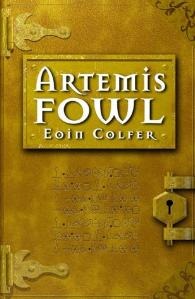
After reading some heavier books recently, I picked up something decidedly lighter at the local book store last weekend. Eoin Colfer’s middle grade book series Artemis Fowl is an easy read, perfect for a kid or an adult who just doesn’t want to have to think too much for a few hours.
Artemis Fowl is a twelve year old boy-millionaire, heir to the Fowl fortune which has been handed down from generation after generation of Fowl who have lived life on the edge of the legal system. Artemis’ father was lost at sea while trying to smuggle soft drinks into Russia after the fall of the Berlin Wall. But Artemis is no ordinary rich boy. He’s graced with intelligence and poise, a combination that serves him well as he tries to continue the family tradition. But unlike his ancestors, Artemis doesn’t see making money in the land of man as the only way to do things. There are ancient and magical creatures that also control a great deal of wealth, and it’s his plan to take that too.
Middle-grade fiction is hard to evaluate as an adult. It has to move at what we might think of as a reckless pace. The improbable is more easily sold to a readership that is a little less schooled. The fantastic is more readily accepted. When reading middle-grade fiction, I make it a policy to completely suspend my disbelief while in the book… something I don’t do as well when reading YA or Adult. I try not to ever say to myself “That’s not what this character would do… or if he did that, then the other guy would do this.”
But you can evaluate middle-grade on other things, more objective things. Does the story flow? Is the writing consistent? Would the pace hold the attention of the average 11 year old?
For the most part, the story meets all of those requirements. But there were a couple of oddities that I had a little bit of a problem with. First, and foremost, for a book called Artemis Fowl, I expected more of the book to be from Artemis’ point of view. Actually, very little of book (well less than 25%) even has Artemis in the scene. The story works, but I kept waiting for the main character to be more front-and-center.
The other thing, and this is a minor thing, but it was jarring. In the edition I read (a first edition), two pages in the book were written almost completely in a passive voice. It’s one of those things I, as a writer, have trained myself to notice. And because it wasn’t a problem throughout the book, I have to wonder if somehow, the editing process on those two pages (56 and 57), was missed. Here is a paragraph to illustrate the issue:
Holly twisted in the troll’s grip, but it was useless. The creature’s fingers were the size of bananas, but nowhere near as pliant. They were squashing the breath from her rib cage with savage ease. Needle-like claws were scraping at the toughened material of her uniform. Any second now, they would punch through, and that would be that.
A few minor changes, and most of the passive voice would be eliminated:
Holly uselessly twisted in the troll’s grip. The creature’s fingers were the size of bananas, but nowhere near as pliant. They squashed the breath from her rib cage with savage ease. Needle-like claws scraped at the toughened material of her uniform. Any second now, they would punch through, and that would be that.
I think that reads better. There are a few other instances in the book where passive voice could be eliminated and the book improved, but for some reason, these two pages are particularly plagued with it.
That said, the book was enjoyable, and I would recommend it to anyone (boys or girls) who like to read middle grade fiction. Boys would especially like this, and anything that keeps middle-grade boys reading, is, in my opinion, a good thing. I’m not sure I’ll read much of the rest of the series, but if my kids bring it home someday, I just might have to see how the story continues.
Sunrise this morning was beautiful. Here’s a best shot I got, but the sky was a little better few minutes before. Had I done this from the bedroom on the second floor, Mt. Rainier was pretty awesome, but running up the stairs, and removing the window screen was a little too much work.
I love lists. I have to-do lists for home and for work. I have a book-to-read list. I have a book wish-list on Amazon. I have a list of blog entries to do. I have a list of lists to make. Ok, not really on that last one.
But one list I rarely ever make is my List of New Year’s Resolutions. I’m kind of a “If it’s a good idea to do it, why not do it now?” guy. For instance, why wait until January 1st to get into shape, when I was able to start doing it in December?
I decided to make a list of New Year’s Resolutions this year, more as a vow to either continue to do things I am already doing, or to try new things that, due to circumstances, I wasn’t able to do before. Perhaps I’ll look back at this a year from now and shake my head, and confirm that the gods do laugh at the plans of men. Or maybe I’ll look at it and nod, and say, “Nice work. Those were good goals.”
Here’s my list for 2012 (in no particular order):
- Shop locally. We started doing this more in the latter part of 2011, but I want to continue the trend. We’ve lived in the same small town for almost 7 years, but there are still many stores I have never been into. That needs to change, both for myself, and for my community. There’s a great local bookstore I was in once or twice in the last 6 years, but I’ve gone in there the last three weekends, and I love it. Now my kids have discovered it, and I can see making it part of out monthly (if not more frequent) outings.
- Be more active in the community. Go to the parades and football games and band competitions and read about what’s going on in the city council and in the arts commission and the local library. It looks like we’re going to be here for quite a while, and I enjoy getting out and talking to people. I no longer feel like an outsider. 7 years is all it took.
- Be more charitable to non-profit organizations that I use frequently or have a direct impact on my life, or my kids lives, or the lives of the people in my neighborhood. Organizations like NPR, Sumner/Bonney Lake Aquatics and the Pierce County Library System play vital roles in my area, and we have to support the services we use. I also support the CMTA, a national organization that has been very important to me for years. There’s an entire blog about that on my list that I’m saving for later.
- Take the kids camping at least twice. It won’t be long trips where we backpack into the wilds and fight grizzly bears. I just want them to see something other than the ‘burbs a weekend or two a year, and to get them (and me) away from computers and screen time.
- In terms of my writing, market myself better. While I can’t control whether or not a publisher thinks my books are good, I can control my market reach, and have a wide audience ready to purchase my books when they do come out. There are simple things that I have not yet done, but will attempt in 2012 that should help.
- Write another book. I don’t know yet what it will be about, but my longer term goal is at least one new book per year.
- Be a better father by being more patient with my kids. Patience is the single hardest thing for me as a father of two young kids, and I think it is the hardest thing to develop.
- Spend more time with friends. This is one I say every years, and something always comes up – whether it be the birth of the kids, or some injury / illness or work. Something always gets in the way. I miss adult conversation that is not work oriented or kid oriented. I think every conversation I had with an adult for a couple of years started and ended with my kids bathroom habits. It would be really nice to talk about world issues and the environment, and have a glass of wine and some really stinky cheese once in a while.
Okay, so that’s my list… for now. It will grow and shrink over the year, but hopefully, by the end of 2012, some of the things there will be something that I ‘just do’ and when I’m setting goals in 2013, the list is at least different.
And to all my readers, Happy New Year! Hope to see you back here frequently in 2012 (feel free to add that to your list of New Years Resolutions.)
Okay, so it’s the last day of 2011, and as every other blogger is doing, I am now presenting you with my Year In Review blog post.
Writing-wise, 2011 was packed:
- I wrote a new novel called Labeled which I started on January 2, 2011, and finished the first draft of on June 4, 2011.
- I migrated my blog from my a computer in my house to WordPress.com, a decision I have not regretted for even a moment. I’ve seen the traffic on my blog rise consistently through the year, though it is still not exactly where I want it.
- I got an Agent!
- I bought a new laptop for my writing.
- I reviewed 49 books. I actually can’t believe I read that many books this year. It’s rather amazing.
- I did multiple major revision passes to my books Nowhere Wild, Army of the Risen and Labeled. Each one is inching closer to being ‘done-done’.
- I volunteered heavily at the PNWA Conference.
- I won first place for a short story I wrote for a local writing contest.
- I was a founding member of the Puyallup Writers Co-op.
- I read my first books on a Kindle. I’ve now read a few more since that initial shock to my system, and though I don’t hate it anymore, it still feels a little bit wrong.
Personally, I also had some major events not related to writing:
- I became an American Citizen in May 2011.
- I had had two surgeries (one on each foot) and dislocated my shoulder once. These medical issues allowed me to spend a lot of time writing this year, and also prevented me from doing much else that was interesting, so this part of the list is a little bit short.
- I traveled back to Canada for my parents’ 50th Anniversary.
- I started getting back into shape.
- I worked a lot from home.
I’m sure I’m forgetting something that I will need to add as soon as this gets posted. But for now, that’s what I got. 2011 was an odd year personally, but I’m proud of what I accomplished on this blog.
2012 will be a little different. I will continue to do book reviews, but I will also branch out into other areas – more human interest stories and opinion. I want people to get to know me through this blog, to learn about my books, and about where my passions in life are. Hopefully my writing will move to the next stage in 2012, and with that, will come even bigger changes personally and professionally. All of which, you will read about here. I hope to see you back here frequently, and leaving comments on a regular basis.
Good-bye, 2011. It’s been real. And hello 2012. I can’t wait to see what’s in store. As long as the Mayans turn out to be wrong.

In 1998, Jared Diamond won the Pulitzer Prize for general non-fiction for his book, Guns, Germs and Steel – The Fates of Human Societies. It’s a fascinating look back at 13000+ years of human history and the evolution of civilization, and why / how one group of people prevailed over another, and why some groups faded away completely.
Diamond’s goal in the book was to show that the environment the people lived in had a greater influence on their success that did the nature of the people themselves. He wanted to refute the racist arguments that Europeans have so dominated the world for the last six hundred years because they were somehow borne “smarter” than those born in Africa or New Guinea. He approached this goal by backtracking from 1500 AD, where the Spanish were just beginning their lopsided series of battles with the natives of the New World. Why was it that 160 Spanish soldiers defeated an army of 80,000 warriors? How did a few shiploads of men invade continents with 20 million people, and reduce those societies to rubble in just a few short years? How did European societies evolve into such powerful nations, while those in Africa, Australia, north and South America failed to reach the same levels?
The answer, as Diamond writes, is in the geography, and in the environment. Powerful societies developed in moderate climates, with east-west axis, available domesticable herd-animals, and most importantly, the cereal-grain crops which helped to lift hunter-gathers into farmers who could support the overhead of having permanent craftsmen, government and military. Diamond documents numerous societies from their points of origin (traceable through both archeology and linguistics) to their modern day descendants. The book is filled with interesting anecdotes and short clips of historical incidents which help to support his hypothesis.
I am an amateur historian at best. Many times in my life I’ve regretted not studying history more in school. I actually considered switching to a history major for a while in college, but by then I was already three years into my Physics/CompSci degree, and couldn’t afford 4 more years of schooling. My exposure to much of history has been constrained to the Anglo-European age, from 800 AD to present day, and much of that has been from reading historical fiction. This book stretched me well outside of my area of knowledge, and filled in numerous gaps. I feel ‘smarter’ for having read it. It’s a book I recommend to anyone and everyone who has even the slightest bit of scientific or historical curiosity. I’m not saying the book doesn’t have flaws in its logic. There are plenty of people out there willing to criticize it for one reason or another. But it at least makes you think, and makes you question your own assumptions about how the world developed.
Diamond’s writing style is inviting enough that anyone with a high school degree should be able to read it, though some aspects do require the critical thinking that I believe isn’t introduced until college. There were a few times where I found myself questioning his conclusions, only to find him addressing that exact issue a few pages later.
If there is a fault to be found with this book, it’s that some chapters become quite repetitive. The four aspects of geographic advantage are documented so many times that you begin to think that a chapter or two could have been cut in order to shorten the book, and little would have been lost.
As a fiction writer, I find reading historical-non-fiction inspiring – not in the sense where the tragedies of mass extinction by small-pox infection is enjoyable, but in that in each society, there were key moments, or key situations that changed everything. The ‘high-concept’ plot, driven by the singular hero that must save the world (or cause its destruction) has not always been fiction. The intrepid explorers who sailed a thousand miles from New Guinea to Hawaii in outrigger canoes with no guarantee that Hawaii even existed are not so different from the fictional crews of the space-ships we authors send out amongst the stars. The native man defending his village against invading demons armed with magical weapons that spout fire is not so different than our heroic police officer in Boston who must stop the aliens from destroying his city. There is fiction in history and history in fiction, and a book like this serves up ideas for novels by the bucketful.
If you’re looking to expand the scope of your reading beyond your fiction list, give this one a try. If you like science / history, definitely add this book to your list.
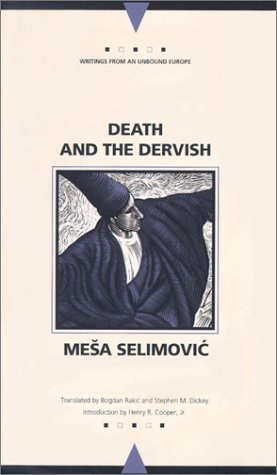 My sister-in-law’s husband, Adam, gave me this book for Christmas either three or four years ago. Adam’s an intellectual sort – now a professor at UCLA in history / political science. His Ph.D, as best I can recall, deals with the effects of ethnic cleansing in Bosnia / Serbia / Croatia during the Bosnian War. As part of his research, Adam spent a lot of time (years) in that war-torn area.
Mesa Selimovic was a Bosnian born writer, and Death and the Dervish, written in 1966, is one of the most acclaimed books to ever come out of Yugoslavia. It’s a story about a dervish named Sheikh Nuruddin in an 18th Century Sarajevo monastery, during the time of the Turkish occupation.
I would love to be able to say that I enjoyed this book. Actually, I would love to say I finished this book. I stopped 37 pages into it. I tried numerous times over the last few years to get farther into it, and even gave it to a friend of mine who I always see reading what I would call “Acclaimed Literature”. He couldn’t finish the book either. He made it almost to fifty pages.
Since I didn’t finish the book, I don’t really feel qualified to review it, nor can I tell you what happened without plagiarizing other reviewers. But yet, here we are, in a book review.
If you look around the internets, you’ll see many glowing reviews for Death and the Dervish – a lot of five star reviews, in fact. Yet, I couldn’t finish it. I’m split on why this is. There are two possibilities:
- I was not patient enough for the book, and it really was going to get better.
- I have reached the limits of “acclaimed literature” that I enjoy reading.
Either way, there was something about the beginning of the book that I didn’t like. It’s pretty easy to identify what it was: the pace. The book spends an inordinate amount of time inside the tortured mind of the main character, examining his every fear and every desire. The writing is detailed and drawn out, manic its sentence length and content. Sentences are tremendously long, sometimes hundreds of words, with numerous semi-colons. By the time you reach the end of the paragraph, you can’t remember what was happening at the beginning. By the end of the chapter, you’ve forgotten the name of the other characters in the room.
My inability to read a book as highly acclaimed as this book makes me feel like a failure as a reader. I don’t feel intelligent enough to read this book. It requires a level of concentration I am no longer capable of maintaining (though I doubt I ever have been able to do it). Perhaps it is a cultural thing: the battle between Eastern European writing from the middle of the last century, and a mind that has grown accustomed to the faster paced writing of modern America and young adult fiction.
I’ve criticized books before for bad writing – lazy writing; objective reasons for saying “this is a poorly written book”. I can’t lay that charge against this book. There is heart and soul in this writing. You can see that by looking at any page. But the style excludes readers like me from enjoying it. And that is key to why I read fiction. I must enjoy it at some level, or at least feel like it is adding to my knowledge of the world. My reasons for disliking Death and the Dervish are purely subjective. It just didn’t hold my attention because it was too slow. I didn’t know I had limits like that.
I guess now I know.
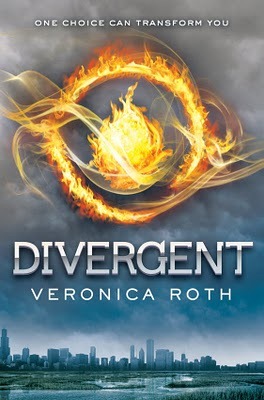 It seems like it’s been a while since I’ve read a book I just didn’t have to think about – one I could just read for enjoyment. I really needed something light, and my wife suggested Divergent by Veronica Roth. Yes, to me, a dystopian (possibly post-apocalyptic) book can be considered light reading.
Divergent is set in the futuristic, and partially destroyed city of Chicago. The city is broken into 5 factions: Abnegation, Amity, Candor, Dauntless and Eurdite. Each faction values one human trait over all others, to the point where citizens who turn sixteen must choose between one of the factions, based on their desire to be selfless, peaceful, honest, brave or intelligent, respectively.
Beatrice Pryor is a child of Abnegation parents, who are leaders of the city. But she doesn’t feel that selflessness is her calling. A special test that she takes prior to her choosing confirms that. But what it does tells her will turn her life upside down, and make everything she does dangerous to herself and to her family.
This is a Young Adult book, and it reads like one. The action is fast-paced, the emotions border, at times, on what would be called melodrama in an adult book. But it is very well written, and keeps the reader turning the pages, or in my case, clicking the forward button on my Kindle. It’s a book everyone writing YA should read, to see how to do the things that separate YA books from regular adult books. There are few things that you have to either suspend your disbelief about… you know, besides the whole dystopian thing. I hope that in the next book, some of these questions are answered. I’m not going to reveal them here (because they seem central to plot). But they do make me want to read the next book, which I think comes out in May of 2012.
There is no doubt this book is YA, and if you aren’t into that, then you might cast a scornful eye at it from time to time. But if you do enjoy YA, this is one you should definitely read, and would be a great book to give to the young adults in your family.
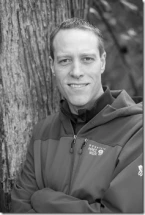

 Joe Beernink