
Two weeks ago, I started a new job. Not surprisingly, my last post here was 15 days ago. As I expected, things got really busy, really quickly. I’m not quite ready to do a full write up on what going back to work has been like… I’m going to wait until I’m closer to a full month to do that. But I do have a few random technical notes I thought I’d pass along.
- Now that I’m out of the house more, I get to see my iPhone 5 in action. The LTE speed is impressive, and just serves to point out how absolutely crappy the wi-fi on the phone is. Images and videos load almost instantly while out in the wilds of Seattle, but sitting in my living room, just 40 feet from my router, I barely get any throughput.
- The downside of the LTE is that using any kind of streaming (i.e. MLB.com to listen to a baseball game) kills my battery halfway through the game. I usually listen to music at work as well, but with the iPhone 5, I have to stop 2/3rds of the way through my day so I have enough battery left to make a call on the way home if I need to. I don’t remember having that issue with my 3GS (at least not when it was new).
- The iPhone 5 also gets really warm when using LTE or has the screen on… so much so that I have to set it on my desktop, instead of in my pocket when streaming audio so I don’t burn my leg. But at least it lets me know when an app is running and burning down the battery.
- The laptop I was given for my new job came equipped with Microsoft Windows 8. Two weeks is a pretty good length of time to evaluate a product. My evaluation? “Why?” I am constantly frustrated by the OS—not because I can’t figure it out—but because they made things that used to be easy and logical, into a demonstration of “look how cool this is”. And it’s not. I’m continuously shaking my head at it, or worse, banging my head against my desk. I spend zero time on the tiles screen except when I have to search for something that used to be easily found through the old Start menu. Sure, there are a couple of things that work better than Windows 7 (like the Search Feature), but it would have been so much better to introduce that feature into the Windows 7 paradigm. Other than that, Windows 8 seems like a complete disaster from a productivity standpoint, and I’ll be keeping my home PC’s on Windows 7 for the foreseeable future.
- I’ve also spent the last two weeks getting used to Visual Studio 2012. I can’t say I’m overly impressed with the new UI for that either. I’ll probably get used to it, but the new interface for Team Explorer hides the features I use most, and requires more clicks to do things than I would prefer. The Test Explorer seems to be lacking pieces that were just intuitive in the past, and I’ve stopped using it altogether in favor of Resharper’s Test Explorer. I’ve also had at least three times where the UI starts behaving erratically, forcing me to restart it to allow me to continue working. The jury is still out on whether or not VS2012 is an upgrade to VS2010 (at least from the UI perspective). I’m not a big fan of the chrome-less look of Windows 8… it just makes things look unfinished.
- Speaking of Resharper—it’s the first tool I always install on my PC after setting up the basics. The latest version of that doesn’t disappoint. This tool is still the greatest productivity add-on for Visual Studio that I’ve ever found. In job interviews, I always ask if the team is using it. If they aren’t, and aren’t willing to let me use it, I probably won’t consider working there. Luckily, my new team insists on using it.
- Under the hood of Visual Studio 2012, however, the cool features for .NET just keep coming in .NET 4.5. The more I dig into it, the more time it saves me in things like async programming and Javascript development. What used to take days or weeks or months to do 3 years ago, now can be done in just a few lines of code. It’s definitely worth upgrading your apps.
- One of the pleasant technical discoveries I’ve made in the last few weeks is pluralsight.com. I used to buy (and lug around) 800 page books each time a new technology came out, and then those books would sit on my shelves for years until I gave them away. With the speed at which technology changes these days, they’re only relevant for a year or two at best, some for just a few months. For $29 a month, Pluralsight gives me access to dozens of very good training courses on the technology I need to do the projects I’m working on right now, and I’m learning a lot. I’m going to buy a tablet (probably a Kindle Fire HD) just so I can watch more of these courses while commuting.
- I’ve also become a recent convert to feedly.com as a blog aggregator. I used to use Outlook as an RSS feed collector, but each time I transferred jobs, I lost my list of feeds. I was going to use Google Reader, but at about the same time I was making that decision, Google decided to abandon the app. I watched the debates about which app would fill that gap, and chose feedly. I haven’t been disappointed. I set up my feeds, and read them on my phone on the train on the way in to, or home from work. It’s synched up to my PC as well, and it’s really easy to add another blog if I need to.
Jumping back into the workforce has stretched me out of my comfort zone technologically, but I’ve found some new tools that help me to be more efficient with my time and more effort. If you have any suggestions for other tools I absolutely must use, please let me know.
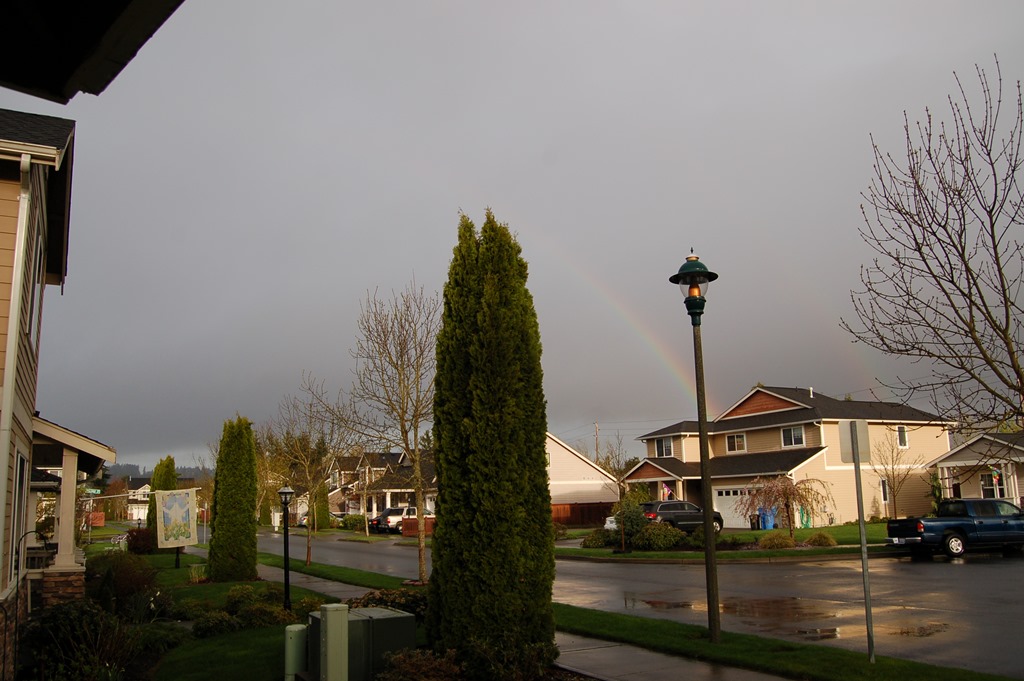
Looked out the window while eating breakfast this morning, and saw a rainbow. So I took a picture—because, you know, that’s how we roll around here. But after taking a picture, I discovered it was actually a DOUBLE-RAINBOW. A double–SUNRISE–rainbow.
How cool is that?
Arthur C. Clarke’s Third Law states that “Any sufficiently advanced technology is indistinguishable from magic.” From a science fiction writer’s point of view, that’s a fantastic law. It allows me to create stories around futuristic ideas that no one here, today, can debate because, dude, to you it’s all magic—you’re not technologically advanced enough to understand it. So I can’t be wrong. Right?
Ahh. Well. Within reason, perhaps.
Recently, however, I’ve come to appreciate that with a small change, the law applies to far more than just technology and to the here and now. I think we should create a extension to Clarke’s law, with one minor change to the original
“Any sufficiently advanced ability is indistinguishable from magic.”
Let me explain.
Last weekend, my wife and I watched the movie Chasing Mavericks, which is based on the life of Jay Moriarity, a teenage surfing prodigy who sets his sights on surfing some of the roughest waves in the world—the mythological break at Maverick’s, near Half Moon Bay, California. The waves at Maverick’s are huge. They’re cold and they’re nasty. They scare every surfer who has ever seen them. The story behind the movie is pretty good, and the movie itself was fine… though a tad reminiscent of a surfing version of The Karate Kid.
But it was while watching this movie that I realized that surfing is one of those advanced abilities that, to me, seems like magic.
Now I know the physics behind surfing. Pressure, surface tension, gravity, speed, friction. I get all that (though I wouldn’t want to try to write the equation for it). I also know that vast schools of surfers paddle out into the surf every day, and ride the waves, all around the world. To them, the act of surfing is not magic—though the experience may be.
But for me, watching someone surf will always be magical. Balance is something I’ve never had much of. I have trouble enough maintaining my balance on solid ground.This is attributed, mainly, to my lifelong battle with Charcot Marie Tooth disease (CMT). Being able to stand up on a surfboard while the swell hurtles me toward jagged rocks, and the wave-front tosses my surfboard board this way and that, is just something that I’ll never be able to do, even on small waves. I appreciate that riding small waves is possible. But watching surfers ride those giants at places like Mavericks… that’s magic.
There are lots of other things that require a good sense of balance that also seem like magic to me: skateboarders working a half-pipe without cracking their skulls every time; construction workers walking the high steel of a skyscraper; rock climbers pulling themselves up a vertical face. I cannot even imagine doing those things. To me, those acts are no different than making a city bus disappear by saying “Abracadbra”.
It’s not that these activities just seem hard, or that I’m not willing to put in the work to learn how to do them. I’ve taken on lots of hard things that took immense commitments to train for, or to learn how to do them. I’ve ridden a bike 100 miles in a day. I’ve written 6 novels. I’ve raised amazing twins (though I was little more than an assistant in that bit of magic). But to surf requires more than just will and training. It requires a magical conglomeration of balance and anticipation and strength—things I will never have.
There are a few other things that will always remain magic to me. Acting for instance. I have zero acting skill. Zip. Zilch. Notta. When I watch good actors, it seems like what they are doing is magical. Their acting has the ability to transport the me into a whole different world of belief. If that’s not magic, I don’t know what is.
On the more practical side, even some of what I do every day requires magic I don’t possess. I’ve been a computer programmer since I was 8 years old. I’ve learned a dozen programming languages, and written hundreds of thousands of lines of code. But when I see new video games with all the amazing artwork and graphics, I can’t help but think that those developers aren’t wizards from another realm. Beyond the technology involved, the artistic skill needed to develop those images is something I will never possess. When I’m working on a website these days, I insist on involving a good designer, to raise my application functionality to a new and impossible level. I’ve seen horrible sites become great with just a little pixie dust from a talented designer.
Not everything I’ve ever thought was magic remains a spell possessed only by a secret society. I used to think that speaking in public was one of those things I’d never be able to do. I’ve watched the speakers at conferences like TED and PNWA and PDC, and thought “I’ll never be able to do that.” I’ve never been good at memorization, and public speaking used to scare the crap out of me. But I started going to Toastmasters, and practicing my speeches. Now speaking in public doesn’t bother me anymore. Perhaps magic can be learned. Or maybe that was just one of the spells that can be cast with just hard work.
Clarke wasn’t wrong in his statement. But I think by substituting “ability” for “technology” we can recognize that magic comes in many forms. Hard work and determination almost always pay off. But when will and talent come together, they create a sense of wonder that can be truly stunning, and beyond belief.
I appreciate the magicians among us. They might not think what they are doing is so awe inspiring, but I do. So thank you, surfers, construction workers, artists and actors of the world. Thank you for sharing your magic with the rest of us. We are all better for it.
If you look at the list of TV watched below, you’ll see that my TV watching seemed to decrease in March. And it probably would have… except that what isn’t seen there is the return of baseball, plus the fact that my wife and I have been completely immersed in re-watching all 7 seasons of The West Wing. We’re part-way through Season 7 now, so I expect this splurge to end soon. It is still one of the greatest shows ever made, and it’ll be hard not to turn right back around and start watching Season 1 again.
Must see movie of the month goes to The Perks of Being a Wallflower. If you went to high school in the 1980’s, you’ll be suffering flashbacks the whole time, but it’ll be worth it. The plot is deep and touching and the ending hurts.
Also, if you haven’t seen the 1995 BBC Miniseries, Pride and Prejudice, you should. I doubt I’ll ever be able to read Jane Austin’s novels (I don’t have the patience for that style of writing), but this series was incredibly well done, and after watching it, I expect I wouldn’t get nearly as much out of the books as I did the series.
Worst movie of the month goes to Sydney White. This movie ended up on our queue back in 2007 when, after giving birth to our two kids, my wife could only watch ‘fluffy stuff’. But we didn’t have a lot of time to watch movies back then, so it stayed there for 6 years, until we were finally in the mood to see another fluffy comedy. Perhaps this movie works for the pre-teen crowd, but my neck ached at the end from shaking my head so often.
My list also shows that I’ve watched two seasons of Weeds. It’s a good show, and, at half an hour for each episode, it’s quick to burn through a whole season in a short amount of time (especially if you fast forward through the most annoying opening credits on television). But I probably wouldn’t miss it if it suddenly disappeared from my queue.
Listed below are the movies and TV series I’ve been watching since Part XI of this series:
- [x] = Number of Episodes watched if TV show
- ( y ) = Rating out of 5.
- Items in bold = ones I highly recommend
Theater
- None
TV Series (watching as aired)
- Castle
- Chicago Fire
- Big Bang Theory
DVD
- Atlas Shrugged: Part II (2)
- Chasing Mavericks (4)
- Connections 3: [2] (4)
- Deadwood: Season 1: [1] (3)
- Homeland: Season 1: [1] (5)
- Leap Year (2)
- Pride and Prejudice: Vol. 1 & 2 (5)
- Sydney White (1)
- The Perks of Being a Wallflower (5)
Instant Watch
- Weeds Ssn 1 [3] (4)
- Weeds Ssn 2 [12] (4)
- Weeds Ssn 3 [6] (3)
- Survivorman [2] (4)
- Cosmos [1] (4)
- Midsomer Murders Ssn 1 [2] (2)
- Doctor Who Ssn 1 [3] (3)
- House of Cards Ssn 1 [1] (4)
* Note that Netflix has changed the way it allows me to access my viewing history, and I can no longer look back for a whole month of watching, so it is entirely possible that I missed something. I should say that most people will be able to see their whole month of Netflix watching, but I have two kids who watch a lot of Sonic the Hedgehog and Strawberry Shortcake, and those cause my list to be longer than most people’s. My instant watch list above is largely from memory.
I can’t recall where I first heard that reading your work aloud could really help with the editing process. Jason Black probably mentioned it in one of his talks at the PNWA Conference. Or perhaps Sally Harding planted the seed in my brain during one of our many conversations. But I never really tried it until I did my last edit on my novella 38 Years Old (Never Kissed a Girl) back in February. I found it highly effective on that story, especially since that story hadn’t been through the gauntlet of multiple beta readers, and I had no intention of paying a professional editor for something I wasn’t going to actually charge for.
The idea of moving my lips while reading one of my novels scared the crap out me. My novels are roughly four times as long as the novella. Reading an 80000 word novel out loud seemed like a recipe for disaster considering my frail vocal cords have about a 2000 word limit at any one sitting—a side effect of a bad case of mono back in the 1990s, and lingering effects of my GBS.
But after trying it with the novella, and repeating it with success with a number of blog entries and even some emails over the last few weeks, I decided to try it with Nowhere Wild. I didn’t expect to find much. I’ve edited this puppy at least 20 times. I’ve had it read by a half dozen readers. I figured there would be a couple of places where I’d added a word that didn’t need to be there, or removed one that should have been left behind.
Yeah, there were a few more changes than that.
I printed the novel in 50 page chunks. 50 pages isn’t too much to carry around, and if, for some reason, I wasn’t able to get through the whole thing, it didn’t seem like a complete waste of paper and ink. It was at this point I learned that my printer is not capable of true double-sided, collated printing, so I had to print it single sided. Sorry trees. Next time, I’ll send the whole MSS down to the local copy shop and get it done in a single shot with half the paper.
I sat down with a highlighter in hand, and read every word. If a section seemed clumsy, I circled it so I could come back to it later. If a word was wrong, I highlighted it and moved on. Simple mistakes I fixed with a quick note. I tried to edit without breaking my speaking flow. Long notes interrupted my cadence and made it impossible to capture the true pace of the scene.
I did about 25 pages a day, so two days per 50 page section and twelve or thirteen days for the whole book. At the end of each 50 page section, I went back through and transcribed the notes into the book, and fixed the issues while the memories were still fresh in my brain.
I’m amazed at how many problems I found using this simple technique. Word territory issues, extra phrases, and dialog stumbles really pop out when you engage your lips. I had heard that, but I never really believed it until I tried it. I wish I had used it on all of my work before sending it out. I know I will do it in the future, including on these blog entries.
If you’ve never tried this technique, I sincerely hope you give it a try, even if you are going to pay for a professional editor. If you’re going to self-publish anything, it’s like having someone sitting over your shoulder while you edit, pointing out all the mistakes you missed the first dozen times you read the piece. I think it’s well worth the effort.
When I graduated from university in 1994, the Canadian economy was in the tank. And because of that (and only because of that, I’m sure), my visions of employers hunting me down and begging me to come help them put a man (or a woman) on Mars as soon as I received my diploma, never came to fruition. Apparently, employers back then wanted practical skills and experience. Sure, I’d been doing farm work all my life, and had cut grass at a golf course, worked in restaurants, and been a night auditor at a hotel for two summers, but those jobs didn’t count as real business or scientific experience. Go figure.
I spent part of that summer after graduation golfing and doing volunteer work at my former elementary school. It was nice to kick back after four years of hard work, and relax. But by mid-summer it was time to find a real job. And when I say it was time, I know this because my parents told me it was so.
I scanned the London Free Press, Toronto Star, and Globe and Mail daily for positions. I sent my meager resume in for every job I thought I had a shot at. I even tried hand-delivering resumes to companies where I wanted to work, but that weren’t advertising. I didn’t get any replies.
My mother then suggested that I go into the local unemployment office and see what they had there. In order to get those leads, I first had to meet with an employment counselor who reviewed my resume and gave me tricks to make it jump out—formatting tips, higher quality paper, etc. They also suggested getting business cards made up, and paper-clipping those to my resume. I thought it a little foolish, since I didn’t have a business, but it actually worked. Sometime in July, I sent my resume in for another job I wasn’t qualified for at EDS Canada. The recruiter normally would have thrown my resume away, except they had never seen a new grad attach a business card to a resume before. They kept the card on their desktop blotter to show to other people my unique approach. A few weeks later, they had an opening for a very junior developer, and that card was still on their blotter. They called. I drove three and a half hours to that interview and I got the job. That little business card launched my career.
When I switched from EDS Canada to EDS in the United States in 1996, I did all of my interviews over the phone. I was still living near Toronto, and the new position was near Boulder, Colorado. It didn’t make financial sense for me to fly out to meet with the team, and since it was basically an internal transfer, the hiring manager didn’t request an in-person interview. The first time I actually met my new boss was on the day I started work, after a two day drive, halfway across the country.
In 1999, I met an HR coordinator for Alaska Airlines at a job fair in Denver. I passed by their booth a few times, but kept stopping and pausing at one of their postings, because I was qualified for it, but I couldn’t see myself moving to Anchorage. Finally, the recruiter flagged me down, and asked me why I hadn’t talked to him yet, since I seemed interested. I told him about my Alaska concerns. He laughed and said the office was in Seattle. I said “Well, I can do Seattle.” They flew me out for interviews a week later. A few weeks after that, I drove the rest of the way across the country and started my new job.
In 2007, I found my next job via an ad on Craigslist. That was the first time I used the internet to help my find a job. I did a phone screen, then an interview in person in Seattle, and started a few weeks later.
I’ve been actively looking for new work since early-February of this year. This time around, nearly everything has been done electronically. I’ve gotten leads via sites like craigslist.org, dice.com, linkedin.com, stackoverflow.com, glassdoor.com and careerbuilder.com. A brief email exchange with a recruiter is usually followed by a phone screen. A second phone interview may follow. I’ve had interviews via Skype, filled out programming tests via third party websites, completed code exercises via gotomeeting.com (this was my least favorite method), and done the traditional in-person interviews as well. One of the more unusual experiences was getting to spend the entire day with a prospective team… attending their scrum, getting assigned a task on their project, and working with some of the team to resolve the issue. That experience was pretty fun, and actually gave me a good feel for the entire organization, and them for me.
I’ve learned a few lessons through this interview process that I’d like share:.
- Keep spare batteries for your mouse / keyboard on your desk at all times.
- Make sure the area behind you on a video interview is not filled with crap, or other people moving around.
- Verify that you have the current version of Skype running before the interview.
- Do not start an install of SQL Server 2012 onto your PC 2 minutes before an interview.
- Always have a glass of water ready on your desk, just in case. And go to the bathroom before every call. A 15 minute call can turn into an hour without you expecting it, and there’s no easy way to stop a call that is going well to tell them you gotta pee.
Most of my interviews went pretty well. I did a couple where within the first 5 minutes I knew that I was not a good fit—either the work was uninteresting, or filled with self-styled cowboy-coders, or the work-life balance tilted to the wrong side of the scale. But I did get to meet with a lot of interesting people, working some interesting projects. At the very least, these interviews re-ignited my passion for working on projects that matter, and for working in new technology. A couple of years ago, I had completely burned out on software development. Now, those batteries have been recharged, and I’m ready to get back to it.
On Monday, April 8th, I’m scheduled to start a 6 month contract in downtown Seattle, just 5 blocks from my last job. I’m going to be keeping right on top of new technology and working on a project fits really well into my goals for what I want to learn about and do in the next few years.
Why a 6 month contract and not a full time job? All I can say is, that at this time, this position just feels right. Because of the demand I saw for my skills during the interview process, I don’t have any worries that I’ll have problems finding work when the 6 months is up. And, since my wife covers our medical insurance through her job, I can get a slightly higher rate per hour doing contract work than I would by working as an FTE. It also makes sure that I am paid for any overtime I work—not that I’m looking to rack up the hours. 6 months is also a long enough contract that I can get a true feeling for whether or not I like contracting, but not so long that if, for some reason, I don’t like it, that I can’t live with the decision for a few months. Sure I don’t get paid for holidays, vacation or sick time, but I’ve factored that into my hourly rate, and will just take unpaid days when I need to.
What does this mean for my writing? Not a lot. I’ll be back to taking the train in to Seattle on a daily basis. I wrote the better parts of four novels on the train, so I expect to be churning out more words after I get used to getting up early again. I’ve got a bunch of editing to get done in the next couple of months, and that commute time will be used wisely.
As for my GBS? Well, at this point, I have to believe my body has recovered enough to be able to do the work, or I wouldn’t be applying for jobs. I expect I will have ups and downs. We’ve outsourced a bunch of low priority things at home—like cleaning and yard work—so my focus will be on work and family and writing. All the extra stuff is extra—at least until I prove to myself that I no longer have to ration my reserves. We won’t know how long that will be until I get back to it.
So if this blog gets a little bit quieter next month, you now know why.
I’d never heard of Halestorm until I heard this song on the radio last week. Reminds me Evanescence a bit. Haven’t heard of a lot of their other stuff yet, but if it’s anything like this, I’ll be filling my rock playlist full.
Enjoy. And Turn it Up Loud.


 Joe Beernink