
Today, though I was fighting the remains of the cold / flu that wiped me out most of last week, started off well enough. I actually got on the train and went to work, which meant I was able to return to my regular writing schedule. I opened my laptop to the place I left off last Monday, and resumed planning my next novel. I have the beginning, and I have the ending. I just had to get the two to meet in a logical and gripping middle. It’s still a work in progress, but I’m getting there. Finding words in the ether after a break is always a calming feeling.
During the middle of the day, I came across two articles on the web that turned my sunny outlook a little bit gloomy. First, this story from The Guardian regarding “the self-epublishing bubble” in which Ewan Morrison parallels the economics of the housing and internet bubbles to the publishing industry. It’s a fascinating and frightening read, and I recommend it for authors, both self-pubbed and not. I actually recommended to the folks at Amazon in the hopes that they realize they are killing the goose that laid the golden egg.
At the present time, I have no intention of self-publishing. I worked too hard to get an agent, and am working too hard to improve my work to make said agent’s job as easy as possible when she goes to sell my polished work, to give up just yet. But I am glad that self-publishing is out there, so that should my novels not find an appropriate audience in a major house (through no fault of my own or my agent’s, of course), I could self publish and make it big that way. I’d like to think that I understand what is involved in self publishing, and that because I understand it, I would be one of the few that could sell more than the 100 book average.
But the article seems to drive a spike through the theory that self-publishing is here to stay because sooner or later, those authors who were only in it for the money, will find out that the money isn’t there and their time is better spent elsewhere. That’s great for those of us who truly love to write, right? Well, not exactly. Morrison theorizes that once the publishing bubble bursts, there may not be much left of a once grand industry to allow the rest of us to be able to reach the audience we need in order to make ends meet. Had I been writing ten years ago, it seems, my chances of breaking in to the market and breaking out as an author would have been much better, assuming the same quality of work. But I wasn’t writing back then. I was goofing off. That’s a little depressing.
Then, later in the day, I read John Scalzi’s take on the legacy authors leave behind. This one struck a bit hard, because honestly, I place a great deal of value in the idea of leaving some kind of legacy from my life. I always have. When I was a teenager and a college student, I wanted to work for NASA to help put a man on Mars. That was something I could be proud of at the end of my career. I could tell my kids that I was gone all day long, five days a week (or more) because I was working on something the human race needed.
But my aspirations for contributing through my work were short lived. Instead, I found myself working on car assembly line systems, junk-mail billing systems, financial systems and Y2K systems for morally and ethically challenged companies, and revenue management systems for airlines. Those early years were fine for my career, but not great for my pride or optimism. I’ve pretty much given up on working on ‘great ideas’ for work, and now see work as something that enables me to take care of my family. Don’t get me wrong – I completely realize that my family is my true legacy and I hope that my kids find something they love to do and do it well and leave their own positive mark on the world.
However, it doesn’t stop me from hoping that something I write won’t leave a legacy as well. I call it my “Beatles moment”. I look back at the music those boys from Liverpool created, and I know that a hundred years from now, their music will still be played, and will still be inspiring people. Sure, it may not be to the same extent that it was played in the 60’s and 70’s, but it will still be recognized when heard.
Notice that I didn’t say I expected to be as famous as The Beatles. I said I ‘hoped’. Perhaps it won’t be me, but one of my stories that is instantly recognizable, even though my name may be forgotten. Perhaps someone will read one of my stories and be inspired to write one of their own, which inspires some grand idea for someone else. I hope for a legacy of story-telling that continues on through me. That legacy was inspired by Farley Mowat and Johann David Wyss and Stephen King and Edgar Rice Burroughs. I want to be part of that chain.
Scalzi, in his so-effective way, pointed out that of the top 10 books in 1912 (100 years ago), not a single one was one that I have read or is by an author I have heard of. Other people commented that they were aware of the books, or of the authors, but I was not. And my hopes on leaving another long term legacy through my writing, drooped just a little more.
Now none of this would have affected me so much had I not already been facing a few doubts of my own coming out of the weekend. I haven’t written a lot lately, and I always get a bit glum between books. Also, I just read a very good book by one of the members of my writing group. This book was a very early draft, but seemed to me to be head and shoulders above anything I write. The author tells the story so effortlessly, and there doesn’t seem to be much left to do to it. I measured this against my writing. I have been working on some of my stories for over three years, and I still have at least ‘one more edit left’, and can reasonably expect that just one more edit won’t do. The story doesn’t seem effortless yet, and maybe it never will. While I am a better writer now than I was three years ago, and the stories come easy, the prose does not, and that will always worry me.
Tonight, on the way home from work, I pulled out the laptop and worked again on the plot for my next book. I’m very close now to tying the beginning to the end. But it was a bit of a struggle, and my mind wasn’t fully into it. Perhaps tomorrow it will be. Perhaps tomorrow, I will read through some of my writing and realize that “Hey, this isn’t so bad.”
Maybe I’ll play The Beatles as I write tomorrow. Maybe “Let it be”. That usually does it for me. But I’ll stay away from “Paperback Writer”. Just for a couple of days, anyway,
In March of 2000, I bought a brand-new Nissan XTerra. In the last almost-12 years, I’ve put on just over 104,000 miles, driving mainly back and forth to work. For a 12 year old vehicle, it doesn’t look too bad.

Back in my single-man days, I drove it on short trips into the wilds of Western Washington and Western Oregon to go hiking and a couple of times, to go kayaking. When I bought it, I had plans to do a lot more kayaking, but I found I liked the idea of kayaking out in the wilderness by myself a lot better than I liked actually doing it. First, since I had no place to store a kayak, I had to rent one. When I did rent one, it was hard to get it off the top of the XTerra by myself. The times I did make the effort, I was so paranoid about getting lost or caught in the tides, that I ended up staying on Lake Washington or Lake Union anyway, where I could easily rent them, right there on the water.
The grandiose plans of amphibious adventure never really came to fruition, but for the most part I enjoyed the ‘truck’. It had plenty of cargo space without being massive. The kids (when they came along) liked to ride in it because it gave them a good view from its ‘stadium’ seating. The shift-on-the-fly four wheel drive came in handy in bad weather, which around here is infrequent, but often enough that you notice the vehicles that don’t have 4WD when you do.
But the XTerra had a few negatives. First, it suffered from horrible gas… mileage. I averaged around 15.9 mpg in the city, though I once did get it up to 21-22 mpg on a trip down the Oregon Coast driving at 45 mph on Highway 101. I contemplated replacing it numerous times for the gas mileage alone. However, once I got a job in Seattle where I took the train to work daily, I only filled up once every 4 to 6 weeks and gas expenses became a reduced reason.
For a vehicle with a V-6, you’d think it would have lots of power, but it really didn’t. On a lot of hills (like I-90 Eastbound towards Snoqualmie Pass), it couldn’t hold 60 mph in high gear, and when it down-shifted, you could wath the fuel gauge fall. Down shifting in the XTerra also sounded like you were sitting behind a taxiing 737.
Still, I grew pretty attached to this truck. It was like a member of the family… one that has been with me longer than I’ve been married, and almost as long as I’ve lived in Washington State. We’ve known for a while that we were going to replace it. It was just a matter of time. It was coming up on some major maintenance needs that were going to cost more than the vehicle was worth, and though we could get a few more years out of it, twelve is not bad, and still more than double what I got out of the 1989 Chevy Cavalier and 2005 Pontiac Sunfire I had before I bought it (combined).
Today, with a little bit of a heavy (but optimistic) heart, we traded the XTerra in for a 2012 Subaru Outback 2.5 Limited.

We started looking around at vehicles last summer, and had narrowed it down to the Kia Sorento and the Outback, and for a while, the Kia was well in the lead. But as we started adding more ‘nice to have’ features to our vehicle needs, I realized were about to buy another kayak hauler. Well not a kayak hauler, exactly. We had talked a few times about buying a vehicle that could tow a pop-up tent trailer to take the kids camping more. Not that we have a tent trailer, or have ever taken the kids camping in the first place. But you know, we’d better buy a vehicle that could tow 3000 pounds if we wanted to. We’d need a V-6 for that, right?
Well, with the V-6, came more expensive dealer packages, and soon, what we had been budgeting for a final price, was already below the base price of the vehicles we were looking at. Yes the V-6 Sorento and the V-6 Outback could do everything we wanted, but with those models and those engines, we were suddenly looking at 18-24mpg again… for features we would likely never (or rarely) ever use. And that’s when I remembered the buyer’s remorse from buying the XTerra. So we decided to downsize our expectations, and to upsize the fuel economy.
The Outback 2.5 gives us the cargo room we need, in a 4-cylinder vehicle that should be excellent in bad weather and still allow us to live the ‘wilderness’ life should we choose. It has roof racks we can put the kids bikes on for summer trips. In a pinch, it’s capable of towing up to 2700 pounds, which should be enough for most reasonably sized tent trailers, should we eventually decide to go that route.
For the most part, this will be the around-town-car and the family-trips-car. Which means I probably won’t get to drive it a lot. I’ll take my wife’s Camry to the train station and in to Seattle when I need to. The kids like the Outback better already than the Camry because they can’t see out of the back of the Camry. I know my wife already likes it better than the XTerra. It’s a smoother ride, and isn’t so bulky.
Personally, I’m not a big fan of the Camry because I don’t fit in it very well. My head brushes the ceiling, and it’s impossible for me to wear a baseball cap while driving it. The road noise in the Camry is the worst I’ve ever experienced (apparently because we got it with “Sport Suspension”). But it does have the V-6, and that sucker moves, so driving it won’t always be a bad thing. Unless I get speeding tickets. It’s not yet 5 years old, so we expect it to last another 6-7 years.
If all goes well, we’ll have this car for at least 11 years. Then we can hand the keys over to our kids, and they can have it as their school car. Hard to believe that we’re already thinking about that. But then again, it doesn’t seem like it’s been 12 years since I bought the XTerra.
Time just keeps flying.
Yes. I’ve missed my update today, and likely won’t have one tomorrow. Fighting some kind of alien flu bug that refuses to die unless it takes me with it. I hope to return to abnormal blogging by Sunday.
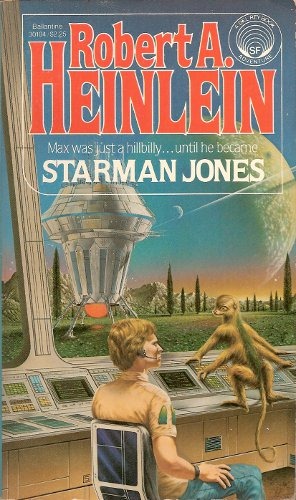 Starman Jones by Robert Heinlein is one of those books I really wish I had read as a kid. In fact, I’m shocked that I hadn’t, and appalled that until a few years ago, I really didn’t know too much about Robert Heinlein and his place in science fiction history. I’m embarrassed to admit I’ve read very few books by Heinlein, and now, here in my early-forties, I am trying to rectify that oversight.
Max Jones is a teenage hillbilly from the Ozarks, living on a small farm with his widowed stepmother. His farm lay along the path of one of the rocket trains that left Earth, bound for orbit. He dreams of going into space like his Uncle Chester Jones, who was a renowned Astrogator – a key member of the interstellar ships that travelled between the dozens of known worlds spread throughout the galaxy. When Max’s stepmother marries a man who is intent on stealing the farm through any means necessary, Max flees and stows away on one of the starships where he not only earns his keep, he must take on more responsibility than he ever imagined.
Starman Jones was written in 1953, and is considered one of Heinlein’s juvenile series. The book is fast paced and entertaining, and still works well, though the dialogue is filled with colloquialisms from the middle of the 20th century. Were I to pick up this book with no knowledge that it had been around for nearly sixty years, it would be easy to recognize it as so. But I don’t hold that against it, nor will I criticize it for dated descriptions of computers or advanced technology. There’s just no way Heinlein could have predicted how far technology would develop in just the last fifty years, though I think he might also be a little disappointed at how far the world has come in the same time frame. Many of the things he writes about, we still don’t have. That is our loss.
Starman Jones is the kind of book I refuse to by an e-book version of because I want them on my shelves for my kids to pick up and read, over and over. Of course, they may have to wait until I’ve read it a couple more times myself. I can’t wait to give this to them to read and to see their reactions. Part of me wants to read it to them for bedtimes stories now, but I know I wouldn’t be able to get through it fast enough. Soon. Hopefully, very soon.
On a side note, I was rather startled as I read this book, because it’s plot is very close (in some places) to my book Labeled. So close in fact, that I expect that at some point down the road, I will be asked if I used this book as inspiration. I’ll say now, and for future reference, that I finished writing the first draft of Labeled in June of 2011, and didn’t even know this book existed until two weeks ago, when I bought it at a used book store. Any similarity between my book, and this, is purely coincidental, and enough of the story is different that I suspect no one will actually accuse me of stealing. I’ll go with the infinite monkeys theory of writing, and say that if you put enough monkeys in front of keyboards, one of them will eventually create on the masterpieces of history. Consider me one of those monkeys. And I’m hoping that if you liked Starman Jones, you’ll like my contribution to the genre when it is published.


 Joe Beernink